
In Christian tradition, worship is rarely a passive experience or a disjointed collection of songs, prayers, and speeches. Instead, liturgical worship, especially within the Anglican and Episcopal traditions, functions as a crafted narrative designed to shape our spiritual lives, theological understanding, and ethical engagement with the world.
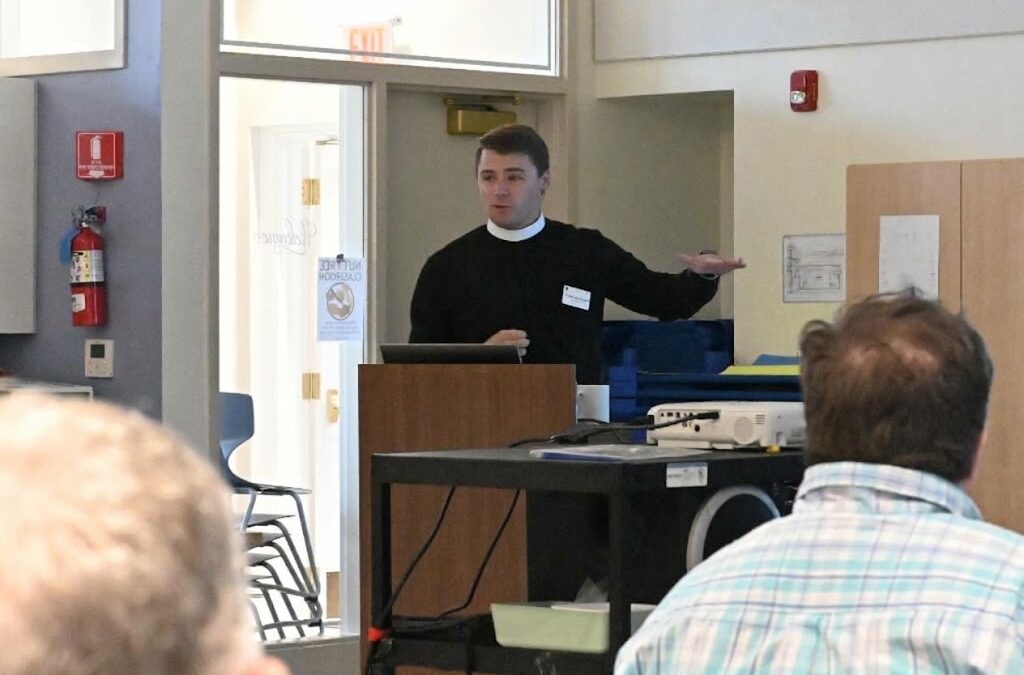
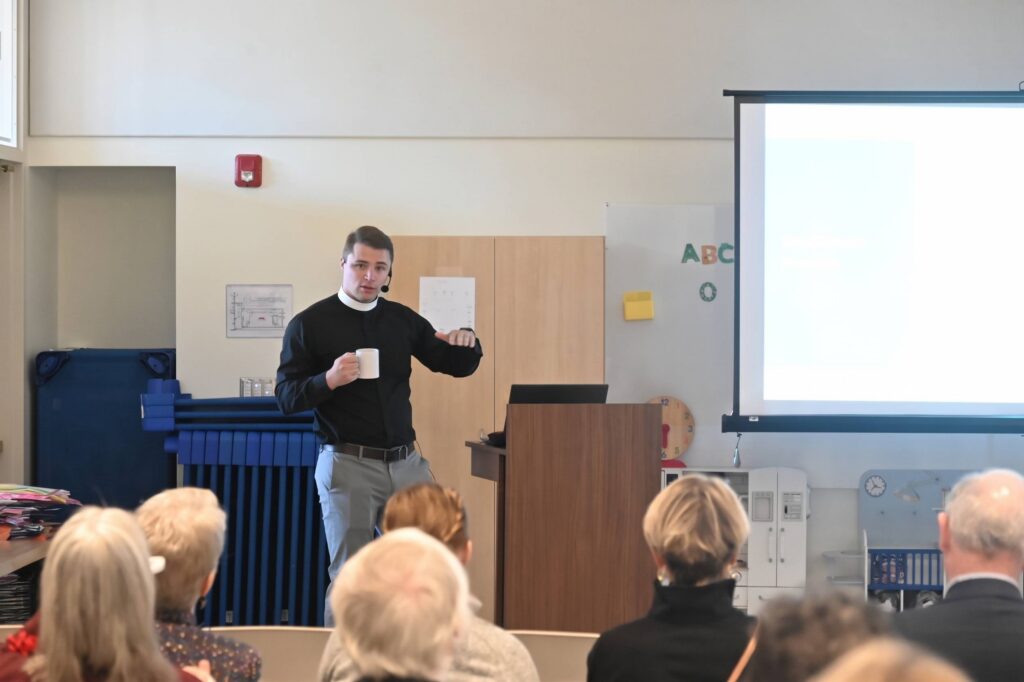
During the fourth Adult Formation session on narrative theology, Fr. Jared Grant explored how narrative criticism applies not only to biblical texts, but directly to the liturgies we pray together every week.
Central to the discussion was an ancient principle of Christian worship: lex orandi, lex credendi—often translated as “prayer shapes believing.” As Fr. Jared explained, “What you pray, how you pray ends up shaping what you believe and how you believe it.”
Understanding liturgy through the lens of narrative theology helps us see that when we gather for worship, we are entering into a fully realized story that reveals God’s character and calls us into action.
What Is Liturgy and Who Is Its Author?
To understand liturgy as a narrative, we must first define what liturgy is. While many people associate the word strictly with a formal church service, its roots run much deeper. “Liturgy is a word that is used a lot to kind of talk about any significant act of worship,” Fr. Jared noted. “Generally it’s corporate, it means it needs other people with you to do it… but it comes from a meaning of ‘the work of the people.’ So liturgy is the way that we are enacting some of our own agency in our relationship with God, through prayer, through worship.”
When applying narrative criticism to a text, one of the primary questions scholars ask is: Who is the real author? To help answer this, the class revisited the hermeneutic lens discussed in session 3. When we look at a Eucharistic service, the answer is complex because the service is constructed from layers of history, scripture, and tradition.
“Within the order of the Eucharistic service, there are so many different real authors,” Fr. Jared observed. “These are not cohesively written documents, nor are they cohesively written in the sense of ‘this is one time period we’re talking about.’ The class looked at examples of different prayers and elements that make a Eucharistic service, like the collect, scripture, and creeds and noted that all are written at vastly different times and places.In addition to ancient texts, modern elements weave throughout the liturgy, from contemporary hymns and custom prayers of the people to the weekly sermon written by the local clergy. Historically, the liturgy is a patchwork quilt of distinct voices spanning thousands of years.
The Liturgy as a Fully Realized Narrative
If the liturgy is composed of so many disparate historical pieces, how can we read it as a singular narrative? Narrative criticism encourages us to move beyond examining isolated historical fragments and instead evaluate the cohesive story being presented to the worshipping community today.
“This is a fully-realized narrative in the same sense that the Gospel of Luke is a fully-realized narrative,” Fr. Jared stated. “It’s put together intentionally to tell a specific story. I want you to start thinking about a Eucharistic service like that because it is very well-crafted to tell us a specific story.”
In this framework, the Episcopal Church acts as the implied author, constructing the service for an implied reader—the gathered congregation. “The implied reader for that is going to be the corporate faithful… When the Episcopal Church asks us to come together to worship together, it is the idea that we are literally coming together to be the body of Christ.”
By stepping into the role of the implied reader, worshippers allow the full scope of the liturgy—its beginning, middle, and end—to reveal God through community and shared prayer.
Storytelling Through Collects and Lectionaries: The Example of Pauli Murray
Every component of the service contributes to the overarching narrative, but certain elements specifically anchor the day’s theological focus. One key element is the collect—a short, structured prayer designed to “collect” the themes of the service.
“The idea of a collect is to collect the ideas of the service,” Fr. Jared explained. “When you read the collect of the day… it is meant to tie a cohesive theme throughout that service… The collect has that theme sort of encoded into it. So, if you’re ever looking at the readings and saying, ‘Why are these together? I don’t see any cohesive pattern here,’ look to what the collect of the day is saying. Try to find and discern a theme out of that, and then go read the readings again.”
This thematic narrative structure is vividly demonstrated during holy days commemorating saints in the church calendar. For instance, on the feast day of the Rev. Dr. Pauli Murray (July 1), the collect and appointed scripture readings work together to tell the story of her pioneering life as a civil rights advocate, lawyer, and the first African American woman ordained as an Episcopal priest.
The collect for Pauli Murray prays:
“Liberating God, we thank you for the steadfast courage of your servant Pauli Murray, who fought long and well: Unshackle us from the chains of prejudice and fear, that we may show forth the reconciling love and true freedom which you revealed in your Son our Savior Jesus Christ…”
When paired with readings from Isaiah 55, Galatians 3 (“there is no longer Jew or Greek, slave or free, male and female”), and the parable of the wicked tenants in Mark 12, the liturgy paints a clear portrait of Christian witness. As Fr. Jared pointed out, the goal of these liturgical choices is not simply biographical instruction: “The question for the implied reader is, how does the life of Pauli Murray reflect our understanding of God in the world? What does her life in witness to the teachings of Jesus Christ mean for us and how we should be living our lives?”
The Arc of the Eucharistic Prayer
The narrative peak of the service is the Eucharistic Prayer itself. The Great Thanksgiving possesses its own dynamic plot arc designed to re-orient the believers’ place in God’s ongoing story of redemption:
- Sursum Corda (“Lift up your hearts”): Prepares the congregation by lifting their hearts into the love of Christ.
- Proper Preface: Shifts seasonally to highlight specific dimensions of salvation history (e.g., Incarnation, Resurrection, Holy Spirit).
- Sanctus (“Holy, Holy, Holy”): Joins the earthly assembly with the ancient, heavenly song of worship.
- Post-Sanctus: Recounts the story of human falling and God’s persistent faithfulness. As Fr. Jared noted, “What we’re telling in this story is our own failure, our own fault, and the reason Jesus needs to come in and be a part of our lives and reset the world.”
- Words of Institution (Verba): Directly quotes Jesus at the Last Supper (“This is my body… do this in remembrance of me”), grounding the moment in Christ’s historic command.
- Epiclesis: Invokes the Holy Spirit upon the bread, wine, and gathered people.
Invested in Being God’s People Today
Why does this liturgical narrative matter? The Church’s Catechism summarizes the benefits of the Eucharist as “the forgiveness of our sins, the strengthening of our union with Christ and one another, and the foretaste of our heavenly banquet.” But the aim of experiencing this story week after week is transformation and mission.
“The narrative that is told in the Eucharist… only makes sense with an understanding of Christ’s messianic goal,” Fr. Jared concluded. “The claims of this service are ones that reinforce the servant leadership of Jesus Christ and his community of followers. And the story told works to reinvest God’s people today into the work of being God’s people.”
When we gather for liturgy, we are entering into an active, holy narrative, one that reshapes our desires, clarifies our calling, and sends us out into the world to embody God’s love and justice.