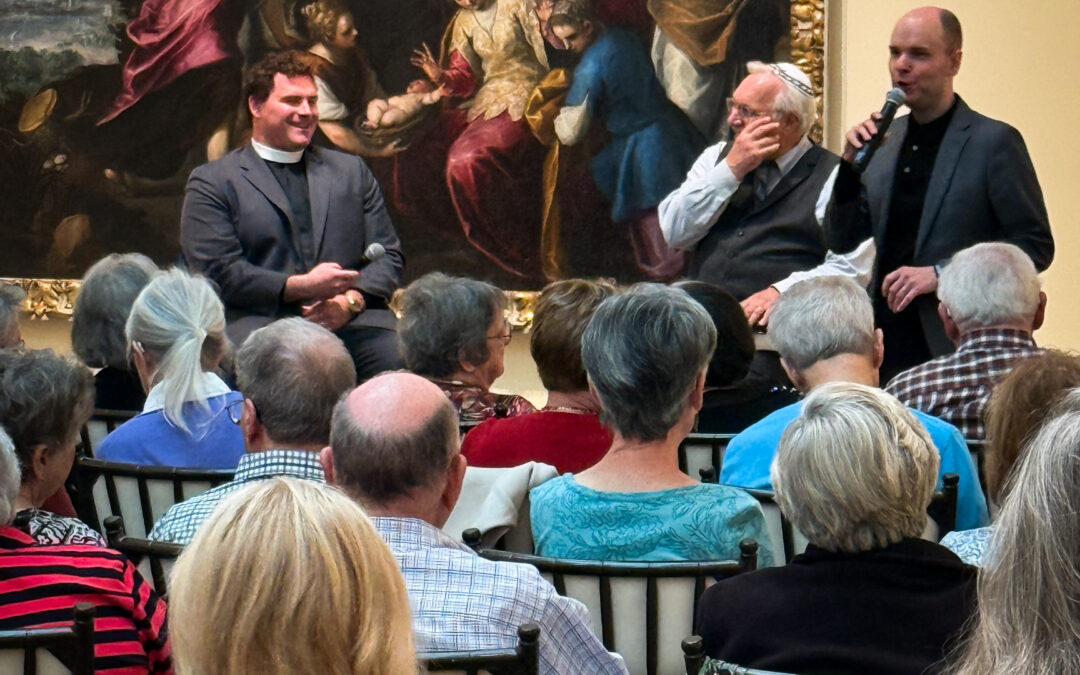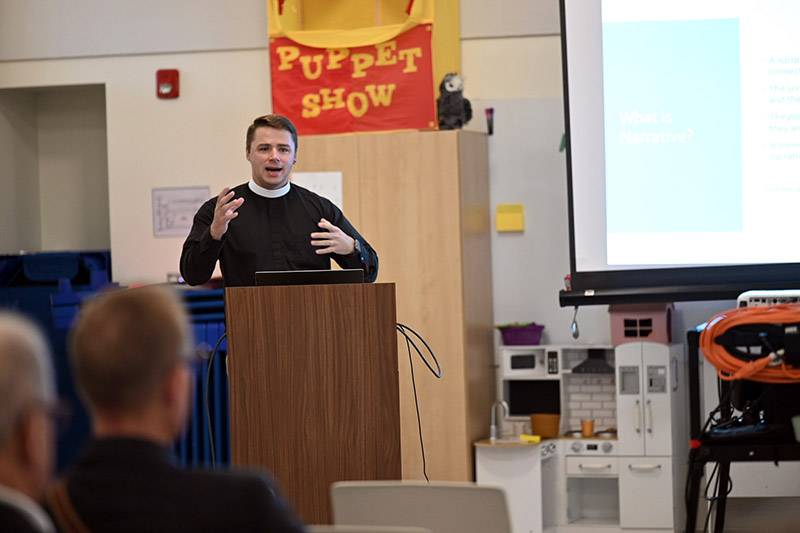


This week, Fr. Jared Grant convened the third in his ongoing formation sessions on narrative theology, guiding participants deeper into the literary and theological mechanics of the gospels. Building upon previous discussions involving Karl Barth, Rudolf Bultmann, C.S. Lewis, and Hans Frei, Fr. Jared focused this week’s session on two defining questions: Who is Jesus, and what is he like?
The seminar explored how narrative criticism reads the gospels as intentional literature by paying close attention to plot, characterization, setting, point of view, and structural motifs.
Fr. Jared opened the session by emphasizing that in Christian theology, Jesus serves as the primary lens, or epistemology, through which believers understand God. To encounter God or understand divine character, one must look directly at the narrative portrayal of Jesus. This Christian theological claim anchors narrative theology, asserting that the stories themselves are meticulously crafted to reveal who Jesus is and, consequently, what God is like.
To demonstrate narrative analysis in practice, Fr. Jared turned to the familiar story of Zacchaeus in Luke, 19. He walked the group through the text line by line, highlighting how Jesus entered Jericho and encountered Zacchaeus, a rich chief tax collector. Participants analyzed the characters, including Jesus, the observing crowd, Zacchaeus, and the implicit references to Abraham and the larger structure of Judaism. Fr. Jared highlighted the intense historical and social friction embedded in the narrative. Zacchaeus lived in Jericho under Roman occupation, and as a chief tax collector collaborating with the oppressor, his identity was deeply fraught. He belonged to the house of Israel yet actively participated in an oppressive economic system.
The discussion also touched on a seemingly minor physical detail, namely Zacchaeus’s short stature, which forced him to climb a sycamore tree. While historical critics might read this through the lens of ancient Hellenistic cultural biases where physical appearance was often moralized, narrative criticism asked what function this detail served within the story’s plot. It illustrated physical and metaphorical outsider status, setting the stage for Jesus to look up, call him by name, and declare that salvation had come to that house.
Transitioning from specific exegesis to literary theory, Fr. Jared outlined the three distinct layers of communication operating within any narrative text. The first was the real-life level, which involved the real author or evangelist tradition, the text itself as the gospel, and the real-world reader in the historical or contemporary church. The second was the intratextual level, involving the implied author projected by the text, the narrator, and the implied or ideal reader addressed by the work. The third was the narrative world level, involving the interactions, dialogue, and events among characters within the story itself. Understanding these layers prevented readers from flattening the gospels into simple transcripts, reminding the room that each evangelist curated their narrative with specific theological and rhetorical goals for their intended audience.
In the second half of the session, we shifted focus to the Gospel of Mark, examining four distinct passages, including the healing of the leper, the man with an unclean spirit in the synagogue, Peter’s confession at Caesarea Philippi, and the healing of the Syrophoenician woman’s daughter in Tyre. Fr. Jared highlighted a prominent structural motif running through Mark’s Gospel where Jesus repeatedly performed miraculous acts or accepted messianic titles, yet sternly commanded those involved to remain silent, a phenomenon scholars term the “Messianic Secret.” Unlike Matthew, which explicitly tied Jesus to Davidic lineage right at the outset, or Luke, which detailed elaborate birth narratives fulfilling messianic prophecies, Mark operated with a different narrative rhythm. Jesus attempted to keep his identity under wraps because public revelation of a political messiah would short-circuit the true nature of his mission.
This tension culminated in Mark 14 during Jesus’s trial before the high priest when he was asked directly if he was the Messiah and openly affirmed his identity, sealing his fate. Fr. Jared explained that the narrative structure built toward this exact moment. When Jesus finally claimed his messiahship openly before the religious authorities, it pushed the narrative toward its climax in the passion and the resurrection.
Toward the end of the session, Fr. Jared addressed the inherent limitation of pure narrative criticism by asking whether modern readers could truly read the gospels as a first-century implied reader would, divorced from two millennia of subsequent history. He argued that narrative criticism alone was insufficient and that a robust theological reading required holding narrative criticism and historical criticism in creative tension. Readers needed to understand the first-century Jewish expectations of the Messiah—someone of Davidic descent, a performer of signs, a champion of the Mosaic law, and a political liberator—to fully grasp how radically Jesus subverted those expectations. The messiahship revealed in Mark’s passion narrative ultimately pointed beyond political revolution to the cross and the empty tomb.
Fr. Jared concluded the session by looking ahead to next week, where the seminar will explore how narrative paradigms connect to Episcopal liturgy and communal storytelling. He reminded participants that narrative analysis is a vital tool that illuminates how scripture forms our imagination, shapes our understanding of God, and guards against ideological misuse.