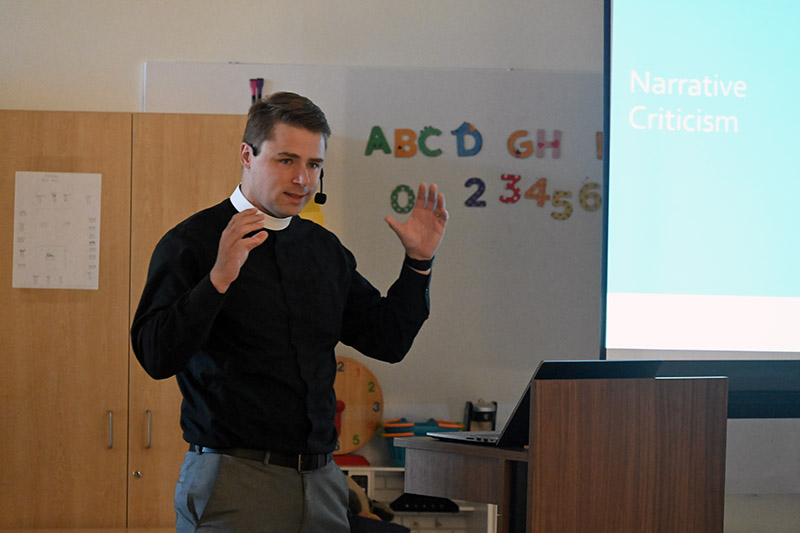

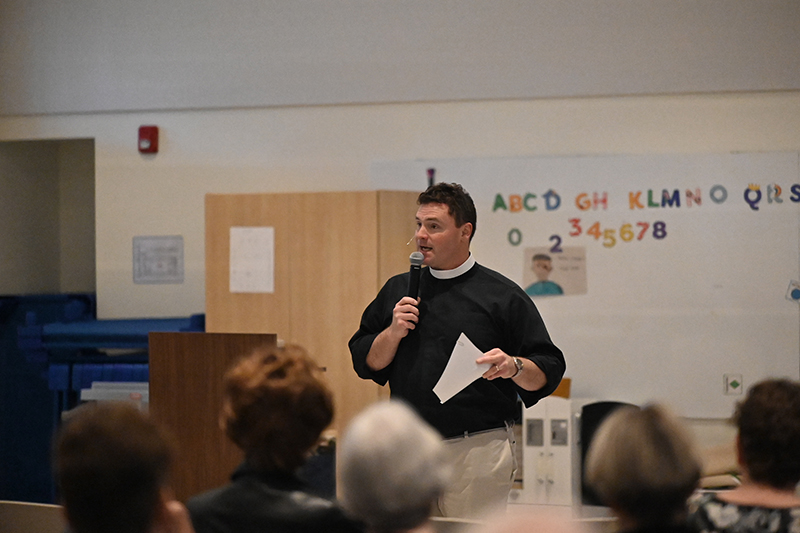
As Christ & St. Luke’s deepens our engagement with our annual theme, “God’s Story, Our Story,” our Adult Formation series turned its focus to one of scripture’s most profound storytelling traditions: the parables of Jesus. Gathering in Lloyd Hall, parishioners kicked off a three-week series exploring how Jesus used narrative to teach, reveal, and challenge his listeners.
Fr. Noah Van Niel opened the session by noting that Jesus was a master practitioner of story. Reading from Matthew 13, Fr. Noah highlighted that when the disciples asked why Jesus spoke in parables, Jesus explained that parables both reveal and conceal divine truth. Parables disrupt our expectations, making the familiar feel strange and demanding active engagement from the listener.
Fr. Noah defined a parable as a concise, allegorical story designed to teach a spiritual lesson. While parables appear thirty to fifty times across the synoptic gospels of Matthew, Mark, and Luke—whereas John utilizes extended poetic metaphors—parables were an established pedagogical tool in ancient Jewish tradition. Stories stick in human memory far longer than abstract rules or lists.
To guide the class’s reflections, Fr. Noah invited participants to hold two framing questions in mind when approaching a parable: What does it mean? (taking the biblical text on its own terms). And: What does it mean to me? (discerning its personal, spiritual application).
The Parable of the Rich Fool
Appropriately timed alongside our stewardship season, the first session focused on parables centered on wealth, stewardship, and generosity. Fr. Noah led participants through Luke 12:13–21, the Parable of the Rich Fool. In the story, a wealthy landowner produces a bumper crop and decides to tear down his existing barns to build larger ones, telling himself to relax, eat, drink, and be merry. Yet God calls him a fool, warning that his life will be demanded of him that very night.
Discussions among participants zeroed in on the core tension: How much is enough?
Participants observed that the rich man’s flaw was not his abundance, but his inward orientation and false sense of security. Rather than sharing his windfall or recognizing that his blessings came from God, he chose to hoard his resources. One participant noted that the landowner was trapped in endless labor, deferring joy and generosity until some future date rather than enjoying God’s blessings and sharing them in the present. Another participant shared a personal illustration about purchasing ten bags of lentils, wrestling with how believers balance practical prudence with trusting God’s daily provision.
Fr. Noah pointed out that the parable raises a fundamental question of ownership: Whose is it, really? One participant noted that the story serves as a memento mori—a stark reminder of human mortality. In a modern world where people spend immense energy trying to insulate themselves against vulnerability, the parable reminds us that material wealth cannot buy ultimate security. Being “rich towards God,” as participants reflected, means cultivating an open heart, practicing generosity, and investing in God’s kingdom rather than building bigger personal silos.
The Dishonest Steward
Moving to Luke 16:1–13, Fr. Noah introduced what is widely considered one of the most perplexing stories in the gospels: the Parable of the Dishonest Steward. Facing termination for squandering his master’s property, a shrewd manager calls in his master’s debtors and slashes their debts, reducing oil bills by half and wheat bills by twenty percent, so that debtors will welcome him into their homes once he is fired. Surprising his audience, the master commends the manager for acting shrewdly.
Fr. Noah admitted that this parable often sends listeners in circles, acknowledging that even the disciples frequently sought “the answers in the back of the book.” Yet, as participants wrestled with the text, deeper insights emerged. Participants noted that while the manager’s motives were self-serving, his actions provided real relief and mercy to debtors burdened by heavy obligations.
Participants discussed how money can be converted into a tool for fostering genuine human connection, mercy, and hospitality. Fr. Noah emphasized Jesus’ conclusion that wealth should be used in service of lasting, eternal relationships rather than stockpiled for self-preservation. The parable culminates in Jesus’ declaration: “You cannot serve God and wealth.”
The Call to Bold Engagement
Before concluding, Fr. Noah touched on the Parable of the Talents in Matthew 25, asking what we choose to do with the gifts we have been given. Jesus consistently challenges his followers not to operate out of fear, but to possess the boldness to take risks to grow God’s kingdom. Whether using dramatic imagery like “outer darkness” or praising a shrewd manager, Jesus uses high-stakes narrative devices to shake listeners out of complacency.
Participants departed Lloyd Hall with a renewed appreciation for scripture’s invitations to wrestle with truth. Parables do not offer neat maxims; instead, they draw us into an ongoing conversation about what it means to align our hearts, our resources, and our lives with God’s kingdom.
Adult Formation meets every Sunday morning during the program year from 9:15 a.m. to 10:00 a.m. in Lloyd Hall. Join us next Sunday as we continue exploring Jesus’ parables!