
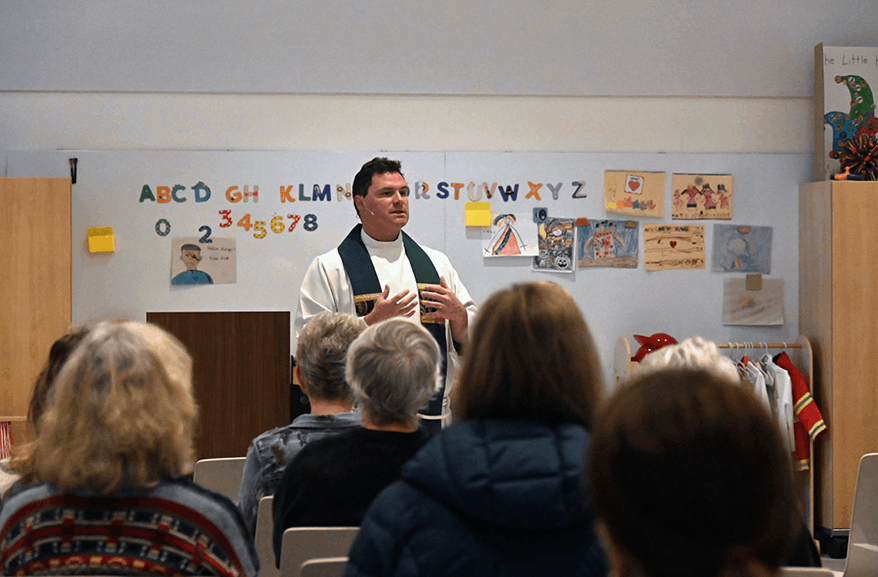
When Jesus gathered crowds along the dusty roads of Galilee, he rarely handed down dry theological dogmas. Instead, he told stories. As Christ & St. Luke’s gathered in Lloyd Hall for the second session of our Adult Formation series on the parables, parishioners dove headfirst into two of the most famous and challenging parables in scripture: The Parable of the Good Samaritan and The Parable of the Prodigal Son.
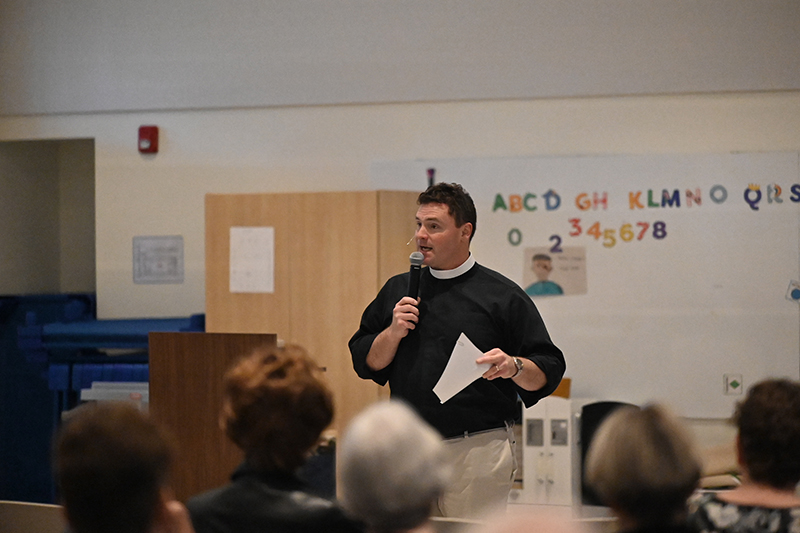
Reflecting on our program year theme, “God’s Story, Our Story,” Rector Fr. Noah Van Niel opened the morning by reminding us why Jesus relied so heavily on parables as his primary teaching tool.
“Jesus turned to parables again and again in order to both conceal and reveal—that interesting paradox of stories meant to reveal divine realities, but in a way that is often confusing or convoluted,” Fr. Noah said. “A good story gets you to ask questions rather than just handing you an easy answer. It makes the world a little strange, gets you on the edge of your seat, and demands your active engagement.”
Having spent our first session exploring parables of wealth and generosity, this second gathering invited us to grapple with what Fr. Noah called “the meaty ones, the real classics.”
The Good Samaritan and the Boundaries of Mercy
Fr. Noah began by reading Luke 10:25–37, where an expert in the law stands up to test Jesus, asking, “Teacher, what must I do to inherit eternal life?”. After confirming that the core of the law is to love God and love one’s neighbor as oneself, the lawyer asks: “And who is my neighbor?”
Jesus responds with the story of a man stripped, beaten, and left half-dead on the road from Jerusalem to Jericho. Both a priest and a Levite pass by on the other side, while a Samaritan—a member of a despised, rival religious community—stops, is moved with compassion, binds the man’s wounds, transports him to an inn, and pays for his care out of his own pocket.
When participants broke into small groups, observations came thick and fast. Several parishioners pointed to the disconnect between religious status and practical compassion.
“By contrasting several different types of people, the priest, the Levite, and the Samaritan, Jesus was illustrating the hypocrisy of certain religious classes,” one participant observed. “It highlights that we have to practice what we preach. Actions speak louder than words.”
Other participants noted the strict purity laws governing temple leaders. “We talked about how both the Levite and the priest would have become ritually unclean if they touched a dead or dying man,” another parishioner explained. “They had legal reasons not to touch him. But Jesus was expanding the definition of what a neighbor is.”
Fr. Noah pointed out a grammatical turn at the heart of Jesus’ teaching.
“What does Jesus do with the lawyer’s question?” Fr. Noah asked. “The lawyer asks, ‘And who is my neighbor?’ But after telling the story, Jesus turns it around and asks, ‘Who was a neighbor to the man who fell into the hands of robbers?’ He completely flips the subject-verb situation. It’s not about standing back and asking, ‘Who over there qualifies as my neighbor?’ It’s asking, ‘Am I being a neighbor?’”
Another participant provided historical context, noting that the Samaritan-Jewish divide stemmed from deep disputes over whether Herod’s temple or Mount Gerizim was the true site of worship. This friction made Jesus’ choice of a Samaritan hero shocking to his audience.
That shock value prompted discussion about who the “Samaritans” are today.
“We landed on marginalized communities and people of color, because the white establishment has often treated them the exact same way the Israelites treated Samaritans, avoiding them and looking past them,” said another participant.
The Prodigal Son and Becoming the Father
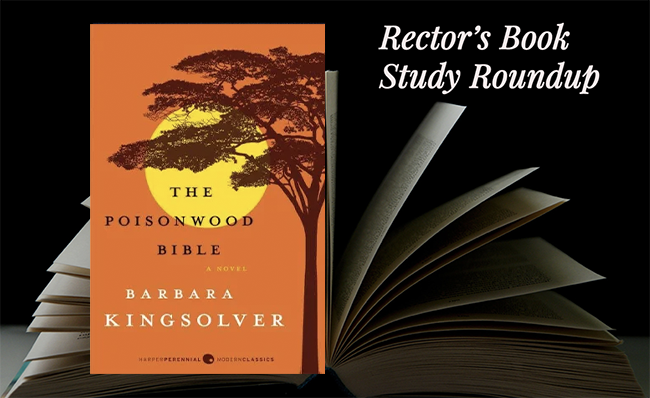
Turning the page, the class moved to Luke 15:11–32, the Parable of the Prodigal Son. Drawing on insights from theologian Henri Nouwen’s book The Return of the Prodigal Son, which parishioners had read together in a previous book study, the conversation shifted to personal testimony.
The story opens with the younger son demanding his inheritance early, an act that, as one participant pointed out, was “tantamount to wishing his father dead.” After squandering his wealth in a distant country, the younger son hits rock bottom in a pigpen and decides to return home as a hired hand.
One parishioner highlighted the father’s extraordinary reaction: “Before the son even speaks, while he is still far off, the father sees him and is filled with compassion. He doesn’t wait for a formal apology; he runs out to meet him. That gives us a breathtaking picture of what God is really like.”
This theme of unconditional welcome hit home for one parishioner, who shared his own story of family reconciliation.
“This is my favorite parable by far,” he shared. “In my youth, I was completely broken off from my family. But after years away, I called my father, and he received me back with open arms. He brought me into his home, and he told my family, ‘You better not show him any ill will.’ This parable isn’t just an ancient story—it is my life.”
Yet, as Fr. Noah reminded the class, the story does not end with the younger son’s return. The elder brother, returning from hard labor in the fields, hears music and dancing and grows furious. He refuses to go in, complaining that after years of faithful service, he was never even given a young goat to celebrate with his friends.
Fr. Noah asked for a show of hands: “Who here identifies with the older son?”
A chorus of hands shot up across Lloyd Hall.
“We feel an understandable amount of justification on behalf of the older brother,” Fr. Noah acknowledged. “He did all the right stuff! He stayed home, worked hard, and never got a big party. How is it fair that the younger guy goes off, acts like a jerk, and gets the fatted calf?”
Fr. Noah linked this tension to Jesus’ Parable of the Workers in the Vineyard: “God looks at them and says, ‘Are you envious because I am generous?’ And we want to say, ‘Yeah! That is exactly the problem!’ We get hung up on human calculations of fairness, but divine grace operates on an entirely different plane.”
Concluding the session, Fr. Noah pointed back to Nouwen’s ultimate spiritual takeaway:
“In our lives, most of us fluctuate between feeling like the younger son who blew it or the older son who is stewing in self-righteous resentment,” Fr. Noah reflected. “But as Nouwen points out, the ultimate goal of the spiritual life is neither of those—it is to become the Father. To grow into that level of mature, open-armed generosity, compassion, and joy that welcomes others home without keeping score.”
Christ & St. Luke’s Adult Formation series on the parables continues on Sunday, November 22 at 9:15 a.m. in Lloyd Hall.