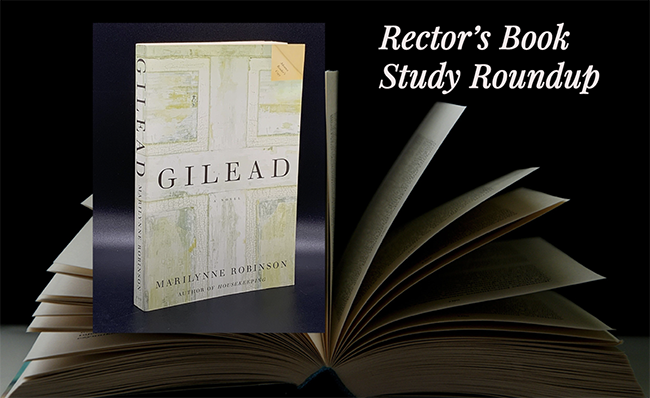

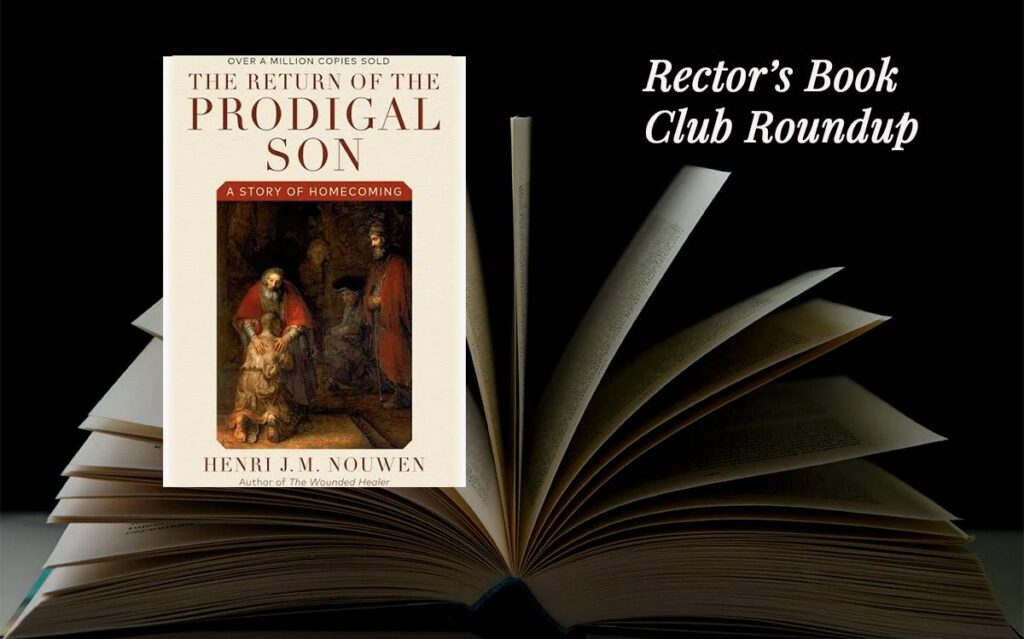
As we gathered in May for the final Rector’s Book Club of the program year, Fr. Noah Van Niel guided us through a different kind of reading experience. Having previously explored rich historical and political narratives, our group turned inward to wrestle with Henri Nouwen’s contemplative classic, The Return of the Prodigal Son.
Nouwen, a Dutch priest and theologian, wrote the book after a chance encounter with Rembrandt’s famous painting of the biblical parable. What follows in his text is an honest, vulnerable dissection of his own spiritual journey, mapped onto the three main figures of the painting: the younger son, the elder son, and the father.
Our group immediately noted the emotional weight of Nouwen’s work. One participant affectionately called the author a “heavy dude,” noting that the book required taking breaks to mentally digest each chapter. Yet, despite its depth, the consensus was that Nouwen’s vulnerability allowed everyone in the room to find a piece of themselves within its pages. As one parishioner put it, “I relate to all the upset… upset is my game.”
Stepping into the Frame
Before diving into the text, Fr. Noah invited the group to spend time simply observing Rembrandt’s masterpiece. When you take the time to truly look at the painting, the artistic genius and theological depth are as impressive as anything the artist made over his remarkable lifetime.
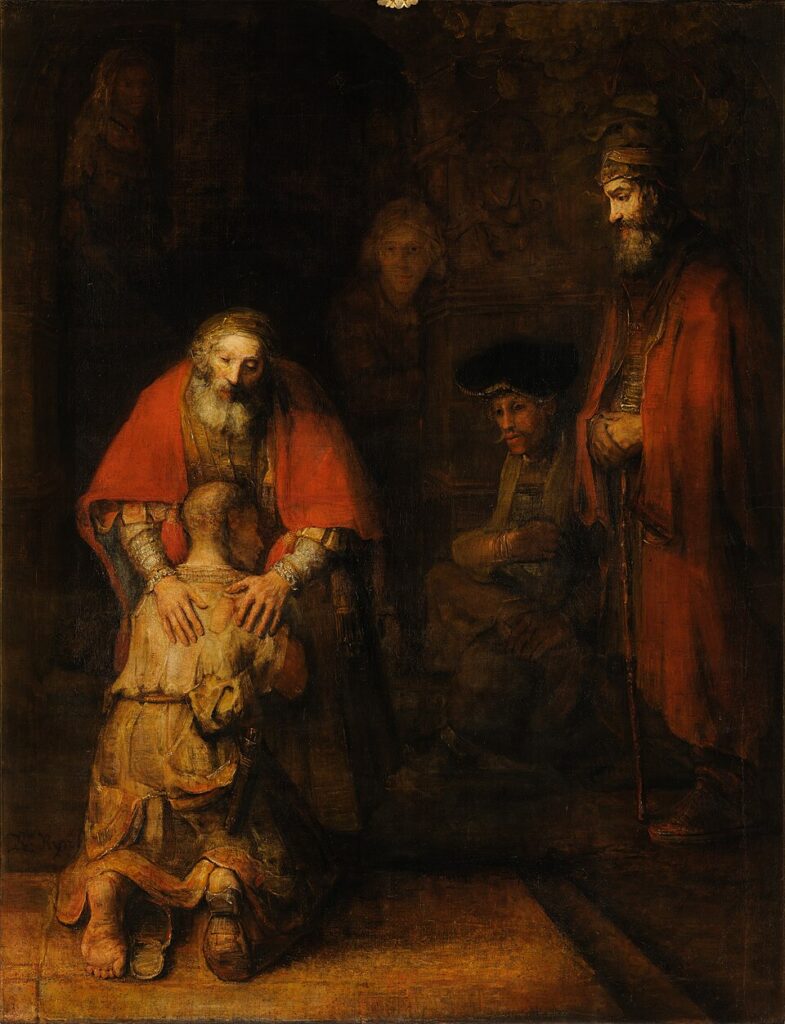
Participants, like Nouwen, noticed the father’s hands. As Nouwen points out, the hands are distinctly different, the left hand is muscular and applies firm, holding pressure, while the right hand is softer, more archetypally feminine, and offers the prodigal son a tender caress. Rembrandt captures the dual nature of God’s love: The strength that holds us and the tenderness that comforts us.
We also noticed the physical devastation of the younger son. “The prodigal son himself looked so much worse than I ever imagined him to be,” one member noted. “I always thought of this guy who’s been out there partying and living the high life… but this looks like a battered man.” With his head shaven, his clothes in rags, and his feet scarred and ruined from working in a pigsty, the son presses his face not against his father’s chest, but against his stomach, evoking imagery of the womb and a return to the very source of life. Yet, hanging from his hip is a small, un-pawned dagger: the last remaining shred of his nobility and identity, which he chose to keep.
In the shadows, participants observed the lurking background figures. Rather than mere extras, the group interpreted these figures as representations of us, the audience. We are the ones standing in the dark or the periphery, witnessing the radical grace of God and deciding how we will let the story affect us.
The Younger Son’s Search for Unconditional Love
As we discussed the younger son, many in the group recognized their own youthful desires to break away and individuate themselves. But Nouwen digs deeper into the younger son’s rebellion, framing it as a misguided search for identity in a world that demands we prove our worth.
This resonated powerfully with the group. One parishioner highlighted a quote from the book that they had underlined eleven years ago and found themselves underlining again: Nouwen’s paralyzing fear that when you stop being productive, people will lose interest in you. It is a terrifying, universally human anxiety to believe our worth is tied only to our output, he said.
“I’m the Prodigal Son every time I search for unconditional love where it cannot be found,” he reflected. “And for some of us, our unconditional love cannot be found at home, and so that’s why we leave it.”
In this light, the younger son’s journey is a fundamentally human quest to find a love that does not have to be earned. His return is the glorious realization that this unconditional love has been waiting for him in the heart of God all along.
The Elder Son’s Heavy Burden of Resentment
Perhaps the most visceral and emotional part of our discussion centered on the elder son. In the painting, he stands off to the side, bathed in the same light as the father and dressed in similar clothes, yet his face is tight with what one member described as a “constricting” anger. He has remained home, done the right things, and walked the straight and narrow, but he is trapped in a prison of his own resentment.
Several parishioners shared how deeply they identified with this dutiful, aggrieved brother. One member recounted the grueling years they spent as the primary caregiver for their paralyzed mother and aging father, while their siblings were absent. When their father eventually passed, the inheritance was surprisingly split with the sibling who had never helped, even after the father had promised it all to them. “I felt betrayed, and I know that it wasn’t really the money that I was looking for,” the parishioner said. “It was the acknowledgement that he saw me, that I just wanted to be seen.”
Another member shared a story of faithfully caring for a dying mother, only to be pushed aside by a returning sibling once the mother had passed. For this parishioner, Nouwen’s book arrived like a lifeline. “My resentment comes up, and he spoke about using trust and gratitude as antidotes for resentment,” they said. “And boy, did that speak to me in such a powerful way… I feel like that indeed brings me closer to God.”
It was a moment of shared grace in the room, realizing how the elder son’s dutiful obedience can slowly curdle into a demanding entitlement. The elder son must realize that God’s love is a gift, not a wage. As Fr. Noah pointed out, releasing that resentment requires us to adopt an entirely new framework for how we engage the world, not one based on keeping score.
Becoming the Father as the Ultimate Vocation
The final, and most daunting, challenge Nouwen presents is that we are not meant to remain the younger or the elder son forever. Ultimately, the Christian calling is to become the father.
As Nouwen writes: “No father or mother ever became father or mother without having been a son or a daughter, but every son and daughter has to consciously choose to step beyond their childhood to become the father and the mother for others.”
One participant honestly admitted, “There’s no father in me… Not yet, man,” acknowledging the difficulty of letting go of our reactive, aggrieved personalities to inhabit the all-forgiving, unconditionally generous posture of the father. To become the father means we must stop demanding that the world be fair and instead choose to be a source of grace. It isn’t easy.
Crucially, Nouwen explains that the path to this joyful fatherhood requires passing through profound grief. “Grieving is praying,” Nouwen writes. To be the father is to allow your heart to break over the sin and sorrow of the world, and to let that despair carve out a deeper capacity for compassion.
As one parishioner who cares for a profoundly autistic son reflected, the grief they initially felt over lost expectations eventually gave way to a remarkable, liberating joy in simply being present with their child day to day. True joy is not the absence of sorrow; it is the grace that emerges on the other side of it.
As we closed our session and prepared for the summer break, the group marveled at how a single 17th-century painting and a priest’s honest reflections could crack open so many closed doors within our own hearts. As one parishioner so aptly put it, “There are books that fall off the shelf into my lap. And this was one of them, because God had something to teach me.”
May we all have the courage to make the journey home, to lay down our rebellion and our resentment, and to eventually open our arms to the world with the radical, forgiving love of the Father, even if it takes, in some cases, the work of all our lives.ble lifetime.