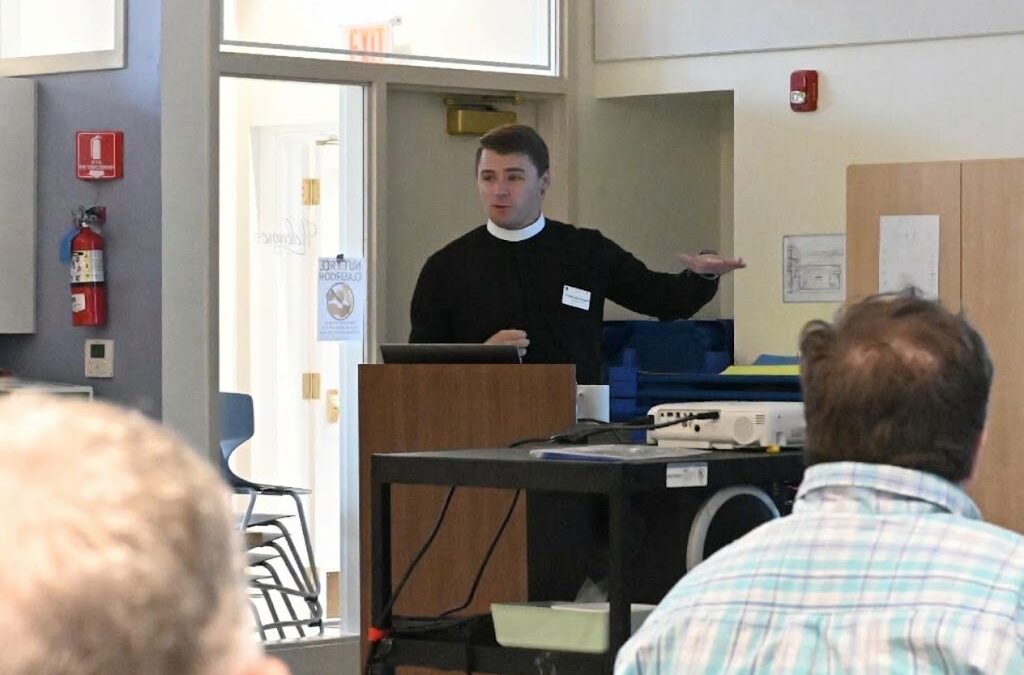

This month’s Queer Theology discussion explored the Episcopal Church’s deep-rooted theology of inclusive love, celebrating the 50-year anniversary of officially welcoming the LGBTQ+ community. Inspired by lectionary readings about Paul’s universalist messages, our group affirmed that the church’s foundation lies in Jesus’s command to love God and love your neighbor. This theology drove decades of progressive change in the Episcopal Church, from ordaining openly gay clergy to approving same-sex marriage, even as these advancements caused significant division within the broader Anglican Communion. Ultimately, the story is one of refuge, deliberate growth, and a secure, love-centered Christianity. Of course there is also much work still to be done.
As part of our introductions, we shared how long we had been coming to Christ and St. Luke’s in Norfolk, and how long we had been attending an Episcopal church. We discovered that almost no one present was a “cradle” Episcopalian born into the denomination. Instead, most of us fled churches that preached hate and damnation toward the LGBTQ+ community. We all found refuge here in the Episcopal Church.
This theme of welcome was apropos of this week’s lectionary readings and led to a fruitful discussion. In Acts 17:22-31, Paul preaches in the Athens marketplace to people of all faiths. He doesn’t threaten them with damnation for worshipping the “wrong” gods; instead, he relates to them as fellow people of faith, speaking with love and welcome. He spoke of the universal search for meaning and a connection to something greater than ourselves. Paul said, “From one ancestor he made all nations to inhabit the whole earth… so that they would search for God and perhaps grope for him and find him—though indeed he is not far from each one of us.”
This idea of “groping for God” resonated with our group, as did the notion that this searching is not a flaw, but is faith itself. The phrase suggests there is no single, clear path to God for everyone. Paul noted that paths suit the “boundaries of the places where [people] live.” We share kinship with all God-seekers. What matters is that you walk a path; otherwise, you risk wandering lost in the wilderness.
Continuing the theme of welcome, we discussed the Gospel reading where Jesus tells his disciples in John 14:15-21, “You know Him, because He abides with you, and He will be in you.” He adds that those who keep his commandments are those who love him and will be loved by the Father. In Matthew 22:36-40, Jesus identified the greatest commandments: love God with all your heart and love your neighbor as yourself. The Episcopal Church is based on this inclusive love. Our gathering concluded by discussing how this theology of love has shaped the Episcopal Church’s history with the LGBTQ+ community.
Many in our group are new Episcopalians eager to learn how the church came to welcome them when others did not. This year, the Episcopal Church celebrates 50 years of officially welcoming the LGBTQ+ community. To mark this anniversary, the Diocese of Southern Virginia will hold a Pride Eucharist at Christ and St. Luke’s on Wednesday, June 3rd at 6 pm. Bishop Susan B. Haynes will be the celebrant, and The Rev. Charles Lane Cowen, rector of St. Andrew’s Church, will preach. All are invited.
The official 50 year anniversary we are marking is when the 1976 General Convention of the Episcopal Church passed a resolution that stated:
“that homosexual persons are children of God who have a full and equal claim with all other persons upon the love, acceptance, and pastoral concern and care of the Church.”
The Episcopal Church’s engagement with the LGBTQ+ community matured over the following decades. As detailed on the Episcopal Church’s website, the voice and influence of LGBTQ+ parishioners expanded. In 1994, the ordination of openly gay and lesbian priests was approved, and in 2003, the Rt. Rev. Gene Robinson was ordained as the first openly gay bishop. These changes caused strife. One group member recalls joining the church after Robinson’s ordination because news reports predicted the pews would empty. He wanted to show support and instead found the pews were full and the congregation was happy to welcome him.
In 2012, the Episcopal Church began blessing same-sex commitment ceremonies and ordaining transgender and non-binary people. In 2015, following the Supreme Court decision on marriage equality, the church approved gender-neutral and same-sex marriage ceremonies. Gay weddings were soon celebrated in Norfolk at St. Andrew’s and Christ and St. Luke’s. Most recently, the 80th General Convention established a Task Force on LGBTQ+ Inclusion to audit the church’s progress and identify areas for improvement.
These changes were based on deep theological study and prayer. In 2022, former Archbishop of Canterbury Justin Welby noted that Episcopal leaders “are not careless about scripture.” He observed that they reached their views on sexuality after reflection on human nature, stating that for these churches, “not to change traditional teaching challenges their very existence.”
This progress has caused significant strife. A number of congregations left the church over gay marriage, some joining Anglican movements under bishops from dioceses that condemn homosexuality. The broader Anglican Communion is experiencing similar divisions, particularly in the Global South. Welby acknowledged that for many conservative bishops, changing traditional teachings is unthinkable and could make the church a target for attack in their respective countries.
Welby’s remarks were part of the 2022 Lambeth Conference discussion on the Call for Human Dignity. The Call states that “all baptised, believing and faithful persons, regardless of sexual orientation, are full members of the Body of Christ.” However, it also acknowledges that many provinces do not permit same-gender marriage. The Call invites bishops to remain “committed to listening and walking together despite our deep disagreement.”
The disagreement continues. The current Archbishop of Canterbury, the Rt. Rev. Sarah Mullally, previously voted to allow blessings for same-sex couples in the Church of England. Now leading the Anglican Communion, she faces the challenge of keeping a fracturing body together. Notably, shortly after her election, GAFCON, representing conservative Anglican churches, resolved to leave the Anglican Communion.
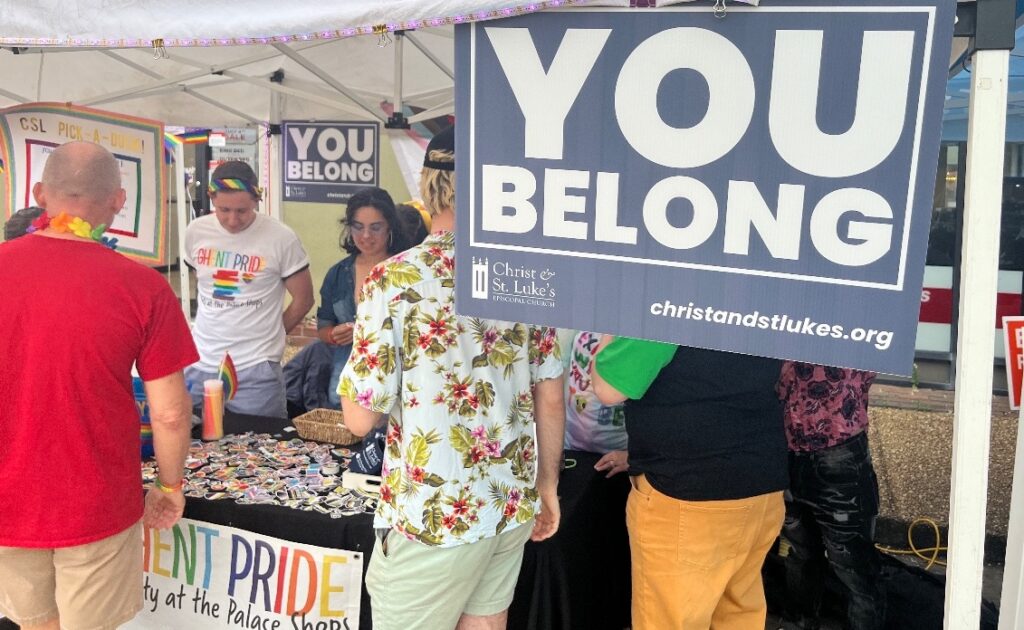
While the division in the larger communion is difficult, we are secure in the knowledge that Christ & St. Luke’s practices a love-centered Christianity. LGBTQ+ members are not just tolerated; they are welcomed as integral members. This is life-saving work. We know this welcome is the result of years of deliberate growth and change. We are grateful to those who came before us—LGBTQ+ people and allies alike—who did the hard work of change.