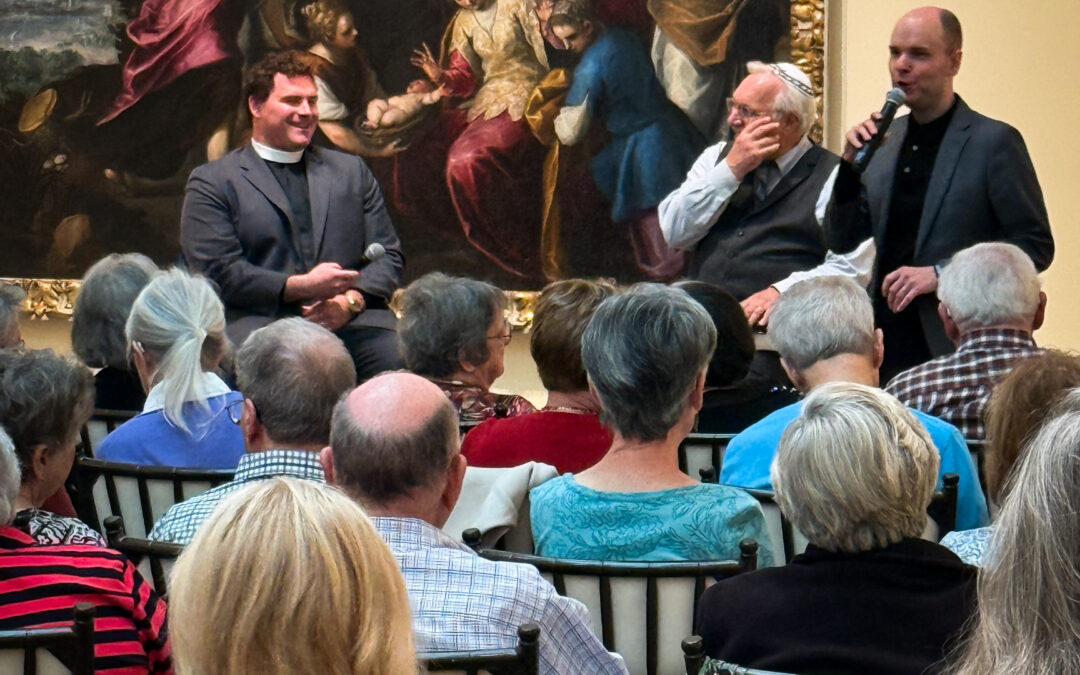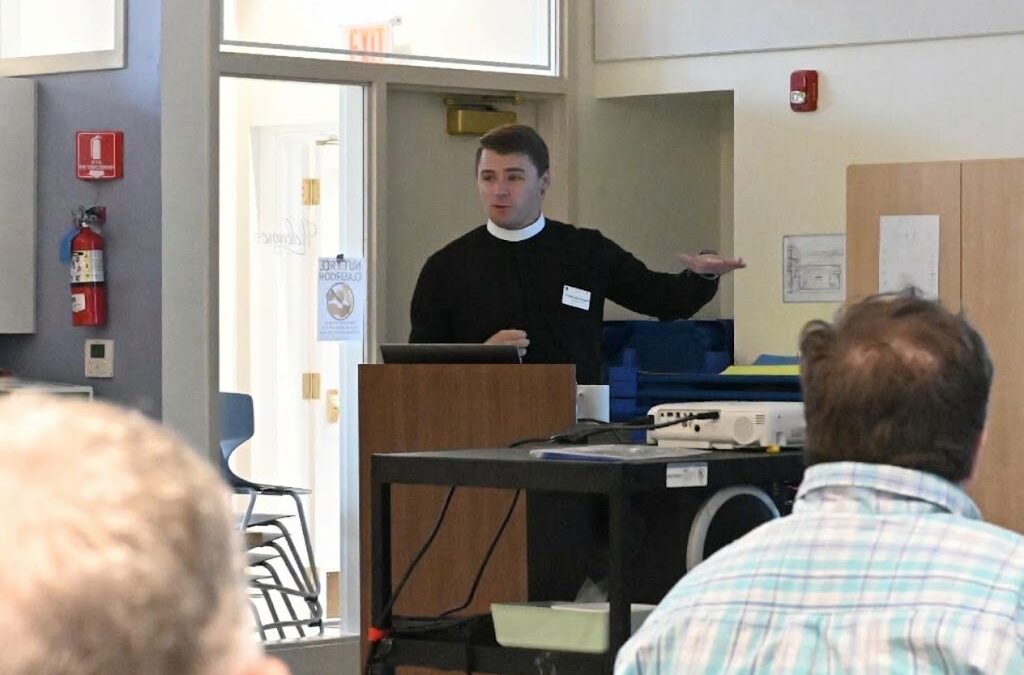

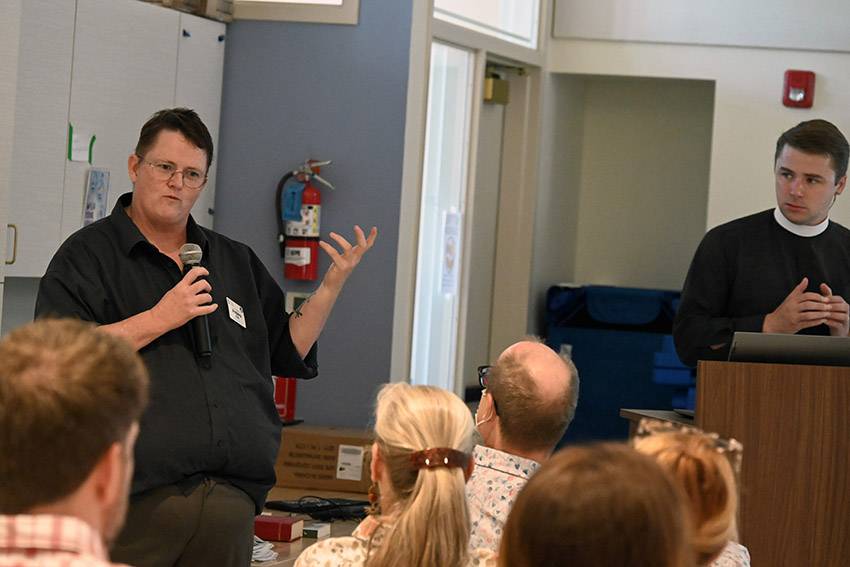
Anders Nolan (left) and Fr. Jared Grant (right) at the final “Rule of Life” formation session on May 17.
Over the last six weeks, our Eastertide Adult Forum about building a “Rule of Life” has been on a sweeping journey through the history of Christian monasticism. We’ve traveled from the isolated caves of the Desert Fathers to the tidal islands of Normandy, and from the ancient regulations of St. Benedict to the modern, bustling streets of Cambridge with the Society of St. John the Evangelist. We have learned how crafting a Rule of Life helps us intentionally regulate our days, resist the chaotic forces of the modern world, and ultimately, find freedom in Christ.
As we gathered for the sixth and final session of our series, Fr. Jared Grant brought us back down to earth to answer the most pressing question of all: What does this look like for those of us living in Norfolk, Virginia?
To help bridge the gap between ancient theory and daily reality, Fr. Jared invited a special guest to share his own personal journey. Anders Nolan, who runs our acolyte program and serves on the Vestry, is also a lay associate at the Holy Cross Monastery—an Anglican Benedictine community in West Park, New York. For nearly a decade, Anders has committed to living out a rule of life. His story of trial, error, and grace was a nice cherry on the top of this formation series.
The Trap of Perfectionism
When Anders first attempted to write his Rule of Life in June 2015, he fell into a trap that many of us face when attempting new spiritual disciplines: Perfectionism.
“I way over-complicated things. I made it really, really detailed,” Anders said, noting that his first rule spanned six pages. “It was definitely an aspirational rule of life where I’m like, ‘If I do this, I’m going to be holy. It’s going to be great. My life is going to be fixed.’ And it didn’t really work.”
Anders had tried to import the exact rhythms of the monastery directly into his busy life, committing to pray morning, midday, and evening prayer without fail. “That has never happened,” he laughed, acknowledging that the demands of his career as university professor, and his personal life, made such a rigid schedule impossible. When he couldn’t keep up, he simply stopped checking the document because he felt he didn’t have the time to read a six-page rule.
Eventually, a brother at the monastery gently nudged him to simplify. In 2022, Anders overhauled his approach. He challenged himself to reduce his rule to just one sentence per category: prayer, work, study, worship, self-care, and outreach. Today, his entire Rule of Life fits on one page. “I keep it as the screenshot on my phone,” he said. “That’s what I see instead of my cat, or whatever… and it is now really the rule of life that sort of lives within me.”
Finding a Daily Rhythm
Anders’ simplified rule isn’t something he agonizingly pores over every single day; instead, he assigns specific focuses to different days of the week.
On Mondays, he checks in on his prayer life, recognizing that the start of the workweek requires a little extra grace. “I’m not always feeling prayerful to my co-workers,” Anders admitted honestly. “It makes me like, okay, I’m going to pray for the people that are frustrating me right now… and it’s a useful way for me to start my work week in an attitude of prayer.”
On Tuesdays, his rule calls him to center an attitude of love and compassion in his work and to carve out time for his creative pursuits. He recently began taking a Tuesday morning watercolor class. Even though his calendar is packed with meetings, this dedicated time has become profoundly spiritual. “That is the place where I am the most quiet, and most silent and with God,” he said.
The Loblolly Pine as Symbol of Flexibility Within Rigidity
Perhaps the most crucial lesson Anders shared was about the necessity of building self-forgiveness into any spiritual practice. During the Q&A, a parishioner noted that a rule will ultimately fail if it lacks grace. Anders agreed, offering a metaphor for how to view a Rule of Life.
“I think of myself as like Loblolly pines,” he explained. “It’s a rigid, tall, soaring tree… but when there’s a big wind, it’s flexible. That’s why they still have a lot of life; they don’t just break… Most of the time I can live my rule exactly as written, but there’s flexibility when I’m there.”

Loblolly Pines.
Fr. Jared echoed this sentiment, reminding the class that St. Benedict’s original rule was designed to create a healthy work-life balance. “What has been done has been done. What has not been done has not been done. Let it be,” Fr. Jared advised. “Rather than internalizing that and saying I’ve got to push through, it’s to say the work takes what the work takes. And I also need to have that space to be a full creature of God.”
Filtering Through the Vows
As Fr. Jared reflected on Anders’ experiences, he pointed out how they align with the three core Benedictine vows we’ve been studying: Stability, Obedience, and Conversion of Life.
When Anders uses his rule to intentionally pray for difficult coworkers rather than distancing himself from them, he is practicing Stability, staying faithfully connected to the people and places God has put in his life. By using his rule to make well-reasoned choices about what he says “yes” or “no” to, he is practicing Obedience to a deliberate, God-centered framework. And by allowing his rule to evolve from a punishing six-page document into a flexible, grace-filled rhythm that includes watercolor painting and self-forgiveness, he is embodying the Conversion of Life.
Navigating Doubt on the Journey
During the class discussion, a parishioner asked: How do you maintain a relationship with God when you have strong doubts about whether He exists at all?
Fr. Jared pointed to the life of Mother Teresa of Calcutta, who struggled with profound doubts and feelings of spiritual emptiness for much of her life while continually serving the poor. She did not let her doubts get in the way of her acting with love and compassion. “Doubt is a real part of any sort of relationship with God,” Fr. Jared assured the group. “Doubt is often a way of saying ‘I don’t know’ rather than saying ‘I don’t believe’.”
This is precisely where a Rule of Life proves its worth. When the winds of doubt howl, the rule acts as that flexible Loblolly pine, keeping us rooted. “When I’m feeling like I don’t understand what’s going on around me, what do you do?” Fr. Jared asked. “That’s where a rule of life can be really beneficial—to say, I need some sort of structure to pull me away from this place and center me and focus me back on what I believe I am actually meant to be doing.” By simply showing up to our promised rhythms of prayer, worship, and service, we allow our actions to carry us through the seasons when our feelings cannot.
Your Turn: Charting Your Deliberate Course
As we wrap up our Adult Forum programming for the program year and move into our summer schedule, the opportunity to build a Rule of Life is in your hands.
You do not need to write a flawless, six-page theological manifesto. You do not need to pray the Daily Office five times a day. All you need is the willingness to look honestly at the forces currently steering your life, and the courage to intentionally choose a few simple practices that will help you center Christ instead. Start small. Perhaps your rule is simply deciding to read the news for only one hour a day, or committing to pray every Monday morning, or even just reminding yourself to regularly return to our community’s core rhythm: Come, See, Go, Be.
Write it down. Put it on your phone screen. Find a friend to hold you accountable, and most importantly, build in plenty of room for grace and self-forgiveness when you fall short.
The path to a deeper faith and a more deliberate life is waiting for you. Let’s start walking it together.
You can watch the full final session on our YouTube channel here: