
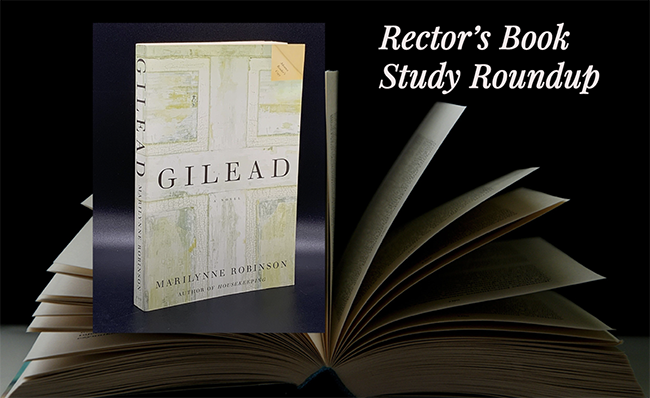
The first Rector’s Book Study pick for our 2026-7 program year was Gilead. Written by acclaimed novelist and essayist Marilynne Robinson, it is a book of faith. It also focuses on beauty and human connection. The book takes the form of a letter from John Ames to his seven-year-old son. Set in 1956, Ames is 76 years old and serves as a minister in Iowa. He knows his heart is failing. He writes the letter to leave a record of his life, his family history, and his love for his young child. At Christ & St. Luke’s, our theme for the year is “God’s Story, Our Story.” The idea is to look at how stories help us understand ourselves, and we saw Ames’s letter, the book, through that lens.
“We are eavesdropping on a person’s struggle of trying to be a better person,” said one Book Study participant. “I love the fact that he’s a minister who is supposed to be on a pedestal, but he struggles as much as anybody and has his own blind spots.”
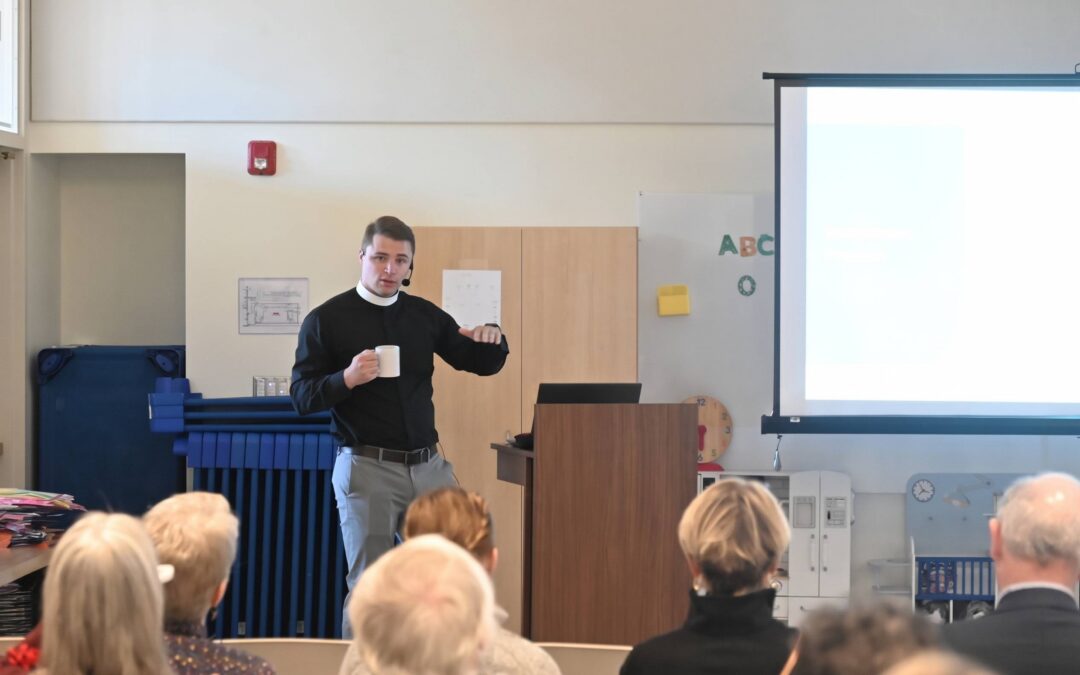
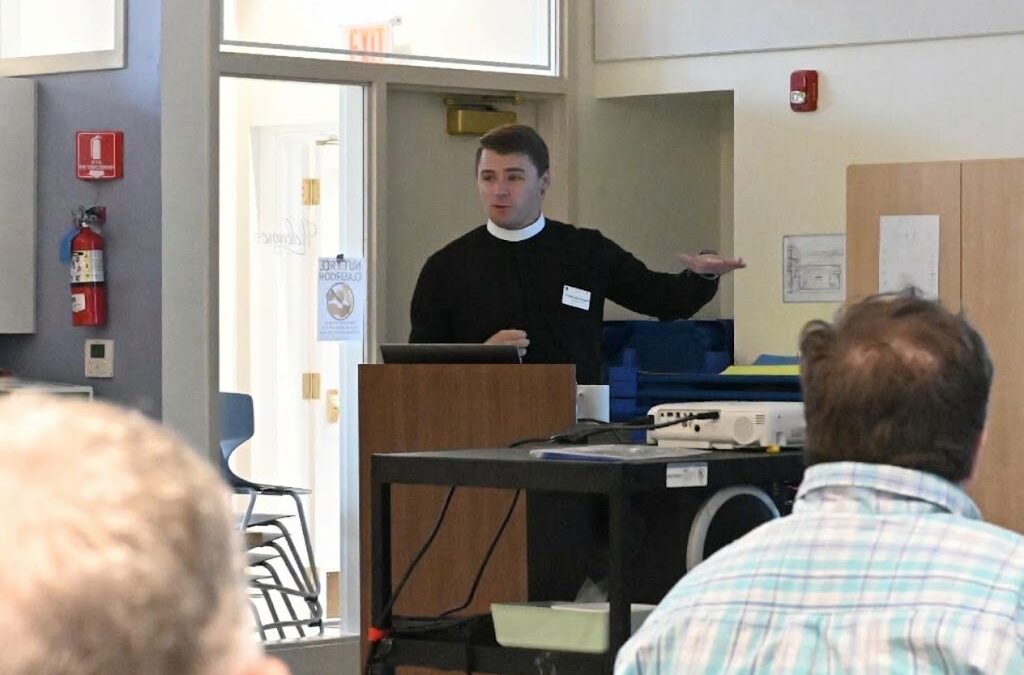
Gilead is the anchor of four interconnected books Robinson wrote about the same part of Iowa. Robinson also writes with knowledge of Christian theology. Fr. Noah opened the session by asking: “What is this book about?”
People gave many answers. They spoke about “legacy,” “stability,” “family stories,” and “grace.” We agreed that Gilead avoids lecturing the reader. It weaves memories, confessions, and insights together but into something ambiguous. As a result, our group also talked about the pacing of the novel. Gilead has no linear plot or sudden cliffhangers. It moves at the pace of the Midwestern prairie. It has a slow, steady rhythm that calls for patience.
“In ways that I think are wonderful, it is a highly religious book without being a religious book,” said Fr. Noah. “It’s not preaching and sort of talking at you… But there is a way in which it’s doing something that is profoundly scriptural in what it is trying to accomplish.”
“In Kansas, things are often subtle, a lot like this book,” said one of our party, who has lived there. Other members of the group expressed frustration that the book didn’t move faster! They did admit, though, that the deliberate pacing contributed to the book’s effect. The letter format lets us step into Ames’s mind. Ames sees his flaws. He names his biases. He admits his jealousy and corrects his memory. Ames uses writing as a spiritual practice. Sitting at his desk with a pen is an act of prayer. This idea sparked a good talk about how we process our lives. Ames spent 50 years in the pulpit. He filled boxes in his attic with thousands of handwritten sermons. As he looks at the end of life, those formal arguments fade. What lasts is his connection with people, a conversation, a blessing, or his son at play outside.
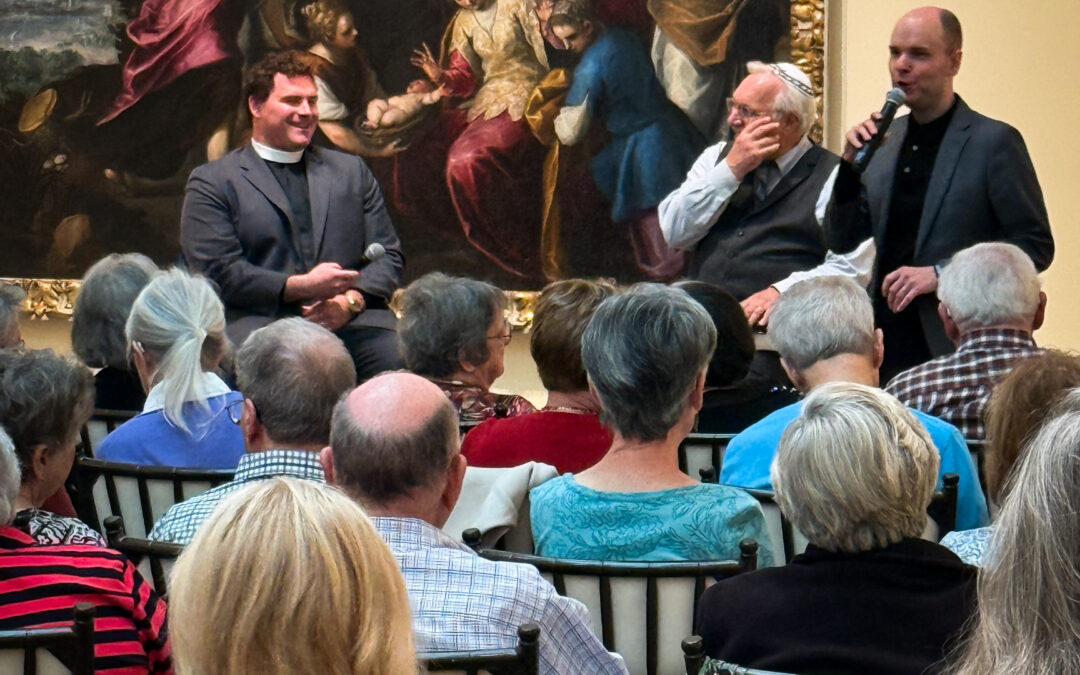
Another parishioner noted that Robinson’s storytelling mirrors Jewish Midrash. It’s a Jewish mode of interpretation that not only engages with the words of a text. It also looks beyond the text and behind the text. It focuses on each letter, and the words left unsaid by each line. For example, Ames picks up a family memory. He turns it in the light, looks at a new angle, sets it down, and picks it up in later pages. Through these fragments, we see a more subtle truth emerging.
The main drama in Gilead, such as it is, centers on Jack Boughton. Jack is the son of Robert Boughton, a Presbyterian pastor and best friend to Ames. Jack is the godson and namesake of Ames. Yet Jack lived as the black sheep of the town. When Jack returns to Gilead in 1956, John Ames feels suspicion and jealousy. Ames sees Jack talk to Lila and play baseball with his young son. Ames worries about his family after he dies. He fears Jack will harm his home.
Our group looked at the behavior of Ames. Here is a pastor of fifty years who preaches grace, yet struggles with resentment. He uses Jack’s past to justify cold feelings. The turning point comes when Jack and Ames sit down to talk. Jack reveals his secret.
When Ames stops judging and listens to Jack, his heart changes. Ames sees that Jack is a hurting man who seeks love and peace.
The climax of the novel, such as it is, happens at a bus station. As Jack prepares to leave Gilead, John Ames steps forward. He places his hand on Jack and gives him a blessing.
Our group reflected on this scene. One parishioner shared how the struggle of Ames helped them face family hurts.
For all it’s meditation on the struggles of family and history, Gilead ultimately offers a bright view of the world. John Ames feels awe for creation. During our session, we read this passage aloud:
“I’ve been thinking about existence lately. In fact, I’m so full of admiration for existence that I’ve hardly been able to enjoy it properly. I feel sometimes as if I were a child who opens its eyes on the world once and sees amazing things it will never know any names for and then has to close its eyes. I know this is all mere apparition compared to what awaits us, but it is only lovelier for that. There is a human beauty in it. And I can’t believe that when we have all been changed and put on incorruptibility, we will forget our fantastic condition of mortality and impermanence, the great bright dream of procreating and perishing that meant the whole world to us. In eternity, this world will be Troy, I believe. And all that has passed here will be the epic of the universe. The ballad they sing in the streets.”
The passage prompted reflection on the interrelation between our fragile lives and eternity.
“There is that sense of how he’s understanding death and mortality as well, which allows him not to be sort of ‘do not go gently into that good nighting’ his way through the book,” said Fr. Noah. “He’s very gently going into that night and very graciously doing it.”
We closed with a quote from the book about human knowledge which was a good reminder about the importance and limitation of the stories we tell and the stories we hear:
“You can know a thing to death and be for all purposes completely ignorant of it. A man can know his father or his son and there still might be nothing between them but loyalty, love, and mutual incomprehension.”
It’s true. We cannot know another person’s heart. We cannot fully know their story. But we do not need full understanding to show them grace. Our talk about Gilead gave us all a rich start to the year.
—Next, we’ll tackle The Poisonwood Bible by Barbara Kingsolver on October 30 at 4:00 p.m.