
What does a Sixteenth-century Italian painting of an infant floating among the Nile reeds have to teach us about healing our democracy?
Well, it turns out, rather a lot…
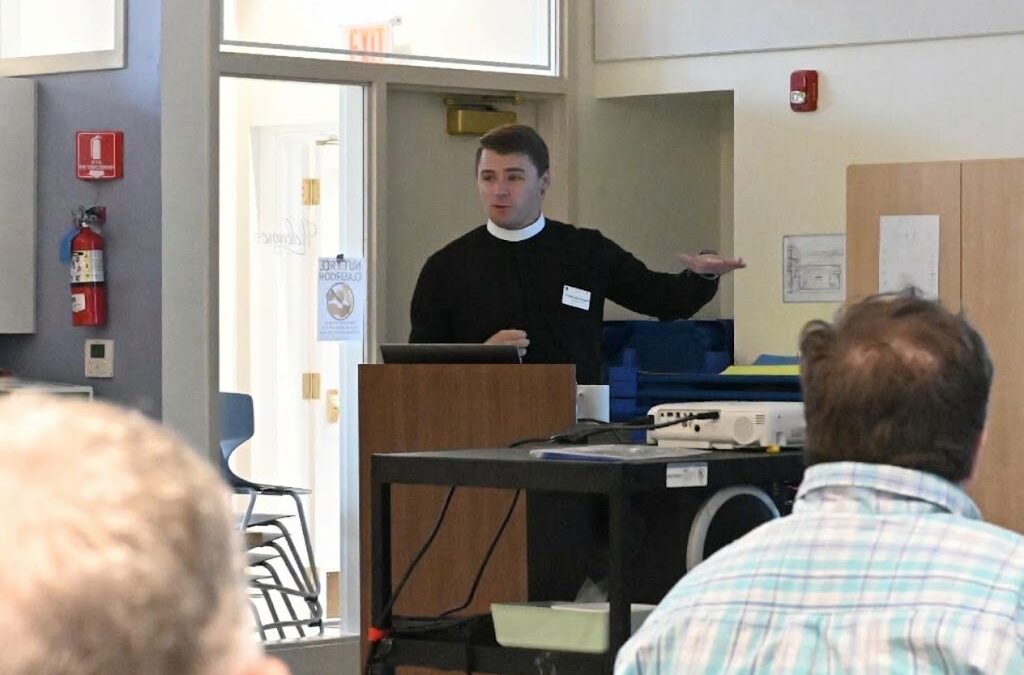
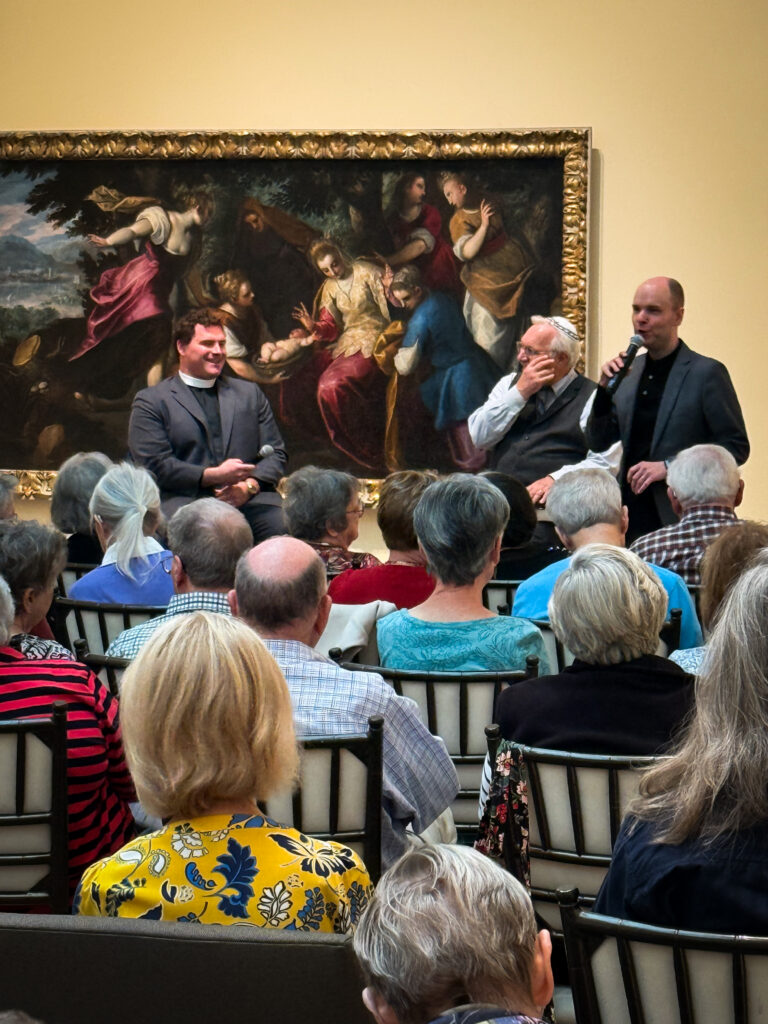
In an era when public discourse so often descends into cynicism, we explored the answer at the Chrysler Museum of Art. As part of the Chrysler’s new Art and Democracy Initiative, program manager Drew Lusher convened a special Civic Salon focused on the intersection of faith and public life. Our own rector, The Reverend Noah Van Niel joined a discussion with Drew and with Dr. Michael Panitz, Rabbi of Temple Israel of Norfolk — and longtime friend of Christ & St. Luke’s.
Together, the panel used four remarkable European masterworks from the Chrysler’s extraordinary permanent collection as entry points to explore four fundamental pillars of communal flourishing: narratives, norms, habits, and rituals.
In an era marked by social polarization, their discussion offered a vision for how the habits of mind and heart cultivated within religious communities can serve as a vital template for building a healthier, more compassionate society.
Opening the dialogue, Rabbi Panitz noted how remarkable it is that modern faith leaders can gather in mutual respect to reflect on sacred texts depicted by Christian artists. For centuries, the rivalries among Western monotheistic traditions rendered neighbors as strangers or adversaries, but today that friction has given way to a shared human response before the divine. To anchor the first pillar of the salon—narratives—the panelists turned to Jacopo Palma’s sixteenth-century canvas, The Finding of Moses.
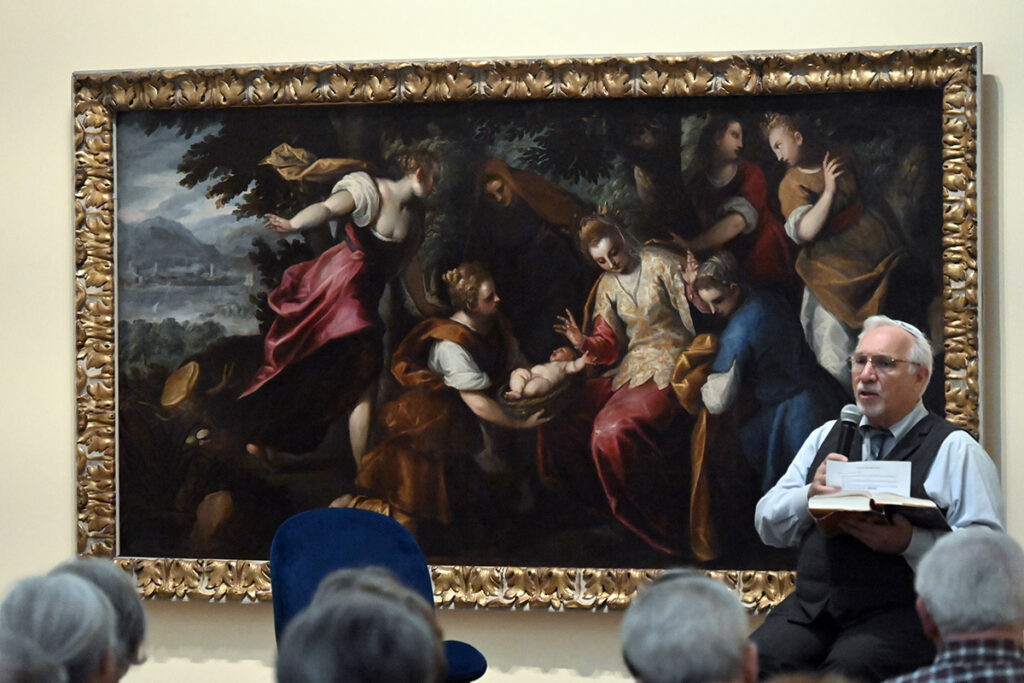
Rabbi Panitz with Jacopo Palma’s sixteenth-century canvas, “The Finding of Moses.”
Reading from the second chapter of Exodus, Rabbi Panitz recounted the story of an infant hidden amidst the Nile reeds by his mother to escape Pharaoh’s genocidal decree. He pointed out a striking detail in the biblical text: No character in the passage is named until Pharaoh’s daughter pulls the basket from the water and pronounces the name “Moses.” Palma’s painting captures that moment of discovery, illuminating the child against a rich Italianate landscape. In Palma’s depiction, Pharaoh’s daughter experiences an immediate surge of compassion that dismantles the barriers of royalty and enslavement.
This story of rescue sparked a wider examination of what secular narratives Americans share today to help us understand who we are collectively. Responding to Drew’s inquiry about how stories function in community building, Fr. Noah emphasized that narrative construction is a human necessity. “This idea of story, and how we both construct it and understand ourselves in it, is a very human process,” he said. Fr. Noah stressed that the essential work of any community is finding ways for individuals to lean into these foundational stories and feel themselves to be active participants in an ongoing collective history.
Expanding on how citizens write themselves into shared secular narratives, Rabbi Panitz offered a personal reflection on civic adoption. Sharing his family history as the descendant of Jewish immigrants who arrived from Eastern Europe between 1910 and 1924, he recalled singing lines from classic patriotic anthems like “land where my fathers died in his New Jersey grade school. Although his biological grandfathers were not present during the American Revolution, participating in that schoolroom civic ritual allowed him to claim the nation’s historical arc as his own. At the same time, the panelists acknowledged that living within a narrative tradition requires wrestling with stories that feel uncomfortable or incomplete by modern standards. Drew pointed out that as America approaches the 250th anniversary of the Declaration of Independence, citizens are still debating the national story and who holds the authority to retell it. Engaging critically with core principles like the declaration that “all men are created equal” allows a community to refine its self-understanding and keep its foundational stories vibrant.
Transitioning to the second pillar—civic norms—the panel examined Bonifazio de’ Pitati’s dramatic painting, Lot and His Daughters.
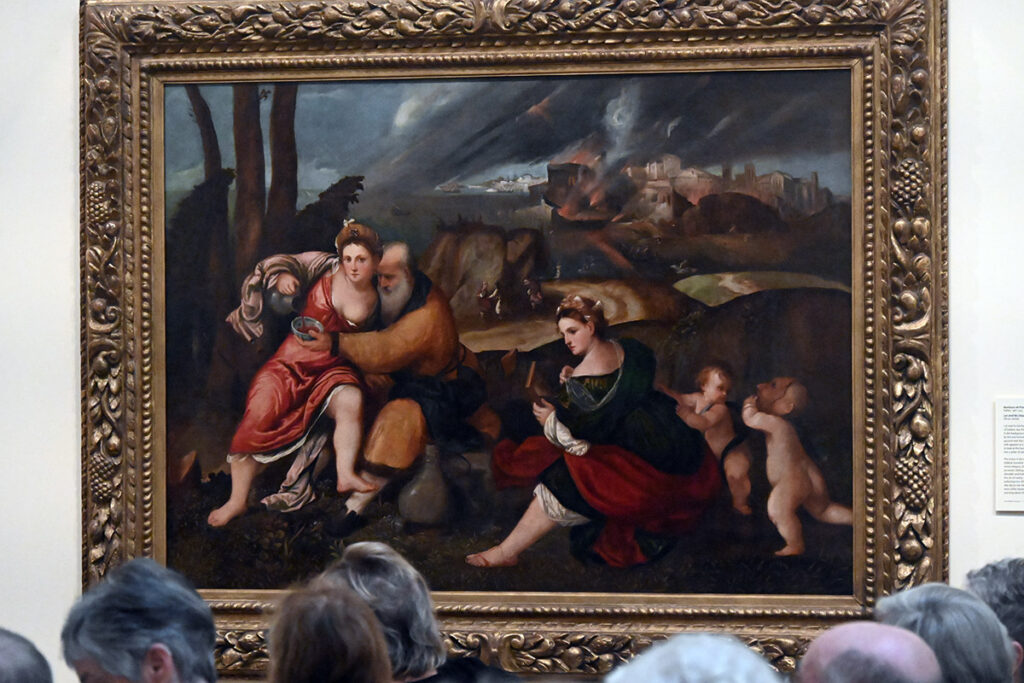
Bonifazio de’ Pitati’s Lot and His Daughters.
Reading from Genesis 19, Rabbi Panitz outlined the troubling narrative of Lot fleeing the catastrophic destruction of Sodom and taking refuge in a cave with his two daughters who get him drunk and seduce him in order to perpetuate the family line. The artist presents a tense composition in which Lot’s daughter stares directly out of the frame at the viewer. Rabbi Panitz suggested that her unsettling gaze poses an uncomfortable moral question regarding human agency under extreme crisis. “Is it that you can’t bear to look at your dad? Or that she wants to engage you with the question: What would you do if you were the last woman alive?” Rabbi Panitz asked. The painting forces viewers to confront the fragile nature of social order and what happens when established moral parameters collapse entirely under disaster.
Prompted by Drew to define how norms operate in modern public life, Fr. Noah drew a clear distinction between formal legal rules and social norms, recalling how educators help children distinguish between the two. “A norm may begin as a rule, but then needs to be backed up by this continual behavior of the people that are in it,” Fr. Noah explained. “There’s shared understanding of what is appropriate and what is not appropriate.” He noted that a church community, for example, may claim a norm of welcome, but if long-time members give newcomers cold stares when they sit in an their pew, the stated norm is undermined by actual behavior.
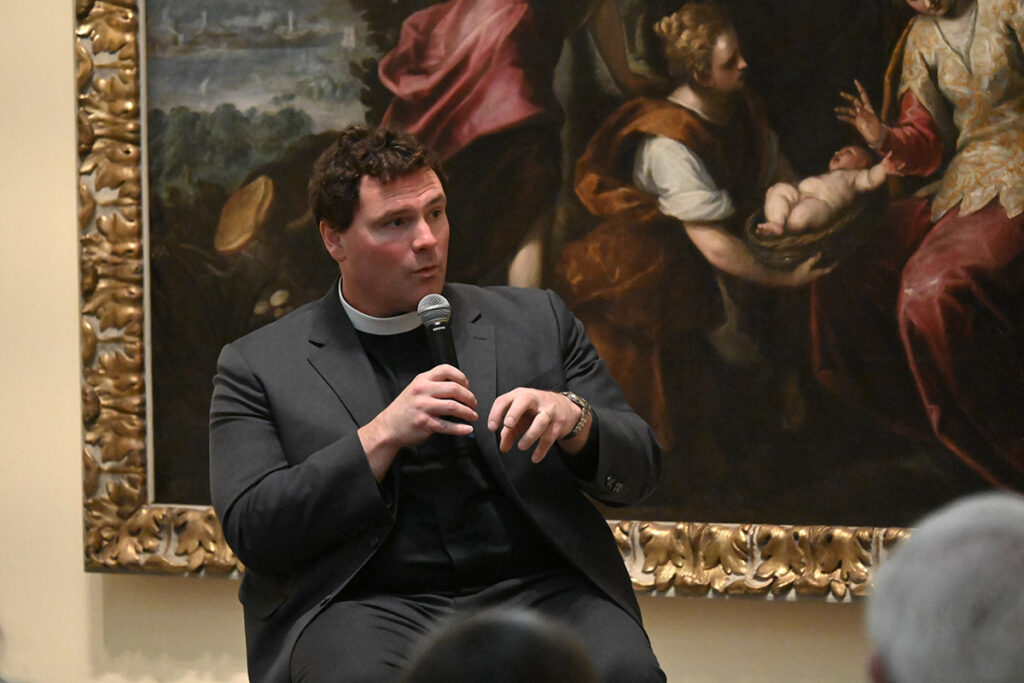
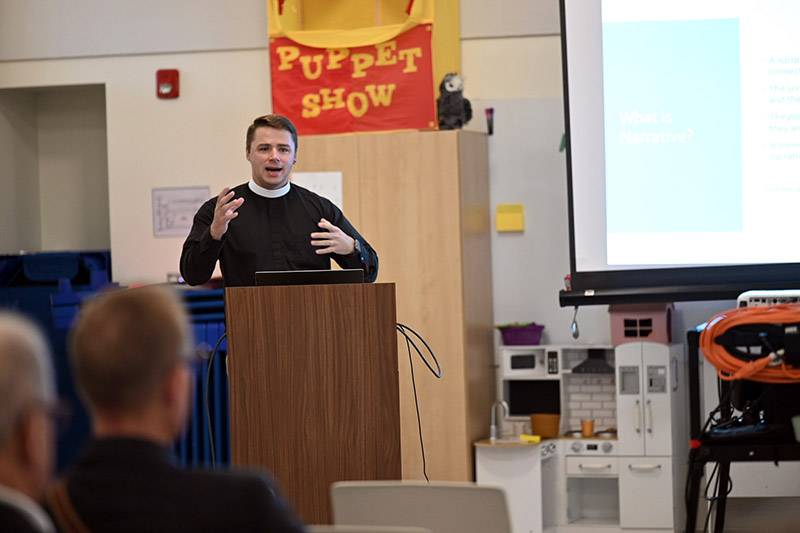
Fr. Noah at the salon.
Applying this insight to the broader American landscape, Fr. Noah delivered a sobering assessment of contemporary public health: “From a civic sense, I think one of the questions, one of maybe the revelations of the last, say, 10 years or so that many of us… have been paying attention to, is this idea that how much of our civic life was built on norms, not laws and rules. And our civic life, then, is disintegrating, is disintegrated because a lot of people are not feeling the need to abide by the same norms.” When citizens abandon unwritten standards of courtesy and mutual restraint, norms reveal themselves to be fragile, leaving society vulnerable to cynicism and fragmentation, Fr. Noah said.
To support stronger civic norms, the speakers argued that society must combine top-down institutional integrity with bottom-up character development. Rabbi Panitz noted that scripture diagnoses periods of social disintegration with the repeating refrain, “there was no king,” highlighting the chaos that ensues when central authority fails. Yet scripture remains deeply suspicious of political autocracy, placing the ultimate responsibility for civic health on individual moral formation. Citing Confucian philosophy alongside biblical tradition, Rabbi Panitz highlighted the importance of cultivating the Junzi, or the morally refined person, whose personal integrity serves as the essential cellular tissue that constructs a healthy public body. Building on this idea, Fr. Noah asserted that both faith traditions and civic communities depend on individuals making a conscious commitment to look beyond self-interest. “What religions try to do… is to take the individual out of oneself as the center of attention, so that the other becomes the center of one’s concern, which is the building block of a community,” Fr. Noah said. Supporting robust civic norms ultimately requires citizens to ask whether the health of the broader collective is worth their personal effort and restraint.
Turning to the third pillar—individual habits—the panelists turned to Paolo Veronese’s magnificent canvas, The Virgin and Child with Angels Appearing to Saints Anthony Abbot and Paul, the Hermit.
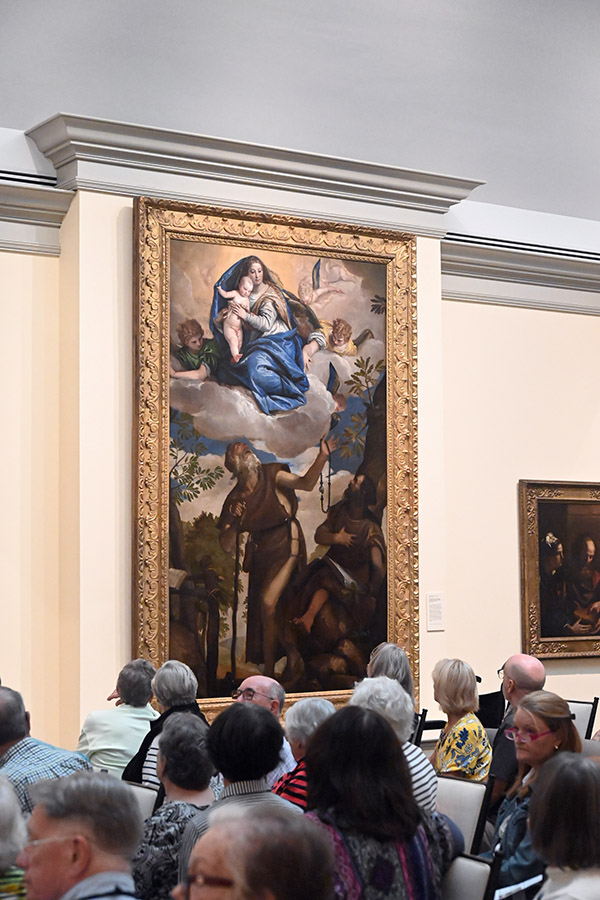
Paolo Veronese, The Virgin and Child with Angels Appearing to Saints Anthony Abbot and Paul, the Hermit.
Fr. Noah detailed the legendary history of the two figures depicted at the bottom of the composition. Saint Anthony Abbot, widely recognized as the father of Christian monasticism, retreated into the desert to seek a life of contemplative solitude, only to learn later in life of Saint Paul the Hermit, who had lived independently in the wilderness from age 16 to 113. Veronese captures their rare earthly meeting, depicting Anthony with a study Bible and Paul holding prayer beads. In response to their faithful discipline, the heavens open above them, filling the upper canvas with radiant, technicolor light as the Virgin Mary and baby Jesus descend into their muted, rugged world.
Fr. Noah used Veronese’s painting to illustrate how spiritual disciplines transform into ingrained personal habits. “I think if we’re shifting our minds to the topic of habits… there’s something really interesting for us to start to think about, about those regular habits, right? Our choices we make that should stop being choices at a certain point. They become subconscious actions on our part,” Fr. Noah said.
For the hermit saints, daily prayer, scripture study, and manual labor ceased to be agonizing daily negotiations; they became automatic rhythms of life that created the capacity for divine revelation in the middle of ordinary existence. Drew added historical context by noting that Veronese’s painting originally hung high above an altar in a side chapel of the Mantua Cathedral before being seized by Napoleon’s troops. In its original setting, worshippers would physically embody habit and ritual by kneeling before the altar and gazing upward into the luminous scene.
Reflecting on what habits individual citizens should adopt to support a healthy secular community, Rabbi Panitz and Fr. Noah discussed the liturgical concept of “ordinary time” (kodesh and chol). Rabbi Panitz emphasized that extraordinary spiritual moments like holy days make sense only when grounded in the vast plains of daily life, offering a humorous analogy for consistency: “don’t floss your teeth just on the morning of your annual dental exam.” In our modern, hyper-connected world, however, many of our daily habits are passively thrust upon us by digital technology and algorithm-driven media. To counter this passive drift, Rabbi Panitz highlighted the growing movement of “Sabbath Unplugged” within Jewish spirituality, where individuals intentionally disconnect from electronic devices for twenty-five hours to shield themselves from relentless technological inputs and refocus on timeless human values. Drew suggested that modern communities desperately need a “civic Sabbath,” an intentional pause where citizens step back from outrage and passively consumed news to evaluate how they intentionally show up for their neighbors. Fr. Noah added that individuals can adopt a civic “rule of life,” making deliberate commitments to practice virtues like active listening, neighborly kindness, and regular participation in public processes like voting.
The final pillar of the salon—secular rituals—was framed by Giovan Filippo Criscuolo’s luminous painting, The Adoration of the Magi.
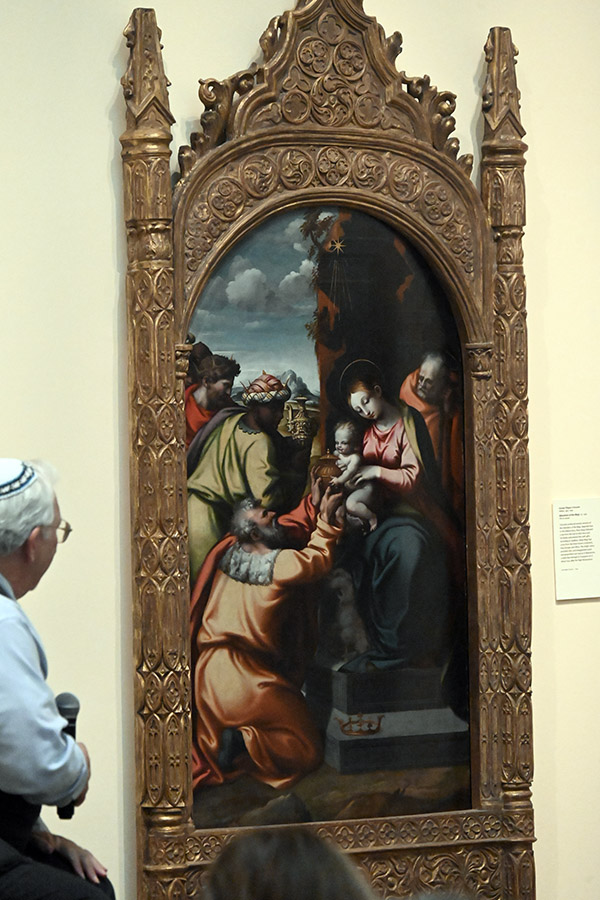
Giovan Filippo Criscuolo, The Adoration of the Magi.
The composition depicts the traditional scene of the Wise Men kneeling before the newborn infant Jesus, laying their earthly crowns flat upon the ground. Fr. Noah noted that this sacred event inspired a rich tapestry of enduring Christian rituals around the feast of Epiphany, including Christmas pageants, singing classic carols, and chalking doorframes with blessings. Illustrating the emotional resonance of such imagery, Rabbi Panitz shared a personal memory from the summer of 1982 in Rome. During a punishing heatwave, he and his wife Sheila sought shelter inside the ancient basilica of Santa Maria Maggiore with their infant daughter. As his wife nursed their daughter beneath a statue of the Madonna and Child, Rabbi Panitz stood watch, overwhelmed by the timeless parallel between the sacred art above them and the universal, tender ritual of parental care unfolding below.
Drawing the discussion to a close, Fr. Noah carefully articulated the distinction between daily habits and communal rituals. “Our rituals are some things that stand out from the ordinary and that we seek to set apart from the ordinary,” Fr. Noah explained. “And we have all sorts of civic rituals within the life of the country, whether it’s July 4th fireworks, or whether it is the institution of a new president… These are the punctuation in the sentences that go on with just the normal letters, and then you have something to add in these inflection points within it.” Rituals serve as essential public inflection points that call a scattered community back to its founding principles and shared story.
Addressing the secular rituals that exist in our broader community, Drew highlighted civic gatherings that people often take for granted, such as Norfolk’s annual Grand Illumination Parade. Although navigating traffic and large crowds can be challenging, Drew emphasized that forcing oneself to attend public events generates vital “common knowledge”—the shared awareness created when community members gather in physical space and see one another participating in the same cultural moment.
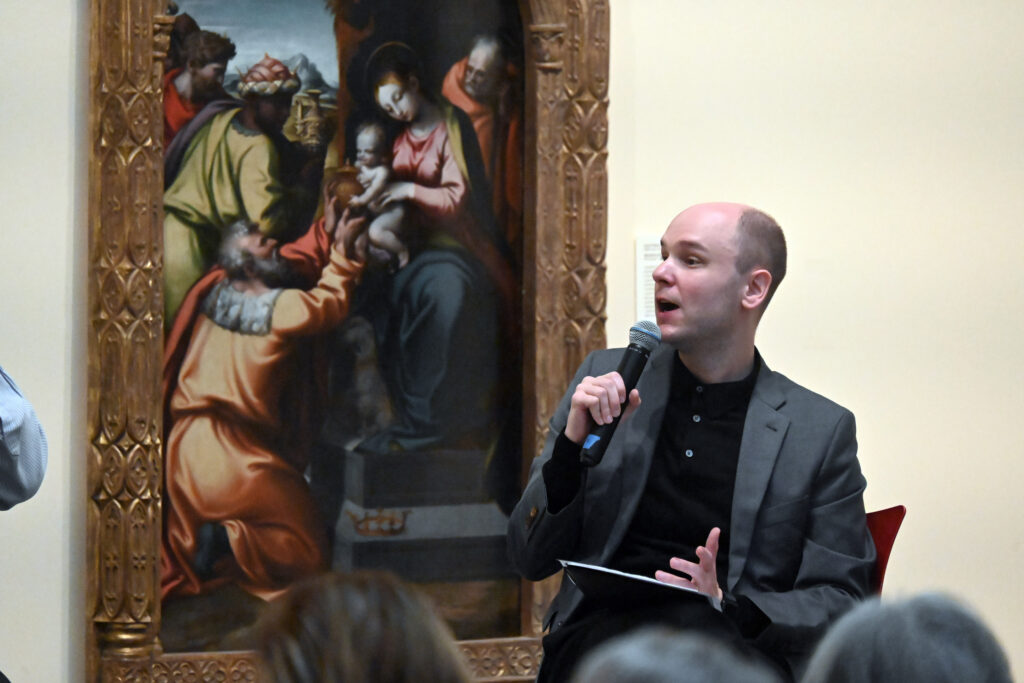
Drew Lusher with the Chrysler Museum of Art.
Simply showing up in public spaces alongside diverse neighbors is a foundational secular ritual that builds social trust and bridges ideological divides. Summarizing the spirit of the Civic Salon, Rabbi Panitz recalled the cherished anthem Let There Be Peace on Earth, emphasizing its central phrase: “let it begin with me.”
Fr. Noah concluded with a charge for the parishioners of Christ & St. Luke’s and the broader Norfolk community, reminding everyone that building a healthy civic society is an active, personal responsibility. “I hope that those of us who leave today leave with a little bit of a conviction and some challenge to say that I have a role to play in the rebuilding and the maintenance of the communities of which I have a part,” Fr. Noah urged.
By actively nurturing our shared narratives, strengthening our civic norms, practicing intentional daily habits, and showing up for public rituals, we can all help usher in a more connected, graceful, and resilient community.
—The next Civic Salon at the Chrysler is on “Place,” and takes place on Tuesday, November 17 from 11:00 a.m. to 12:00 p.m. It will feature Sharon Manana, Director of Community Engagement with Work Program Architects, and Patric Mullins, Executive Producer of Rouge; It will explore the relationship between place, culture and citizenship.