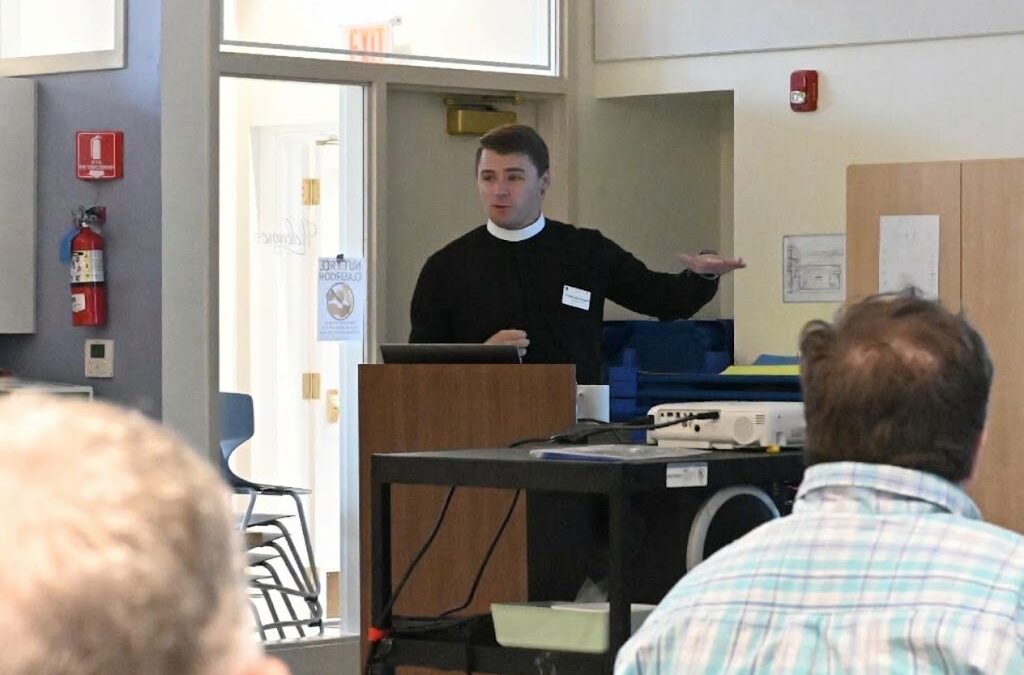

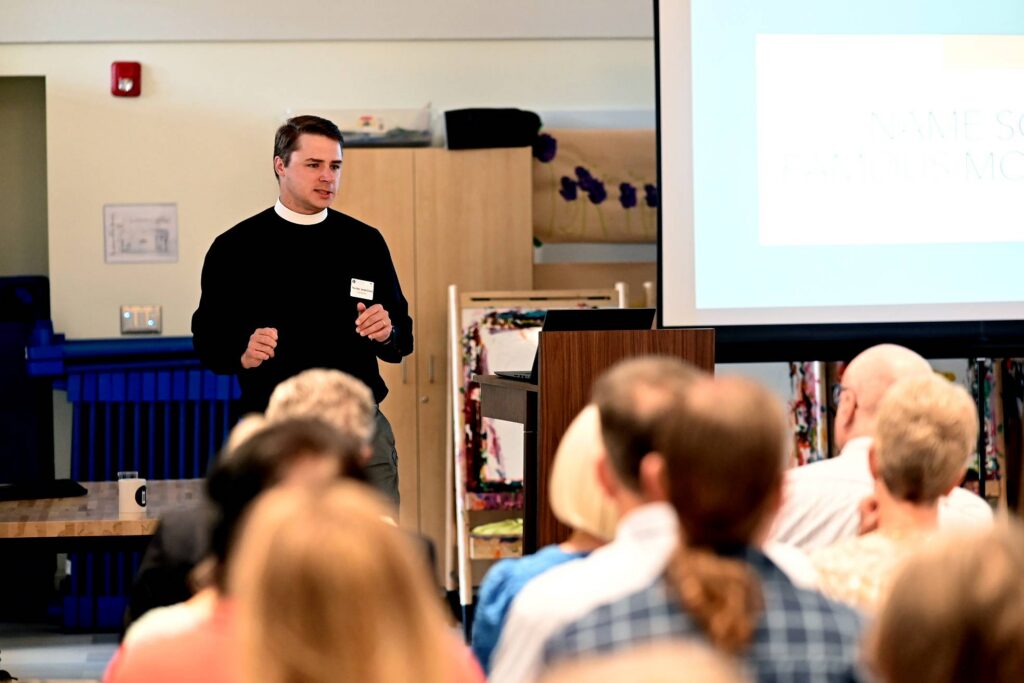
In our third week of the “Building a Rule of Life” Adult Forum, Fr. Jared Grant brought our lively Sunday morning class back to the foundational purpose of our Eastertide study. Our shared goal over these six weeks is not to become medieval ascetics — even though we’ve looked at monastic traditions — but to ask ourselves how we might thoughtfully regulate our own days.
How do we walk the path of discipleship amidst the noise of modern life? As we pivot toward the deeply personal work of practical theology, we spent this past Sunday exploring the mechanics of St. Benedict’s Rule to see what spiritual tools we can borrow to build our own frameworks for encountering God.
Why Monasticism?
Before diving into the rules themselves, we asked a vital question: Why did people become monks or nuns in the first place? While a deep, personal calling from God certainly played a major role, Fr. Jared pointed out that ancient society was simply not set up to care for everyone. For second-born sons who received no inheritance, or women who were denied social and economic agency, monasteries offered a vital lifeline. They were not just isolated hideaways for the ultra-holy; they were places where people could survive and be supported. Far from being totally cut off from the world, these abbeys became thriving centers of economic development, political administration, and theological learning.
To illustrate this, Fr. Jared shared photos from a recent trip to Mont Saint-Michel, a breathtaking Benedictine monastery built on a rocky, tidal island off the coast of Normandy, France. Despite its seemingly isolated location, which was historically only accessible at low tide, the abbey was a bustling village. Inside, monks gathered in the refectory to eat while listening to spiritual readings. In the scriptorium, they worked painstakingly to hand-copy Bibles and historic documents, preserving human history for future generations. Below the abbey walls, an entire village of laypeople lived, supported the monks, and were in turn supported by the monastery’s economy.
Deconstructing St. Benedict’s Rule
So, how did St. Benedict regulate his bustling communal life? He wrote 73 specific chapters, which Fr. Jared categorized into four main areas. Interestingly, most of the Rule focuses on everyday actions rather than high-minded theology. Roughly 33% of the chapters deal with structure and governance, outlining dormitory rules, governing the tools of the monastery, and who serves in the kitchen. About 19% of the chapters dictate the rhythms of prayer and worship. Meanwhile, 17% focus on “amendment of life,” providing a restorative framework for what to do when community members fail, exploring the vital roles of forgiveness and grace. Only about 20% of the Rule focuses on “qualities of life,” addressing the inner character and temperament of the monks. Each chapter, however, is often difficult to define with one characteristic. There is often a mix of each of these four categories in each of the 73 chapters.
Benedict left nothing to chance, meticulously detailing how his community should function. But since we are not living in a cloister under the watchful eye of an abbot, how do we apply this to our lives in Norfolk?
The Three Core Vows: Stability, Obedience, and Conversion
To distill Benedict’s exhaustive regulations into practical tools for our modern context, Fr. Jared introduced the class to the three core Benedictine vows. Much of the language below is taken directly from the Rev. Jane Tomaine’s book, St. Benedict’s Toolbox.
1. The Vow of Stability: This is the vow to remain present and faithful to people and place. “Stability can translate to any relationship, such as family, marriage, friendship, or church community,” Fr. Jared explained. It means staying connected to the joys and pains of those around us, rather than fleeing or distancing ourselves physically or emotionally. (St. Benedict’s Toolbox, Part II Introduction) “That one cuts deep,” Fr. Jared admitted. In our highly individualistic society, true stability asks us not to build personal fortresses, but to remain engaged in our communities even when things get difficult.
2. The Vow of Obedience: Obedience involves listening and responding to God’s direction coming through scripture, other people, the world around us, and spiritual teachers. It is about actively choosing which forces we allow to have power over our lives (St. Benedict’s Toolbox, Part II Introduction).
This concept sparked a thoughtful class discussion. One participant highlighted the tension that obedience often brings in the modern world. “It’s a rising challenge for me personally between the obedience to the law versus obedience to morality,” he shared, pointing out the difficult discernment required when worldly rules conflict with Christian values.
3. The Vow of Conversion of Life: This vow serves as the perfect balance to stability. While stability calls us to remain, conversion of life calls us to remain open to transformation, change, and growth by the Holy Spirit (St. Benedict’s Toolbox, Part II Introduction). Borrowing language from the Order of the Holy Cross, Fr. Jared noted that this vow is about ongoing “growth towards the fullness of the image in which we are made.” It is the lifelong, restorative process of returning to the Imago Dei—the image of God.
Filtering Our Lives Through the Vows
To put these vows into practice, Fr. Jared invited the class to look at a few of St. Benedict’s specific rules through these three lenses.
When examining Chapter 39, which dictates the daily food portions, including two cooked dishes, fresh produce, and a generous pound of bread, with special provisions for the sick, we can see these vows at work. We see stability in the deep communal care for the elderly and weak. We see obedience to scripture in the strict warnings against overindulgence, ensuring that food serves the body rather than ruling it.
Another example is found in Chapter 66, concerning the porter of the monastery. Benedict commands that a “sensible old man” be placed at the door. Whenever a visitor knocks, the porter must immediately reply, “Thanks be to God.”
This rule is instructive in Christian living. It demonstrates stability by insisting that the monastery remain deeply connected and hospitable to the outside world. It shows obedience by requiring the monks to welcome every guest as if they were welcoming Christ himself.
Crafting Your Own Course
As the session ended, an attendee profoundly asked, “I’m wondering if most people have a way of life… maybe they just don’t think about it?”
“That’s a yes,” Fr. Jared agreed. “If you’re not actively engaged with this, you won’t know what’s ruling your life. There are forces that are in control of you, whether you know them and can name them or are engaging with them. And so, a big part of this really is just saying, I’m intentionally saying that these are the things that I’m doing.”
As we move into the final weeks of this series, our challenge is to take any specific action we want to adopt, whether regarding our prayer routines, our work habits, or our social media consumption, and filter it through these three vows. How does this action connect me to others? What force am I obeying? How is this helping me transform into the image of God?
Next week, Fr. Jared will be away representing our diocese at the Provincial Synod. In his stead, Fr. Noah will lead the class, shifting our focus to the Society of St. John the Evangelist to explore how another rich Anglican monastic tradition can offer practical tools for our daily lives. No matter what forces are currently steering your ship, it is never too late to chart a new, deliberate course toward a humbler faith and a more intentional life.