

At Christ & St. Luke’s we love exploring the intersection of art, faith, and the human experience. Whether we are marveling at the historic Christian art at the Chrysler Museum or listening to the majestic sounds of our choir, we are constantly engaging with creative expression. But how often do we stop to truly evaluate what we are seeing and hearing?
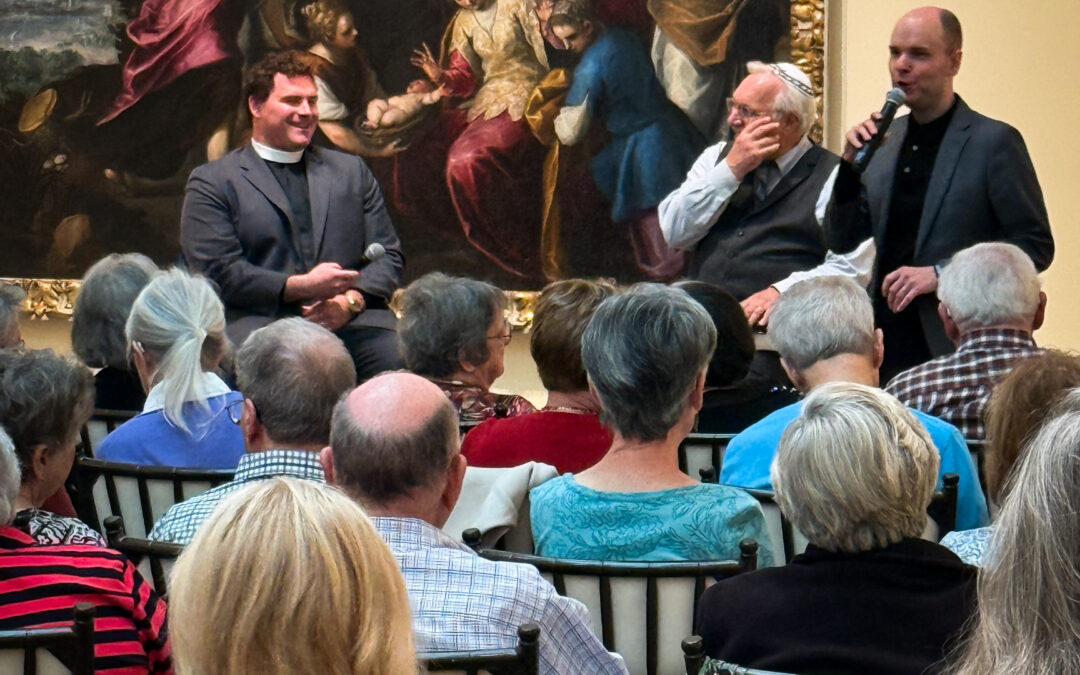
Recently, the Christ & St. Luke’s Arts Guild hosted a fascinating conversational session in the Choir Room after the Sunday 10:15 a.m. service, titled“Confessions of an Arts Critic.” The session was led by our very own Dr. Page Laws, a brilliant theater, film, and arts critic who often writes for Cineaste magazine, widely considered one of the world’s premier journals of contemporary moviemaking.
With deep roots at Christ & St. Luke’s (she affectionately described herself as the oldest member in terms of years attended since childhood, fondly recalling her father’s work as an usher) Dr. Laws brought a wealth of humor, academic rigor, and practical wisdom to the group.
Born to Be a Critic
Dr. Laws joked that her destiny was sealed from day one. “When I was born my parents looked in the cradle and said, ‘critic,’” she laughed, noting that they playfully spelled it with a ‘k’, the way playwright Samuel Beckett did.
While the word “critic” is often spat out as a “mean epithet,” Dr. Laws reminded the room that criticism is supposed to be a deeply thoughtful, benign activity. Throughout her career, she has straddled two worlds: She is an academic who writes heavily researched essays, but she is also a journalistic critic who must produce quick, digestible reviews on tight deadlines.
This dual identity often put her at odds with her close friend and legendary local critic, the late Mal Vincent. Despite being dear friends (they met when she was just 14) their styles couldn’t have been more different. While Dr. Laws is a meticulous academic who insists on reading a script or opera libretto before reviewing it, Mal preferred to walk in fresh and write entirely off-the-cuff. They also had fiery political debates. “I mean we would get so mad at each other,” Dr. Laws recalled. “I would say, Mal, pull over. I’m getting out of this car.”
Another hallmark of her unique process? The art of writing in the dark. While working as a staff writer at the Virginian-Pilot, her colleagues relentlessly teased her for her addiction to using different-sized note cards during shows. But Dr. Laws insists that taking “careful and copious notes” in the dark is an essential trick of the trade. When it comes to deadlines, her routine is equally intense: after a Friday night show, she writes her first rough draft before she goes to sleep, takes a nap around 1:30 a.m., and wakes up at 5:00 or 6:00 a.m. to polish it before sending it to her three editors.
The Bottom Line: Two Crucial Questions
So, how does a professional critic evaluate a show? Dr. Laws shared a well-worn, “ratty-tatty” handout with the class, detailing the specific questions she asks herself every time the curtain goes up. You can download the handout as a pdf by clicking here if you’re curious.
First and foremost, a critic must answer the bottom-line question for the reader: “Is it worth seeing?” As Dr. Laws pointed out, audiences are spending their hard-earned money, sometimes upwards of $300 for big tickets, and they deserve to know if it’s a good investment.
But the second, equally important question requires more nuance: “Was it a good decision for this particular arts organization to attempt this particular work?”
This is where a critic’s mercy and judgment come into play. A touring Broadway show backed by millions of dollars should be held to a different standard than a local community theater operating on a shoestring budget. Dr. Laws explained that while you must cut local theaters some slack regarding resources, you still should be honest if they make a terrible programmatic choice.
“If everybody is singing off-key, then you know somebody made a questionable decision,” she noted, recalling a particularly rough local production of Evita. Conversely, she didn’t hold back her criticism of a recent touring production of Mrs. Doubtfire at Chrysler Hall, calling it a “misfire” that suffered from terrible acoustics and was simply “an awful idea” to adapt into a musical in the first place.
Looking Deeper: Unity and Context
Beyond those initial questions, Dr. Laws urged the audience to look for “unity of effect”. Has the director ensured that the sets, costumes, music, and acting all work together in harmony to create a unified impression?
She also stressed the importance of context. A good critic asks how a piece fits into its genre, how it compares to the author’s other works, and whether it makes you understand something new about a familiar text. This is particularly true when theaters attempt to modernize classics. During the Q&A, one attendee expressed frustration with directors setting classic Shakespeare plays in World War II without a clear thematic reason, to which Dr. Laws wholly agreed that such choices must be justified by the production.
Another vital skill is learning to distinguish carefully between the actor and the character. When something goes wrong on stage, a fair critic must figure out exactly who is to blame. “The actor can only say the lines that he or she is given,” Dr. Laws reminded the room.
Meryl Streep, Spoilers, and Point of View
The Q&A portion of the session brought up some fantastic discussions about film and celebrity. One attendee asked how a critic judges a heavyweight like Meryl Streep when she transitions from complex, dramatic masterpieces like Out of Africa to lighter, modern roles like The Devil Wears Prada.
Dr. Laws offered a surprisingly delightful piece of trivia: Meryl Streep waited on her table at the Yale Cabaret when Streep was very young! As for judging her later career choices, Dr. Laws views it as a beautiful evolution. “I decided it was a liberation,” she shared. “That she did such amazing work early in her life that now she’s having fun.”
The group also discussed the tricky ethics of “spoilers.” When writing a review, how do you talk about the plot without giving away the ending? Dr. Laws explained that this is an incredibly delicate balance because “plot detail reveals the character,” and you want to give your readers a sense of the character’s journey without ruining the expectations of the audience.
If you are evaluating film instead of live theater, Dr. Laws also highlighted the power of camera angles. If a camera is looking down on an actor (a high-angle shot) or looking up at them (a low-angle shot), the filmmaker is actively manipulating how we feel about that character’s power and importance. We instinctively understand these visual cues, even if we don’t consciously think about them.
A Final Nugget of Wisdom
An attendee asked Dr. Laws to provide one final “nugget” of wisdom for those of us who aren’t professional critics, but who simply want to be more engaged audience members next time we sit in a theater.
Her advice was beautifully simple: “Look at the set.”
“Think what is being done with this and how much it costs,” she urged. Consider the physical space of the theater, look closely at the environment the artists have created, and appreciate the immense effort it takes to bring a story to life.
Paying close, critical attention to the art we consume is not about finding flaws; it is about seeking truth, beauty, and connection. Learning to critique art fairly helps us actively engage with the world around us rather than passively consuming it. We are incredibly grateful to Dr. Laws for sharing her expertise, her wonderful stories, and her lifelong passion for the arts with our parish.