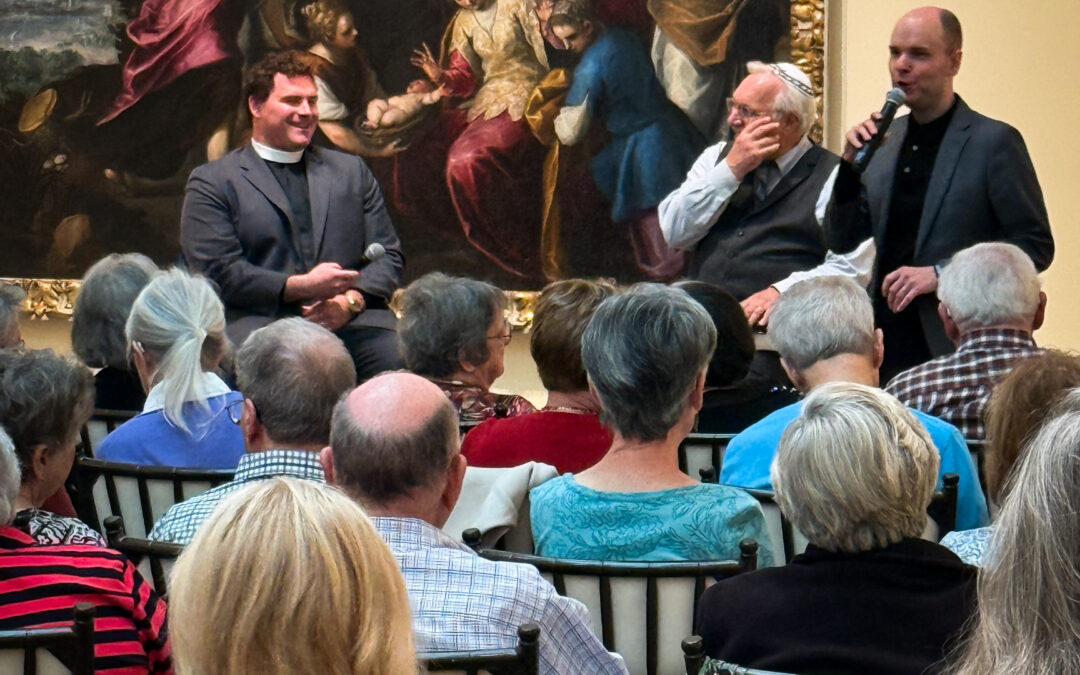

Earlier this year, our parish was blessed to welcome The Rev. Canon Leyla King as a guest speaker for our Lenten Adult Formation series, “Make No Peace with Oppression”. As a Palestinian-American Episcopal priest serving in the Diocese of West Texas, Rev. King shared the moving and often harrowing history of her ancestors, including her grandparents’ terrified flight from the region in 1948. She challenged our community to hear the voices of the “First Christians” and to rethink the historical and political narratives we have so often accepted about the Holy Land.
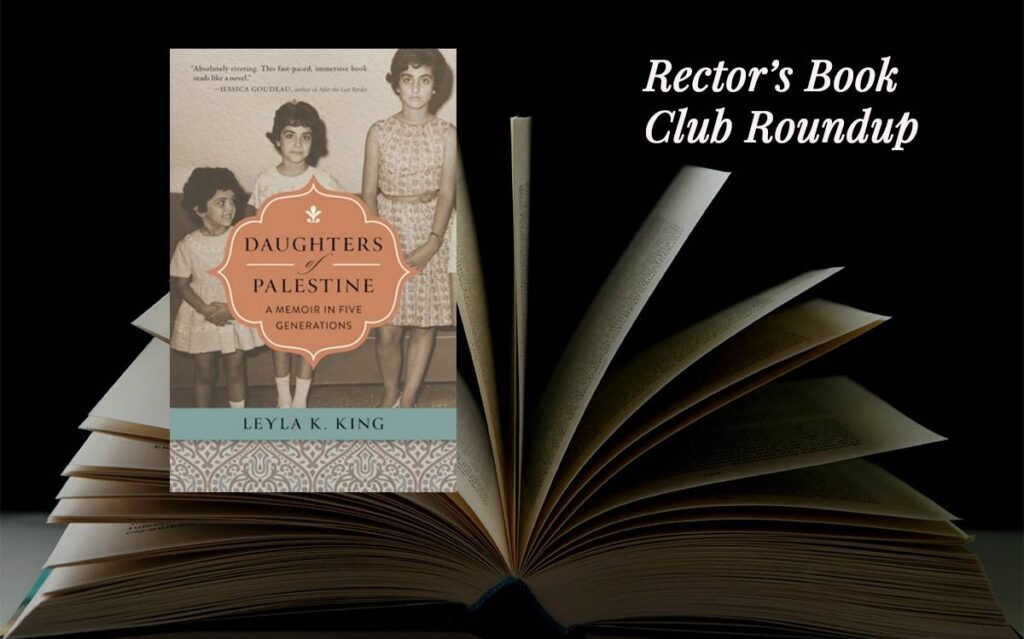
To deepen our understanding of this perspective, our most recent Rector’s Book Club gathered to discuss Rev. King’s memoir, Daughters of Palestine. The discussion was rich, challenging, and for many readers, personal, proving once again that engaging with complex truths is essential to our calling.
The Power of Personal Narrative
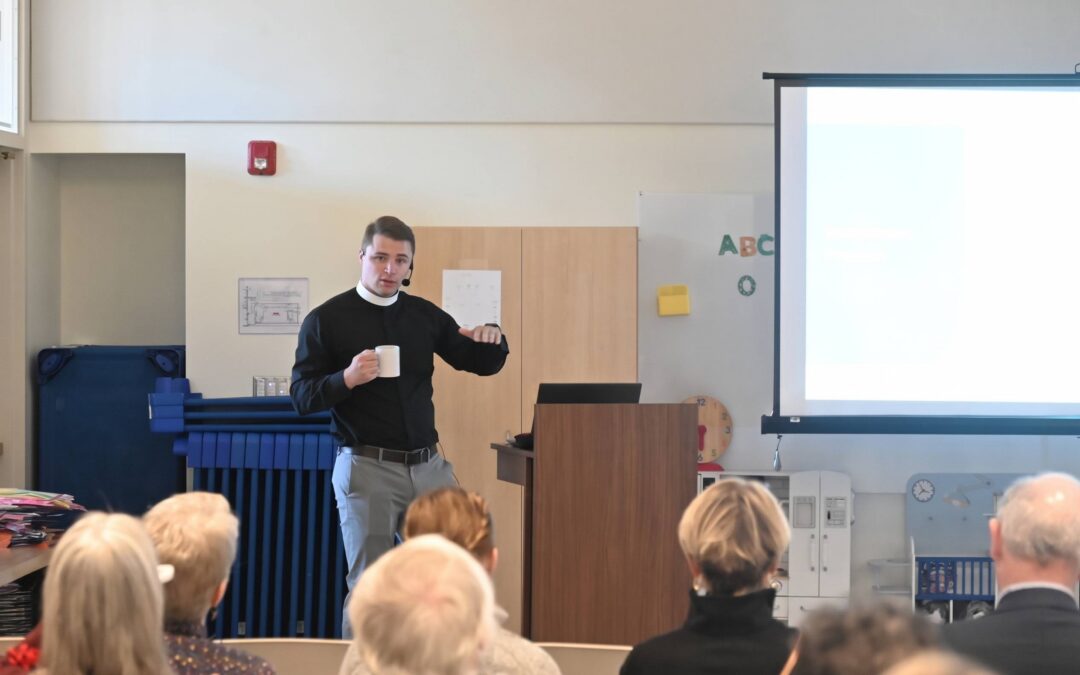
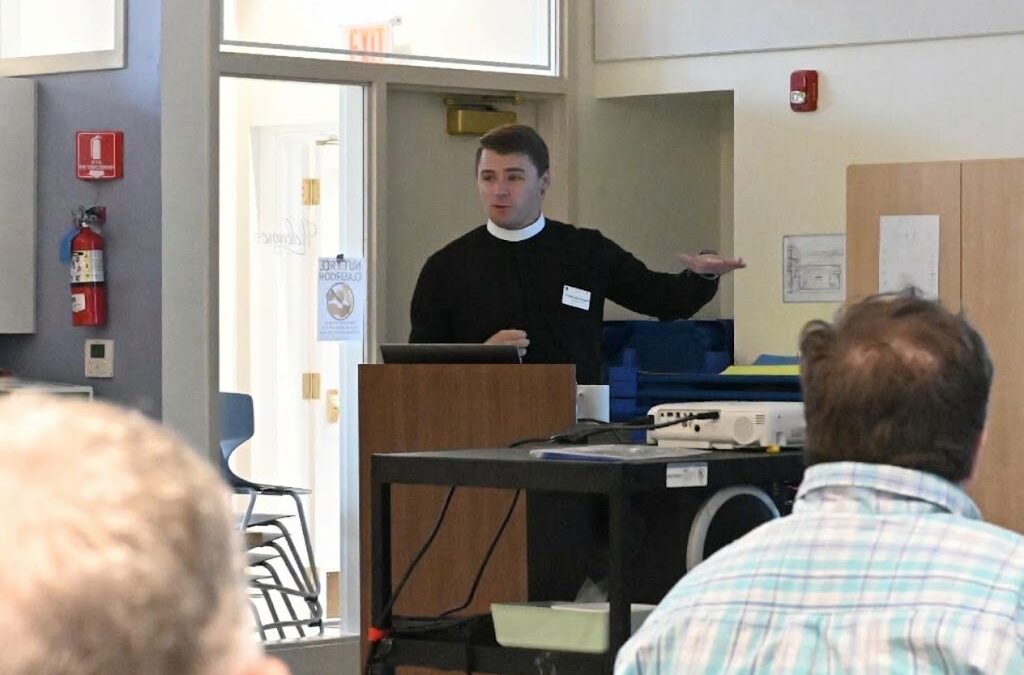
Fr. Noah Van Niel opened the conversation by noting the unique impact of the book’s format. Instead of a dry, dates-and-names political history, King offers an intimate window into the lived reality of her foremothers. “I was reminded in reading this just how much drama can be packed into a domestic life in terms of world events colliding with one’s normal daily activities,” Fr. Noah reflected. “It was a real testament to that kind of power that can exist within just our own stories.”
This sentiment resonated strongly with the group. One attendee observed that the historical record we consume is often skewed, saying, “history is usually written by the victors.”
By telling the stories of her grandmother and great-grandmother, King cuts through geopolitical noise. “I think that’s the power of the personal narrative,” another attendee said. “That’s the part that moved me… you can’t argue with the truth of her story.”
The group was particularly moved by the sheer fortitude of King’s ancestors. Reflecting on the harrowing journeys of these women, fleeing from Palestine to Lebanon, to Syria, and eventually to the United States, one attendee marveled at their grit. “I guess for me, it’s like, wow, that was heroic, and brave, and it took a lot of fortitude and grit to do that,” the attendee said, recognizing the immense resilience required to continually uproot one’s family in the face of danger. Another attendee lamented not asking these crucial questions of their own immigrant ancestors sooner. “I wish I had realized it younger.” Leyla King’s foresight to sit down with her grandmother twenty years ago with a mini cassette recorder to capture these stories was an invaluable gift, we agreed.
Intersecting Lives and Lost Harmony
For some in the room, the memoir felt remarkably close to home. One attendee with a Lebanese background reflected on the sections detailing the civil war in Lebanon, recalling stories told around their own aunt’s table. “This book was extremely personal to me. I felt my life kind of intersected with her life,” the attendee said. “When she was talking so much about this family, in my mind, I said, ‘I know all these people… I know these people’.”
A poignant theme that emerged from the text was the lost harmony of the Middle East before the mid-20th century. Attendees were struck by King’s descriptions of a time when Arabs, whether Muslim, Christian, or Jewish, lived peacefully as neighbors. “Everyone knew the faith and tradition of the families around them,” one attendee read from the book. “Such differences were honored and respected… I so wish we could have that, you know?”
The tragic shift from this coexistence prompted deep reflection.
Navigating Controversy and “Staying in the Room”
The book club did not shy away from the fact that discussing Palestine and Israel can be incredibly fraught. Several attendees shared their experiences of trying to discuss the conflict with neighbors and friends who hold staunch views on one side of the other, sharing the difficulty of navigating those relationships while disagreeing.
This led to a conversation about how to handle deep disagreements in our polarized world. Rather than cutting people off, the group discussed the necessity of maintaining connections even with people you may strongly disagree with. One attendee highlighted the danger of isolation, pointing out that “misinformation is being fired into democracy” to keep people at odds. They pondered the principle that when encountering radical or biased views, “under no circumstances can you cut someone off… because if you cut them off, they can go and find 10 more friends who will be more radical, who will reinforce that misinformation route.” The consensus was clear: “It’s so important to stay in the room with such people, even when faced with profound disagreements and difficulties, and to state them calmly, but respectfully, if it’s possible.”
Although to do so can sometimes prove impossible, we did agree. But that is the challenge of Christian listening, and Jesus was often instructive in how to navigate such difficult conversations without pouring gas on the fire.
From Fault to Responsibility
As the discussion turned toward the seemingly intractable nature of the Middle East conflict, Fr. Noah offered some insight into the desire to pass judgement on another person or group of people: Who did the worst thing first? How should they be punished? How should we punish the person who retaliated? And so on.
In the case of Palestine, the irony was not lost on the group that many of the people who displaced King’s family had themselves fled oppression in Europe. That did not mean that rolling barrels of explosives into King’s family’s neighborhood was acceptable. But the concept of the oppressed becoming the oppressor is an ancient one, Fr. Noah said.
“The sense of ‘whose fault is it’ can be intellectually satisfying, but ultimately not productive,” Fr. Noah explained. Instead of getting caught in endless loops of blame, he challenged the group to look forward: “If we can start to understand, get less hung up on whose fault it is, and try to reconcile that. And then instead try to find ways in which we can take some responsibility for that which was done. That, I think, is a more productive way to go forward.”
This shift reminded the group of the power of simply breaking bread together to overcome difficulties. “If you can share food with people… often by the end of the meal there’s just this weird shift,” one attendee said. Another attendee drew a direct line from this concept to our recent joint Lenten book study series with Second Calvary Baptist Church. “I just find myself thinking over and over again about the meetings with Second Calvary and how powerful it was to sit around tables together, to share stories and experiences, and to listen,” they reflected.
Leyla King’s Daughters of Palestine served as a mirror reflecting our own responsibilities as peacemakers in a fractured world. By exploring the intimate, domestic realities of a Palestinian Christian family, we were invited to see beyond the headlines and recognize the sacred humanity in our global and local neighbors. The book called upon us to listen, to stay in the room even when conversations get difficult, to embrace our shared humanity, and to actively take responsibility for building a more just and loving world, one story and conversation at a time.ocial media consumption, and filter it through these three vows. How does this action connect me to others? What force am I obeying? How is this helping me transform into the image of God?
Next week, Fr. Jared will be away representing our diocese at the Provincial Synod. In his stead, Fr. Noah will lead the class, shifting our focus to the Society of St. John the Evangelist to explore how another rich Anglican monastic tradition can offer practical tools for our daily lives. No matter what forces are currently steering your ship, it is never too late to chart a new, deliberate course toward a humbler faith and a more intentional life.