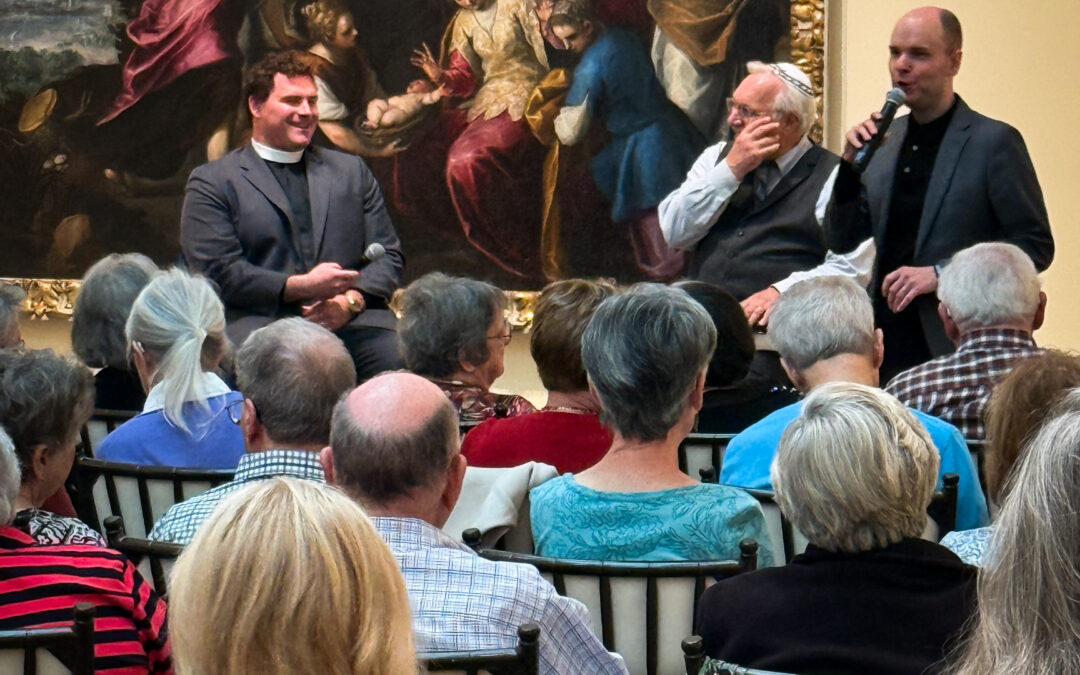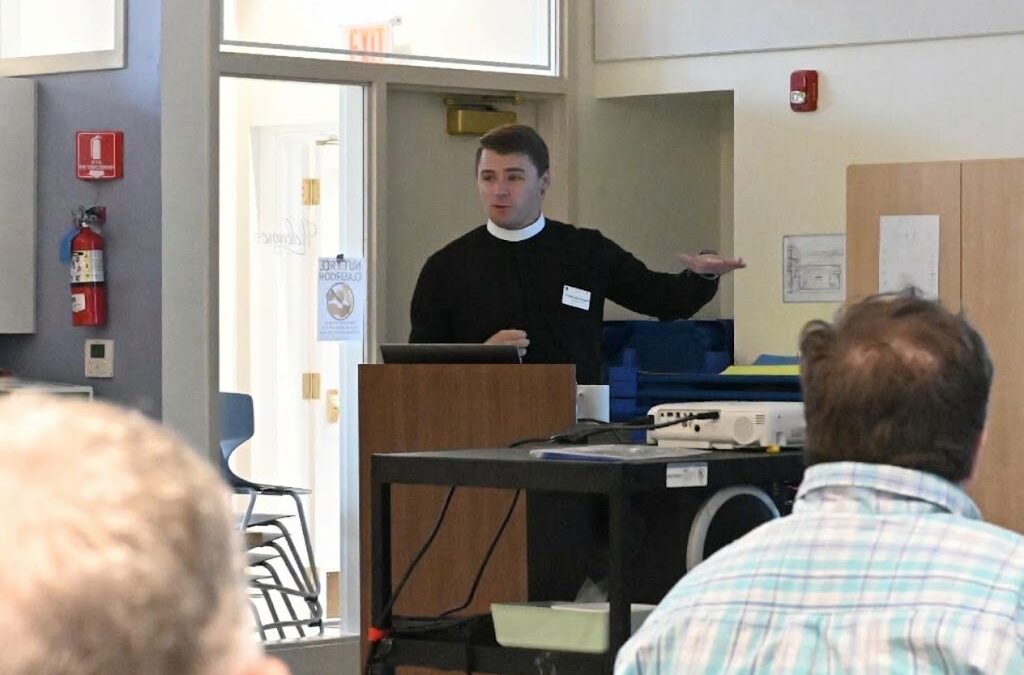

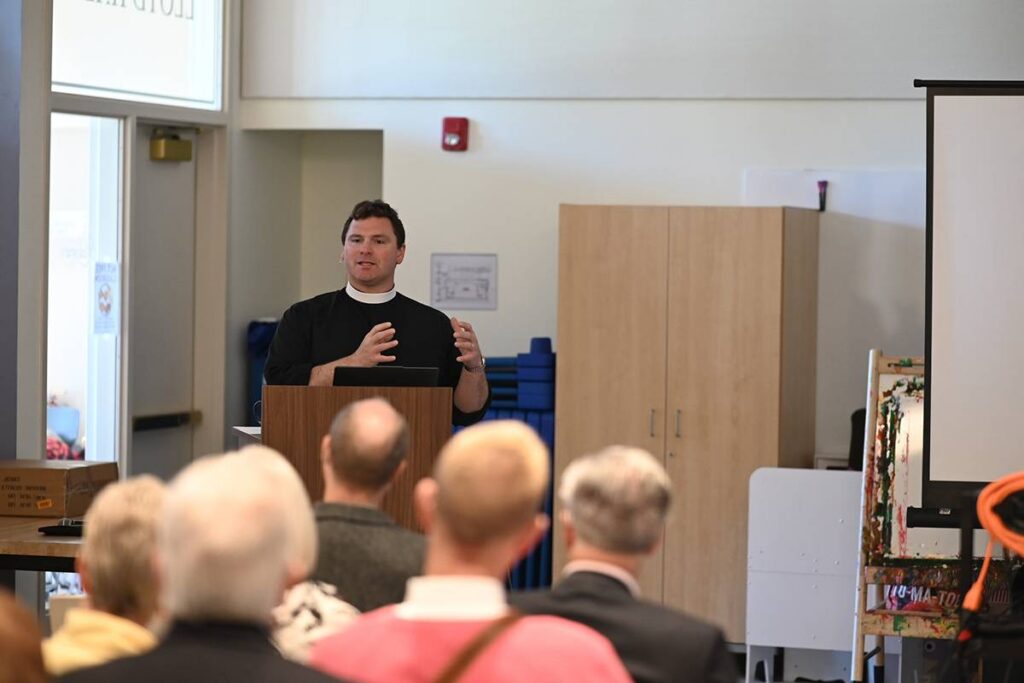
Over the past few weeks during our Eastertide Adult Forum, we have been exploring the ancient Christian practice of establishing a “Rule of Life.” We’ve filled out index cards to identify the forces steering our ships, and we’ve taken a whirlwind tour of the desert fathers and early monastic pioneers. This past Sunday, Fr. Noah Van Niel stepped in to lead the class, guiding us through the rich, and sometimes surprising, history of Anglican monasticism and introducing us to the living, breathing monasteries that still thrive in the Episcopal Church today.
The core premise of the session rested on a paradox: How can rules make us free? As Fr. Noah explained, adopting a certain amount of form and structure can engender a great deal of freedom for many people. He compared a Rule of Life to the bumpers on a beginner’s bowling lane. By providing safe boundaries, we can “throw the ball with a little less fear and a little less chaos.” Throughout Western Christian history, this wisdom of intentional, structured living has been captured most completely by monks and nuns.
A Brief, Dramatic History of Anglican Monks
We often think of monasticism as an antique creation, but it was fundamentally responsible for shaping Western Christianity. While the movement began with hermits in the desert and evolved into communal living under leaders like St. Benedict, monasteries eventually reached their apex in the High Middle Ages, producing spiritual giants like Bernard of Clairvaux, Thomas Aquinas, and Julian of Norwich. Monks and nuns essentially held the flame of culture and learning throughout the Dark Ages.
However, the monastic tradition hit a massive roadblock in the 1500s during the Reformation. After Henry VIII broke away from the Pope to form the Church of England, he took the highly consequential step in 1536 of dissolving all the monasteries and convents. He absorbed their land, their wealth, and their properties for the crown, wiping out the monastic presence in England. For about 300 years, to be a monk or a nun was considered strictly forbidden in the Anglican tradition.
It wasn’t until the 1830s and 40s that a revival occurred, thanks to the Oxford Movement. Led by Anglican priests like John Mason Neale and Edward Bouverie Pusey, , this movement sought to recover the “Catholic” elements of the faith like sacramental worship, chanting, incense, and vestments. But these thinkers weren’t just fancy theologians; they planted their churches in the poorest slums of England during the Industrial Revolution, mixing transcendent worship with a highly engaged social agenda.
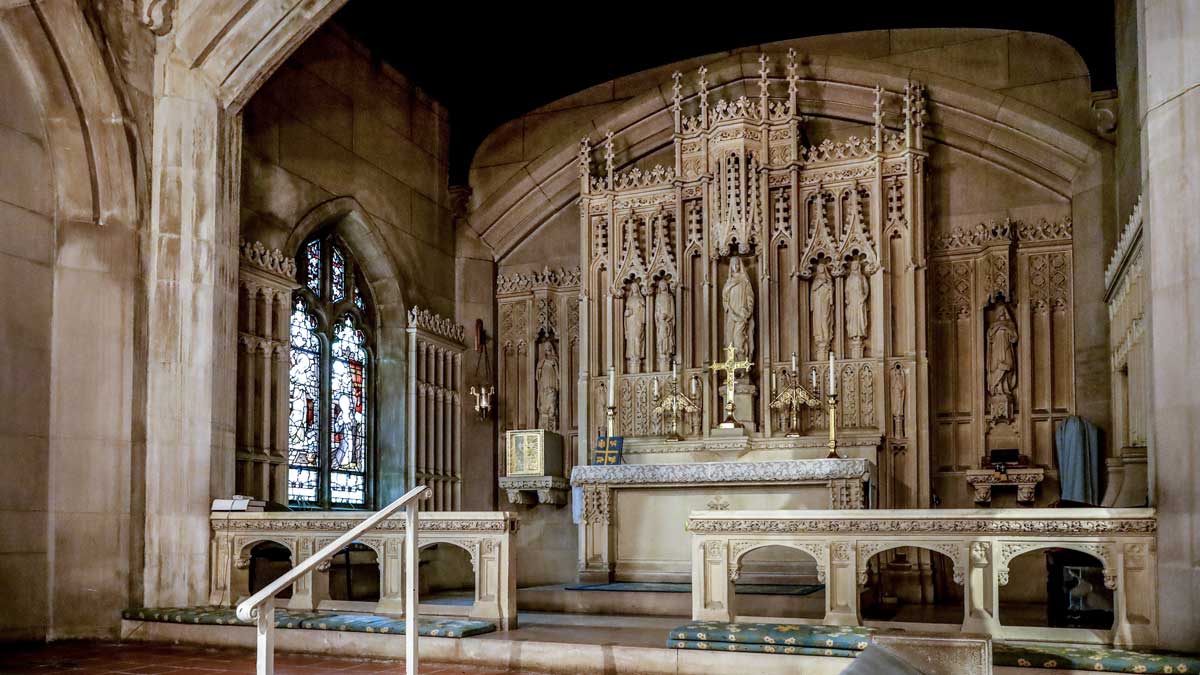
Fascinatingly, this movement also sought to recover Neo-Gothic architecture, which eventually inspired the building of our very own stone tower and sanctuary at Christ & St. Luke’s in the early 1900s. Along with the architecture and the incense, the Oxford Movement successfully revived religious orders for men and women, reestablishing monasteries and convents within the Anglican tradition.
Modern Monasticism: Alive and Well
Fr. Noah broke the illusion that monasticism is a relic of the past by taking the class on a virtual “show and tell” tour of four vibrant Episcopal monastic communities operating today.
- The Community of St. Mary (Sewanee, TN): A Benedictine order of nuns located near the University of the South. Along with their rigorous daily cycle of prayer, they run an Organic Prayer Program, inviting young interns to work in the gardens and experience a life guided by prayer, work, study, and rest.
- The Society of St. Margaret (Duxbury, MA): A coastal convent of sisters who balance their quiet, contemplative life with strong service connections to Haiti. Fr. Noah recalled how setting yourself apart in such an intentional way changes the atmosphere of a place, making it deeply restful.
- Holy Cross Monastery (West Park, NY): An Anglican Benedictine community of men known for its incredible hospitality and retreat ministries. This happens to be Fr. Jared Grant’s favorite retreat destination, and our late Fr. Jess Stribling even requested memorial donations be sent to this monastery recently.
- The Society of St. John the Evangelist (SSJE) (Cambridge, MA): Tucked gently off a busy road near Harvard University, this monastery was Fr. Noah’s spiritual home during his Divinity School years. He described the remarkable experience of walking off the noisy street into a stone sanctuary filled with chanting and incense, a community of men who possess remarkable clarity and peace.
Reimagining Poverty, Chastity, and Obedience
While the daily schedules of these monks and nuns might look different, they all share a variation on the three classic vows of the monastic life: poverty, chastity, and obedience. But as Fr. Noah read from the SSJE rulebook, we learned that these vows are far more nuanced than simply having no money or following strict orders.
Their vow of poverty is not just about giving up bank accounts; for SSJE monks, it is a spiritual renunciation of our culture’s obsession with individualistic fulfillment and private security. It is a daily call to surrender inner and outer riches and rely entirely on God’s grace. Their vow of chastity is a commitment to remain completely available to Christ, acknowledging that while it fosters a beautiful inner solitude, it also requires leaning heavily on the genuine support of the community through inevitable seasons of loneliness. Finally, their vow of obedience is not an excuse to abdicate personal responsibility or hide from the world. Rather, it is a loving consent to God’s will, ensuring that community life is never used as a shelter from claiming one’s own power as a child of God.
Building Our Own Rule
So, why does all of this matter for those of us navigating traffic, jobs, and families in Norfolk?
First, a Rule of Life is not a self-improvement plan designed to maximize your personal potential. As Fr. Noah pointed out, modern culture loves to hijack spiritual practices for individual gain, but a true Christian rule is meant to be an aid to life in community.
Creating and living a rule on your own is incredibly difficult. Unlike the monks at SSJE, we are not living in a controlled environment. We face interruptions, inconsistencies, and the very real demands of our families and our careers. Managing our desire to accomplish things and please others, while intentionally carving out space for God, requires an immense amount of grace and flexibility.
When asked during the Q&A if monks are holier than the rest of us, Fr. Noah offered a liberating truth. “They are hardly holier than us,” he smiled. “They’re just called to a certain way of living in relationship with God”
We may not be called to live in a cloister, but we are all called to intentional living. As Fr. Noah shared from the wisdom of the bishop who ordained him, who was also a monk, a tenet for any spiritual practice is simple: “Pray as you can, not as you can’t.”
As we move into the final weeks of our “Building a Rule of Life” series, we will begin the practical work of crafting our own frameworks for encountering God. Whether your rule involves five minutes of silence in the morning, a commitment to Thursday Lunch Ministry, or simply showing up to worship on Sunday, the goal is to create a rhythm that helps you abide in God’s presence, so that you can exude that love to the world and people around you.