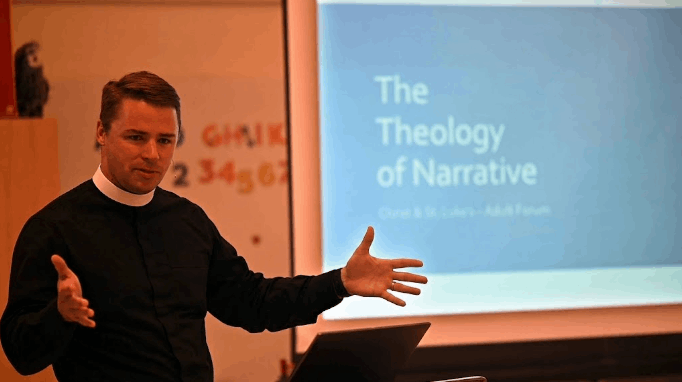

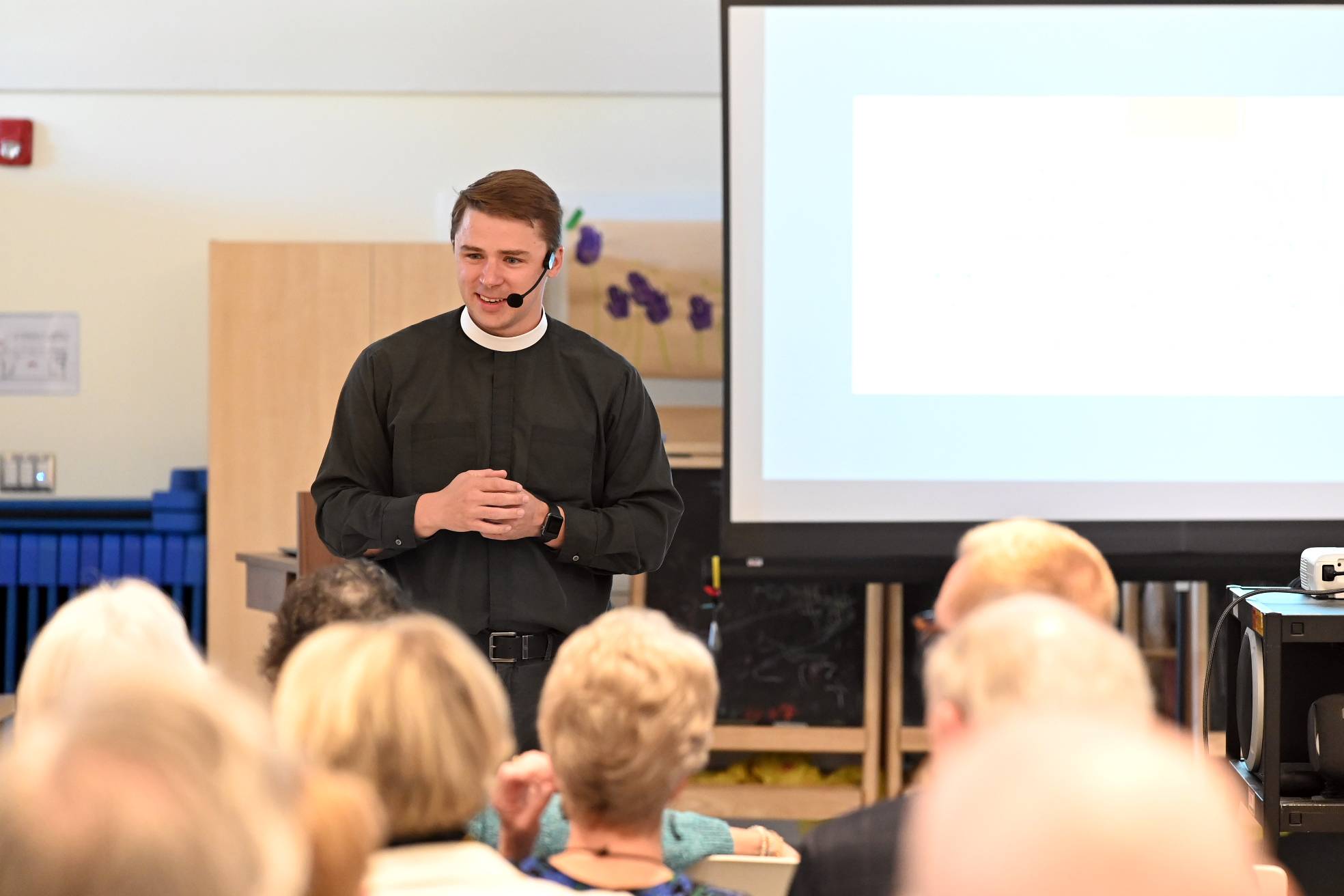
Fr. Jared Grant leading the first of six adult formation sessions on “Building A Rule of Life,” April 12, 2026 at Christ & St. Luke’s church.
Whether we realize it or not, unspoken rules already govern our daily lives. We have routines for how we get ready in the morning, habits for how we consume information, and boundaries for how we interact with our families. But the profound question we must ask ourselves as Christians might be: Do these unspoken rules center on Christ?
This Eastertide, a season bursting with new life and hope, we are inviting our community to bring some intentionality to our days. This past Sunday, a lively group gathered for the first session of our six-week Adult Forum, “Building a Rule of Life,” led by Fr. Jared Grant.
Fr. Jared kicked things off by asking everyone to pull out an index card and answer a rather vulnerable question on one side: “What force currently has the most influence in your life?”.
He gave the room a few minutes of quiet contemplation before asking for brave souls to share. The responses were remarkably honest, reflecting the very real challenges of navigating the modern world. While one parishioner beautifully noted that “the love of Jesus and Mother Mary” was their guiding force, others admitted to struggling with heavier burdens.
“Ennui… a listlessness,” one person shared. “Probably news and politics. Just doom and doom-scrolling,” another confessed, prompting knowing chuckles across the room. Answers like “inertia,” “dopamine,” and “self-preservation” highlighted how often our daily rhythms are dictated by mere survival or biological impulses rather than spiritual intentionality. Multiple people simply answered, “Family and their needs,” a reality many parents and caregivers in our community know all too well.
“Sometimes we’re not even aware of what’s going on,” Fr. Jared pointed out, validating these experiences. “We’re just kind of consuming.”
Then Fr. Jared asked the group to flip their cards over and answer a second question: “What force would you LIKE to have a bigger influence on your life?”.
People called out their hopes for a more spiritually grounded life. “Spontaneity, grace, and laughter,” one person shared. Another drew inspiration directly from Psalm 103, seeking more “tenderness… loving kindness… and tender mercies.” One parishioner perfectly captured the tension of the active Christian life, saying, “I am more of a Martha trying to do God’s work, but I want to be more of Mary and be more seeing the big picture of the spiritual side.” Other answers included “joyful diligence, also known as enthusiasm,” “peace and tranquility,” and the desire to make “deliberate, well-reasoned choices.”
“That is exactly what we’re talking about here,” Fr. Jared explained. “How do we get from this area where we have something in control of our lives that we are not super happy about… to that place where we’re making those well-reasoned choices that help guide through the chaos?”
The answer lies in establishing a “Rule of Life.”
But what exactly is a “rule”? When Fr. Jared threw the question to the room, the audience offered a variety of insightful definitions. People called it “a guideline,” “a path with boundaries,” and a “routine.” One parishioner noted that a rule is inherently “protective,” while another beautifully described it as “a living matter”.
Fr. Jared grounded the conversation in the rich monastic tradition of the Church, specifically pointing to the Rule of St. Benedict, written around 530 CE. While the word “rule” can sometimes sound restrictive or punitive, St. Benedict’s original vision aimed to be anything but. In his prologue, Benedict wrote that he intended to “establish a school for the Lord’s service,” famously promising to “set down nothing harsh, nothing burdensome.”
The purpose of a Christian rule is not to bind us in legalism; rather, it is designed to amend our faults, safeguard love, and ultimately help our hearts overflow with the “inexpressible delight of love,” Benedict wrote. As a footnote to Benedict’s text simply explains, “it is called a rule because it regulates the lives of those who obey it.”
While St. Benedict wrote his specific regulations for monks living together in a monastery, detailing everything from dormitory regulations to when to say ‘Alleluia’, the core ethos of a Rule of Life is for all of us. We may not be living in a cloister, but we are all called to live holy, intentional lives in our respective worlds.
To find the foundation for our own modern rules, Fr. Jared directed us to the primary source material: the Bible. When asked for examples of biblical rules, the room quickly brought up the Ten Commandments and the Sermon on the Mount. But Fr. Jared also highlighted a surprisingly beautiful source of Old Testament regulation: the Book of Leviticus. Often dismissed as a dry manual of ancient dietary and sacrificial laws, Leviticus also contains a profound, liberating truth.
“The book asserts that holiness is for everyone,” Fr. Jared noted, quoting Leviticus 19:2: “You must be holy because I, the Lord God, am holy.”
Leviticus is also the birthplace of the ultimate community guideline: “You shall love your neighbor as yourself” (Leviticus 19:18).
When Jesus was later tested by religious scholars about the greatest commandment, he didn’t invent a new rule out of thin air. He pulled from this deep, ancient tradition, pairing the command to love God with the command to love our neighbors. On these two rules, Jesus famously said, hang all the law and the prophets.
Perhaps the most eye-opening moment of the class was realizing how deeply these sacred rules are already embedded in our weekly worship at Christ & St. Luke’s. The liturgy we pray every Sunday is a regulatory force that shapes who we are. As Fr. Jared reminded us, the Eucharist is not just a lovely ritual; it is a direct command. When Jesus broke the bread and shared the wine, he gave us a clear, actionable rule: “Do this for the remembrance of me.”
Our Baptismal Covenant serves as another ready-made Rule of Life. When we stand before the congregation and promise to continue in the apostles’ teaching and fellowship, to persevere in resisting evil, to seek and serve Christ in all persons, and to strive for justice and peace, we are actively laying down the boundaries and aspirations for a holy life. We are committing to the sacred rhythm that we often summarize at Christ & St. Luke’s in four simple words: Come, See, Go, Be. We come into community to see the unconditional love of Christ, and then we go out into the world to be that restorative, liberating presence for others.
As the session ended, Fr. Jared left the group with a piece of homework: Keep your index card. Take it home. Put it on your fridge or use it as a bookmark. “Think about how you might answer that original question,” he challenged. “How do you get from the first side of the card to the second side?”
Our goal over these six weeks is not to hand out a rigid list of chores, but to equip our parishioners with the spiritual resources to build their own personal framework for encountering God. Whether your rule is as detailed as St. Benedict’s or as simple as “Come, See, Go, Be,” the intention is the same, to carve out space for the Holy Spirit amidst the noise of our lives.
We invite you to join us for the rest of this series, meeting on Sundays during Eastertide from 9:15 to 10:00 a.m.
Next week, we will dive deeper into the fascinating history of monasticism—a tradition that historians argue is as foundational to classical Christianity as the Eucharist, baptism, and the scriptures themselves.