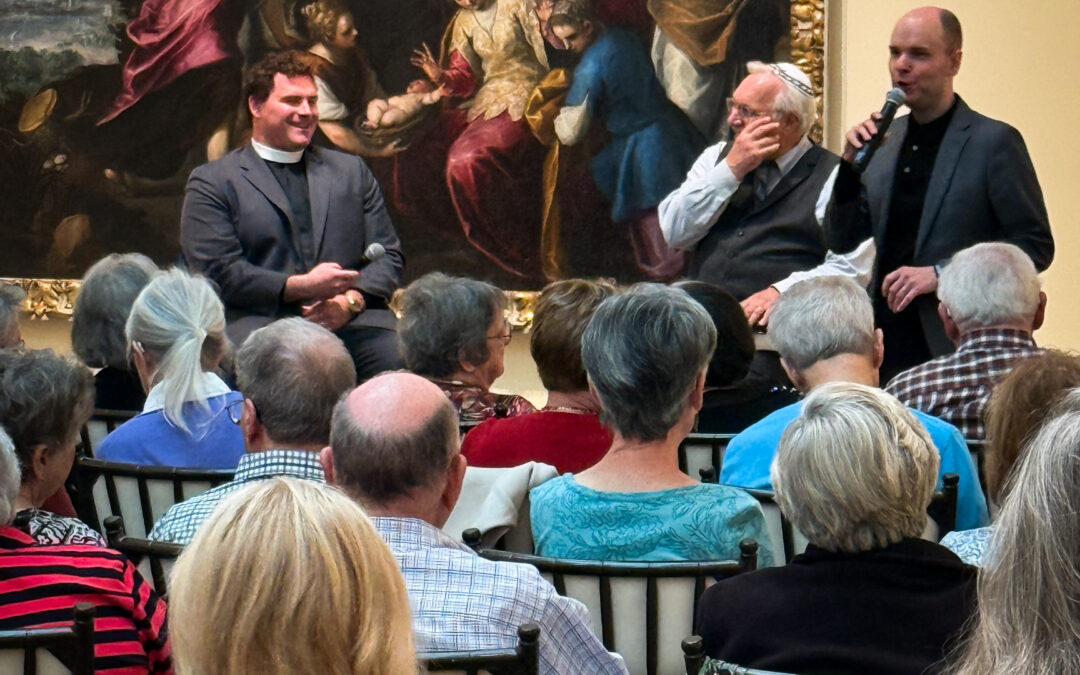

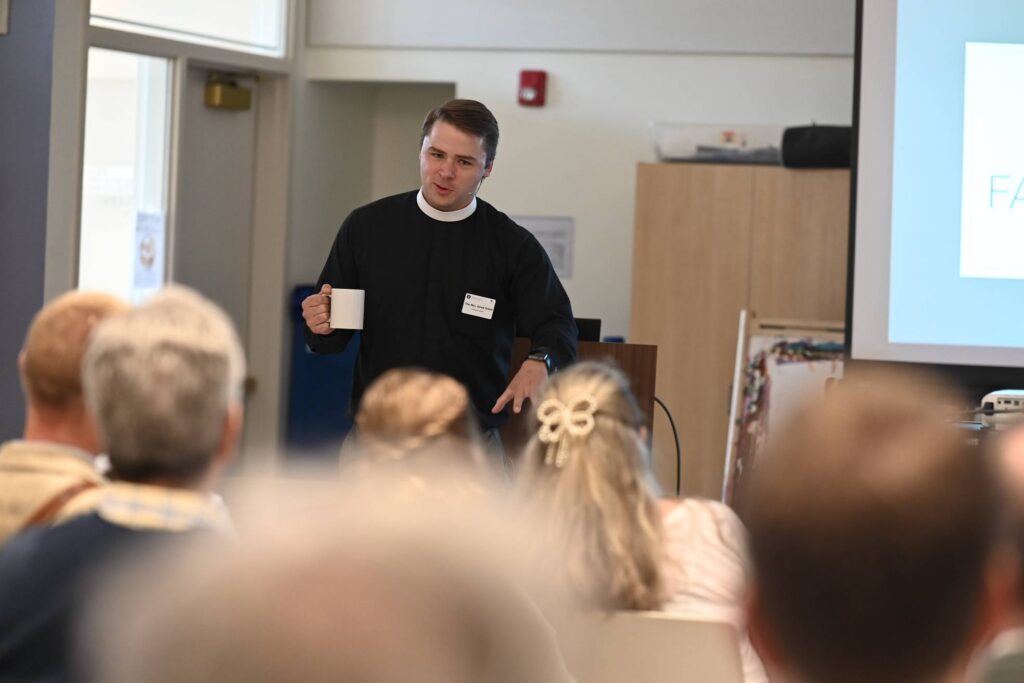
Fr. Jared Grant exploring monasticism at our adult formation class on Apr. 19.
This past Sunday, our lively Adult Forum gathered again to take the next step in “Building a Rule of Life”, looking back at the spiritual giants who blazed this trail.
Fr. Jared Grant opened the session by defining a rule using a humble footnote at the end of the prologue to the Rule of St. Benedict: “It is called a rule because it regulates the lives of those who obey it.”
This regulation is never meant to be a punishment. Instead, as the class discussed, these rules are designed to help us live in harmony and in community, with a clear understanding of what God is calling us to do and be. To understand the roots of this practice, we turned our attention to a surprisingly fascinating history: the ancient Christian tradition of monasticism.
The First Monks and a Runaway Cow
To understand how foundational monasticism is to our faith, we looked at a quote from church historian Robert Wilkin, who noted that monasticism is “among the oldest and most durable Christian institutions and must be reckoned as a distinctive mark of classical Christianity along with the Eucharist and baptism, bishops, creeds, and the canon of scripture.”
But where did this movement start? Wilkin tells a story in his book, The First Thousand Years, to frame the derivation of the word Monasticism.The English word “monasticism” derives from the Greek word monachos, which translates to “solitary”. The oldest surviving document to use this specific term is not a high-minded theological treatise, but a legal petition from around the year 320 CE: A farmer in Egypt named Aurelius Isidorus filed a complaint that his neighbor’s cow had repeatedly trampled his field. When the farmer caught the cow and tried to return it, the owner and his friends attacked him with clubs. The petition notes that the farmer would have been killed if “Deacon Antonius and a ‘monk’ named Isaac” hadn’t happened along the road to come to his defense.
Why were these early monks seeking solitary lives? As our class rightly guessed, they were looking to be “set apart” and avoid worldly influences. During the 300s, Christianity transitioned from a persecuted, underground identity to a legalized religion, eventually becoming the official religion of the Roman Empire. As the church became deeply entwined with worldly power and empire, many devout believers felt called to physically separate themselves from society to preserve the radical, counter-cultural nature of their faith.
The All-Star Lineup of Monasticism
While many of us could rattle off the names of famous monks like St. Augustine, the class took a whirlwind tour through the lives of the key figures who shaped the very concept of a Rule of Life. Parts of biographies below are taken from Lesser Feasts and Fasts, which is one of the Episcopal Church’s calendars of noteworthy individuals throughout Christian history.
St. Antony the Great: Traditionally regarded as the founder of Christian monasticism, Antony was born to a wealthy Christian family in Egypt. After his parents died, he heard the Gospel of Matthew read aloud: “If you wish to be perfect, go sell your possessions and give the money to the poor, and then you will have treasure in heaven. Then come follow me.”Feeling deeply convicted, Antony gave away his wealth and moved into the Egyptian countryside, dwelling alone in caves for 20 years. In 305 CE, he founded an early form of communal monastic life. St. Athanasius famously wrote that Antony was “like a physician given by God to Egypt,” noting that anyone who came to him full of anger was turned to kindness, and anyone troubled by doubts gained peace of mind. Antony saw the way Jesus called us to use our possessions for the common good, and he crafted a specific, highly intentional way of life to respond to that call.
St. Pachomius: While Antony lived largely in isolation, Pachomius is regarded as the founder of cenobitic (communal) monasticism and the author of the first formal, written Rule of Life. Born to a pagan family in 292 CE, Pachomius first encountered Christianity under dire circumstances: He was imprisoned as part of a forced military conscription. While in prison, local Christians visited the inmates, bringing them food, supplies, and comfort. Astonished, he asked why strangers were treating them so well, and the prisoners replied: “These people are Christians, and therefore they treat us with the love for the sake of the God of heaven.” Deeply moved, Pachomius was baptized upon his release. He eventually founded a vast federation of monasteries for both men and women, establishing a structured rule so they could live out their communal love together.
St. Benedict and St. Scholastica: Moving to the West, we looked at St. Benedict, who was educated in Rome during the chaotic fall of the Roman Empire. Disgusted by the political and social instability around him, he retreated to live an ascetic lifestyle near Lake Subiaco, eventually founding the famous Monte Cassino Abbey around 525 CE. It was there that he penned the Rule of St. Benedict, which remains one of the most influential spiritual documents in history. Interestingly, his twin sister, Scholastica, now the patron saint of nuns, started a parallel monastic tradition for women. Benedict’s rule was intensely practical, detailing everything from dormitory regulations to how to handle an excommunication, all to create a functional, deeply reverent community.
St. Francis of Assisi: Born in 1182 to a wealthy merchant, Francis famously renounced all his material possessions to become a mendicant friar. During a time when the Pope had explicitly declared that no new monastic rules were needed, Francis boldly crafted his own rule and successfully secured the Pope’s blessing. However, the intense poverty and suffering that Francis embraced was incredibly difficult to replicate. As the book Lesser Feasts and Fasts poignantly notes: “Of all the saints, Francis is perhaps the most popular and admired, but probably the least imitated. Few have attained to his total identification with poverty and the suffering of Christ.” This serves as a vital reminder that a Rule of Life is highly personal; what works for one spiritual giant might not be the exact path for you.
St. Augustine of Canterbury and Queen Bertha: Finally, we touched on our own Anglican roots. St. Augustine, a monk, arrived in Canterbury in 597 CE as the first missionary to the Anglo-Saxons. However, when he arrived, he found that King Ethelbert’s wife, Queen Bertha, was already a practicing Christian. Her private chapel, St. Martin’s, became the oldest English-speaking church in existence. Augustine would go on to become the first Archbishop of Canterbury, forever tying the monastic tradition to the roots of the Episcopal Church.
Charting Our Own Course
Why spend a Sunday morning talking about desert hermits and medieval monks? Because these pioneers recognized that the ambient culture of their day was pulling them away from God, and they took drastic, deliberate action to correct their course.
Over the next few weeks of this Adult Forum, we will make a pivot. We are moving away from the broad history of monasticism and stepping into the deeply personal work of crafting our own individual Rules of Life. You do not need to move to a cave in Egypt or take a vow of absolute poverty to be holy. But you do need to ask yourself: What deliberate, well-reasoned boundaries and practices do I need to put in place to ensure that Christ remains at the center of my days? How do I get from surviving the forces that currently control my life, to thriving under the forces of grace, tenderness, and love?
We invite you to keep pondering these questions and join us next Sunday from 9:15 to 10:00 a.m. as we dive deeper into the specific mechanics of St. Benedict’s rule to see what practical tools we can borrow for our modern lives.