
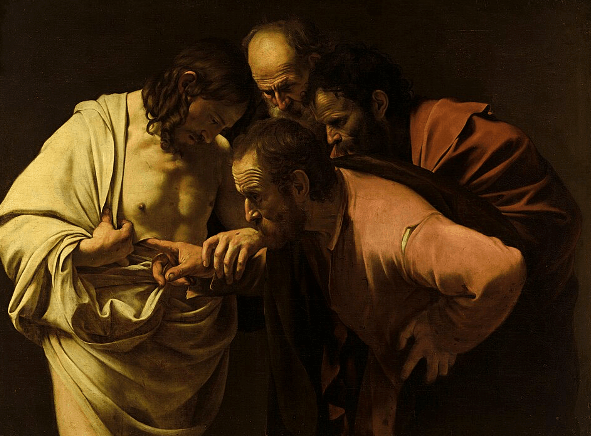
Caravaggio, “The Incredulity of Doubting Thomas,” 1602.
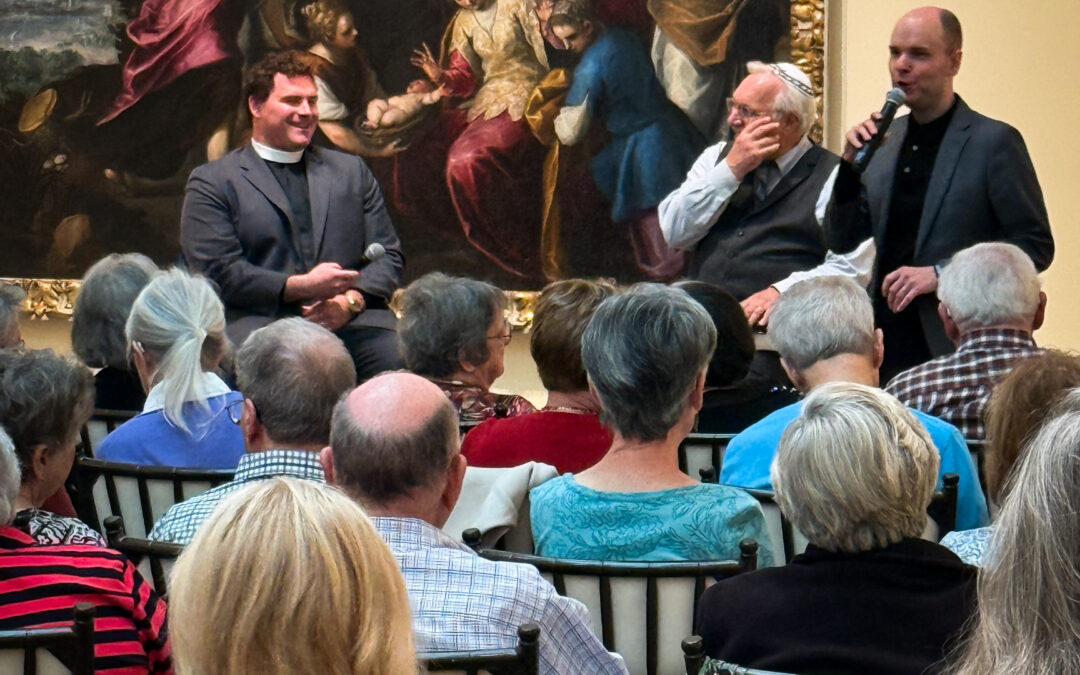
In this month’s Queer Theology Discussion Group, we focused on the story of Doubting Thomas in John 20: 19-31. We began with people’s past relationships with the story. Many had experienced the story as a cautionary tale of the shamefulness of doubt, while others of us had experienced something more in line with Fr. Jared’s sermon, with the story as a celebration of the welcoming of doubt in faith. From there, we launched into exploring various Queer readings of the text, reading ourselves first into the text as Thomas, and then in relationship with Jesus.
In discussing Thomas, we built off of an idea proposed by a non-binary, Queer Catholic blogger, Phoebe Carstens, who focused on Thomas’s experience of missing Jesus’s first visit, when Jesus volunteered the wounds on his hands and side as proof of Himself, and then on the “audacious” nature of Thomas’s “doubt” during the second visit. Carstens writes:
“I can only imagine how gutted Thomas must have felt when he heard the other disciples’ news of their amazing encounter with Christ. What might he have been thinking: Jesus just happened to pick his time to show up when everyone was around but me? Did he not care that I wasn’t there? Didn’t Jesus want to appear to me, too?”
So, when Jesus reappeared to the disciples again with Thomas present, Thomas only asked for what the other disciples had already received: Go witness his Lord and his wounds, to allow him to believe. He wanted to once again be able to touch his beloved teacher, whom he had thought dead. As Carstens points out:
“Perhaps his response… was not simply disbelief, but rather a sort of prayer. An audacious request indeed: Lord, I want to experience you for myself. I want to feel you with my own hands, see you with my own eyes.”
All the other disciples got this same proof in Jesus’s first visit, “the only difference is, Thomas had the audacity to ask.”
In this story, Thomas was the “queer” person in this gathering, the one who was left out and different from everyone else in the room. And he had the audacity, the courage, to demand to be included. And it was that which lit up the discussion in our circle, the bravery it took to speak up, to ask for what you desire, and even more boldly, claim that you belong in a space even while others are denying your existence or telling you to be silent. Members of our group shared experiencing homophobia. Many of us still persisted in being out, even at risk to ourselves, and even if it made others uncomfortable.
We discussed the importance of our little discussion group as a safe space for being queer, and that our group exists in the larger space of our church, which is likewise a safe space, where we don’t have to worry about being judged by our gender or sexuality. Almost everyone in our group found the church because of Christ & St. Luke’s’ clear messaging in banners and on their website that all truly were welcome, and their relief that the church lives out their promise.
As evidence of that, one ally member of our group, made note that to have a visibly queer, trans man, leading the procession as Crucifer, trusted as the Acolyte Master for our largely youth ministry, was for them a powerful signal that Christ & St. Luke’s was indeed a safe space for all as a church founded on love and community.
We then embarked on a queer reading of Jesus in the story through this photograph by Elisabeth Ohlson Wallin, in which she reimagined Caravaggio’s famous “The Incredulity of St. Thomas” painting …by casting a trans man, who has had top surgery, as Jesus, their top surgery scars standing in for the wound in Jesus’s side:
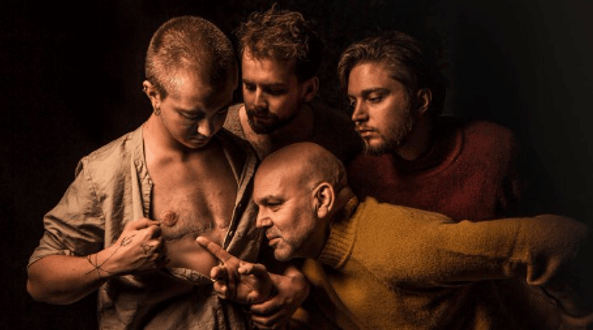
We first looked at this image, and people shared what they noticed, and I invite readers of this blog to do the same. What do you notice in the image? How does the image help you imagine the story differently?
People in our group observed how curious all the disciples looked, not just Thomas. Another person remarked on how in this image, Thomas is an older man than the rest, as if to have the bravery to ask for proof, he needed the benefit of wisdom and age. All remarked on how the young man placed in Jesus’s role looks so loving, gentle, and not at all annoyed or fearful of baring his chest. How he does so willingly, pulling aside his shirt with one hand while his other hand rests gently on Thomas’s wrist, guiding him to touch his scar. Jesus was, and is, His disciples’ teacher, and this was one more instance of Him teaching them and guiding them to belief. It is clear, in his face, that he does this out of love rather than out of a sense of resigned obligation.
In Thomas, asking to see the wound is like asking trans people for “proof” of their transness, or of any LGBTQ+ person to convince someone else of the truth of their experience and existence. This can be a wearisome burden, and can be destructive, as people come with assumptions of what makes someone really one gender or another, or if bisexuality is real, or if maybe someone who is a lesbian just hasn’t met the right man yet. Currently, in today’s climate, the toxicity and aggression of disbelief are most vehemently directed at trans people, where even for those people who claim allyship can also harbor misguided beliefs like that a person isn’t truly trans unless they have had gender affirming surgery and hormone replacement, as if fully passing is a more legitimate way to be trans.
The key thing in the story, and in this picture, is that Jesus loved Thomas. They were a chosen family. And so, when Thomas asked for help in understanding, Jesus offered him that openly and willingly. That is the same for all of us. When I was first transitioning, my friends and family had questions and didn’t always understand the difference between gender and biological sex. But they loved me, and I loved them, and so I made myself vulnerable to answer their questions.
But also, as Austen Hartke, a trans theologian, points out, but doing this, he also cautions that not all have the right to demand this of him or me or of any trans person, just as not all people could demand that same vulnerable proof from Jesus. Hartke wrote that, “Jesus made a decision to do something for Thomas because of the relationship they had. At the same time, Jesus set a necessary boundary to ground that relationship (and others) in love.” He set this boundary after showing his wounds by saying, “Have you believed because you have seen me? Blessed are those who have not seen and yet have come to believe.”
Jesus shares himself with Thomas because of their personal relationship. But Jesus was not going to go and appear to everyone in the world, one by one, year by year, to show them the proof of his resurrection. Ultimately, others needed to be able to come to a belief without direct proof. Similarly, it is not practical or safe for every trans person to go out and prove to everyone they meet that trans people exist and are human beings worthy of love. While having a person they love come out is a part of many people’s personal journey into coming to love and understand trans people, or gay people, we cannot wait for the whole world to personally know a trans person. Ultimately, we need allies who are able to trust in the validity of other people’s experiences without demanding proof or personal relationships.. Likewise, when an acquaintance at a party starts asking me to explain my existence to them, while their curiosity may be genuine, trans-people have every right to walk away from that conversation. I do not owe the world the emotional labor of teaching everyone about transness.
In this, while some others and I in our group come to this from a place of transness, we have every identity in our little group, but they, too, identify with the burden and toll of having others not believe you when you tell them who you are. And what a relief it is to be around those who do believe and honor who you are. In this, it was pointed out that in the second picture we looked at, the close-up of a hand touching a top surgery scar, the hand that was touching the scar was tattooed, and in this way, maybe also symbolized its bearer’s own “queerness” in defying normalcy, and thus broadcasting their safety as a friend and an ally. Their hand is marked just as the trans person’s chest is marked.
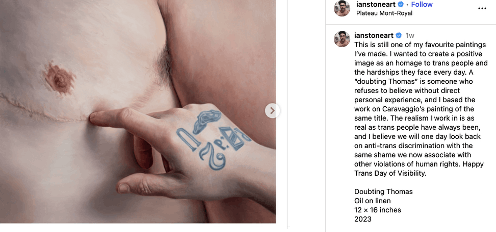
We finished our conversation by discussing how, unlike some narratives of the afterlife, where all “flaws” are removed when you ascend into heaven, Jesus bore his wounds when he was resurrected.
And so maybe this shows us that wounds are not flaws, but rather our scars are an essential part of who we are and what we have become.
Interested in Queer Theology? For more information on our Queer Theology Discussion Group contact Anders Nolan. All LGBTQIA+ people and allies are welcome.