
As we approach the culmination of our six-week Eastertide Adult Forum, “Building a Rule of Life,” we are making the pivot from theory to practice. Over the past month, we have explored the ancient history of monasticism, the wisdom of the Desert Fathers, and the structure of St. Benedict’s Rule. Last week, Fr. Noah Van Niel guided us through the living tradition of the Society of St. John the Evangelist and showed us examples of other Episcopal monks and nuns actively living out these vows today.
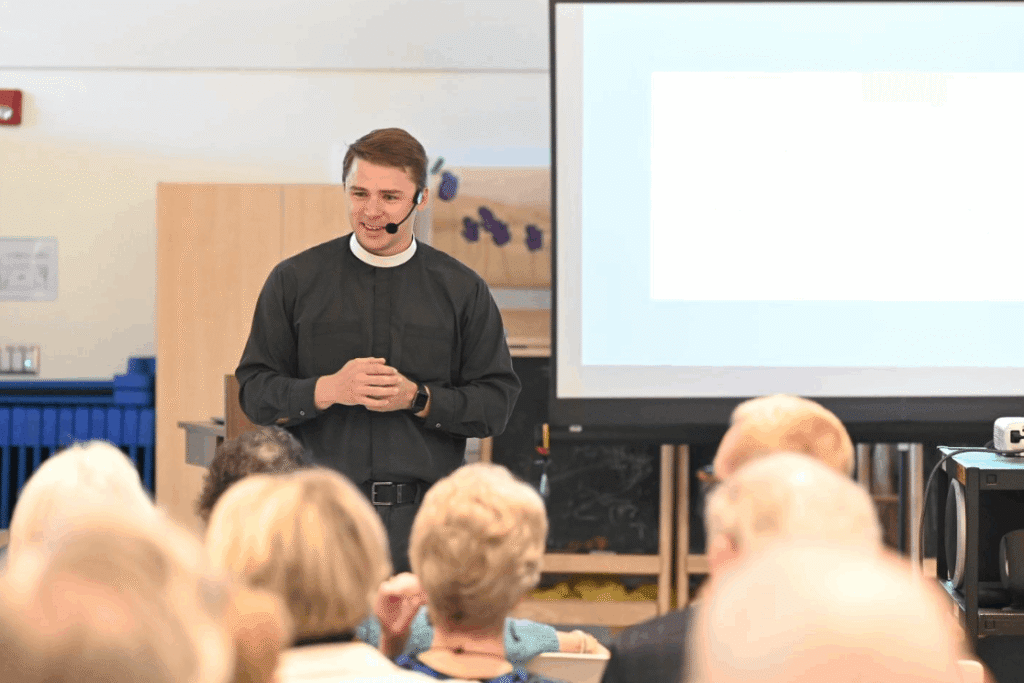
This past Sunday, Fr. Jared Grant returned to lead our fifth session, shifting our focus to the ultimate question: How do we craft our own Rule of Life? We are not moving into monasteries, but we are seeking a sacred framework to regulate our days, center Christ, and live more fully into our baptismal vows.
Translating Ancient Vows for Modern Lives
To help us bridge the gap between cloistered monks and our Norfolk lives, Fr. Jared drew heavily from the Associates Rule of the Order of the Holy Cross, an Anglican Benedictine monastery in West Park, New York, where he regularly retreats and where our own parishioner Anders Nolan is also an associate. For non-monastics, the traditional vows of stability, obedience, and conversion of life are translated into practical, daily commitments:
1. Stability: In a monastic setting, stability often means remaining physically in one community. For us, the Order of the Holy Cross defines stability as being steady and regular in our prayer life and in our obligations to family, work, and community. It means rooting ourselves where we are, engaging fully with the people God has placed around us, and not running away when relationships or circumstances get difficult.
2. Obedience: We often bristle at the word “obedience,” but in a Rule of Life, it is about giving ourselves over to the right forces. As Fr. Jared explained, we are called to listen for the voice of God speaking to us in sacred scripture, the traditions of the church, daily circumstances, and the words of others. Crucially, obedience means trying to translate that divine word into concrete action in our lives.
3. Conversion of Life: This vow is a commitment to remaining open to transformation. It requires reflecting on our lives through regular self-examination, believing that what God wants for every human being is growth towards the “fullness of the image in which we are made”—the Imago Dei.
A Counter-Cultural Calling
To support these vows, Fr. Jared outlined several core values that inform a Rule of Life: community, hospitality, humility, balance, and mindfulness. Finding balance, structuring our days so we are neither overworked nor unfulfilled, is notoriously difficult.
When discussing mindfulness and community, one class participant made a profound and honest observation. They noted that these concepts seem entirely counter-intuitive to the American values we are socialized into, values of individualism, getting ahead, and looking out for oneself. Viewing life through a community perspective requires a massive mental shift.
Fr. Jared agreed, offering a theological reorientation. As Christians, our primary identity must be that we are children of God. While we may love our country, our American identity, our professional ambitions, and our personal desires must all be filtered through our baptismal vows. Crafting a Rule of Life is the intentional work of deciding which forces we allow to guide us, ensuring our faith dictates our actions rather than the ambient culture around us.
The Disciplines: Building Blocks of Your Rule
So, what disciplines go into a Rule of Life? Fr. Jared shared a menu of practices from the Holy Cross Associates Guide that we can incorporate to support our values:
- The Holy Eucharist: The central act of our faith. Making corporate worship a priority allows us to reflect on Christ’s sacrifice, receive love as the gathered body of Christ, and find the energy needed to combat the world’s hardships with grace and mercy.
- The Daily Office: Anchoring our days in Morning, Noonday, or Evening Prayer. Fr. Jared mentioned resources like the Book of Common Prayer and the Mission St. Clare app, which organizes readings for you.
- Personal Prayer: Beyond corporate liturgy, we must find our own ways to talk to God. For some, this might be taking a hike, sitting quietly in nature, or finding solace in a quiet morning routine.
- Self-Examination: Using tools like St. Ignatius of Loyola’s Examen to check in on our actions. Are we remaining open to transformation? Where do we need to readjust?
- Study and Stewardship: Deepening our knowledge of the world and actively caring for God’s creation, including how we responsibly use our financial resources and spiritual gifts.
- Mission: Taking our God-given purpose and stepping out into the world to spread love and further God’s kingdom.
Spiritual Tools for the Journey
You do not have to do this work alone. Fr. Jared offered several practical tools to help maintain your rule. You might seek out a spiritual director, someone outside your usual pastoral relationships who can challenge you, guide you, and keep you accountable. You could keep a spiritual journal, which doesn’t have to be filled with words; for those who process the world visually, drawing is a beautiful form of prayerful examination. Finally, attending or forming a small faith-sharing group with fellow parishioners can provide the communal support necessary to sustain these vows.
During the Q&A, a participant jokingly asked if they could just copy someone else’s rule. While Fr. Jared acknowledged that monks technically do live by a rule they did not write, he stressed the profound spiritual value in personal ownership. Engaging in the hard work of self-examination to craft a rule specific to your life is a valuable process.
Another practical, slightly humorous question arose: “When is there time for watching television?”. Fr. Jared explained that a Rule of Life isn’t about achieving absolute perfection; It is about intentionality. Your rule might include a limit on media consumption, like deleting news apps from your phone or checking the news for only one hour in the morning so you aren’t perpetually consumed by the world’s chaos. Another participant summarized this ethos: “Stop multitasking… Be in the moment.”
Descriptive and Prescriptive
As the class wrapped up, Fr. Jared handed out copies of Growing a Rule of Life by David Vryhof, a workbook from the SSJE brothers. He left us with Vryhof’s summary of what makes a rule effective: A Rule of Life is both descriptive and prescriptive.
It is descriptive because it articulates our intentions and the beautiful, grace-filled way we want to live. But because we are human and will inevitably fall short, it is also prescriptive, showing us the exact, predetermined path to return to our original vision and reconnect with God. Above all, your rule must be simple, realistic, and achievable. You don’t need to write a rule to solve world hunger; you need to write a rule that helps you abide in God’s presence today.
The group’s homework after the session was to spend some quiet time with their workbook, answering the reflection questions, and drafting their own simple rule. Next week, we will gather for our final session to workshop our rules together, sharing resources and building accountability. Even if you couldn’t make the session in person and are catching up online, we hope you’ll download some of the resources linked to here and do some of the work to create your own rule of life.
No matter where you are in your spiritual journey, it is never too late to chart a more deliberate course toward God.
You can watch video of the session here: