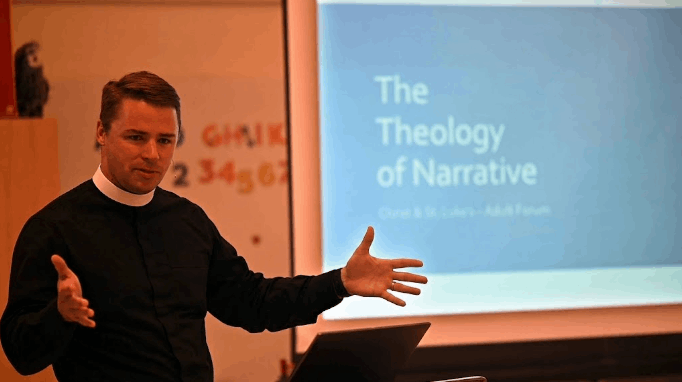

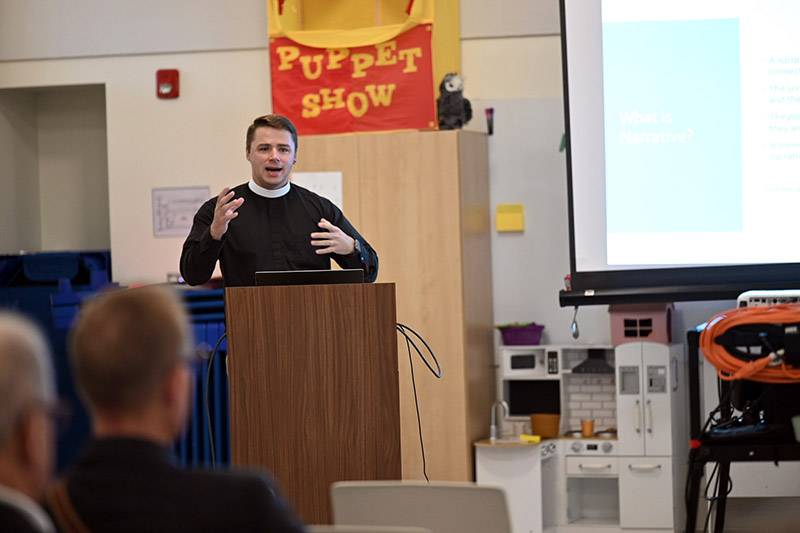
This week was the second installment of our narrative theology formation class. Father Jared Grant explored how Christians read, interpret, and inhabit sacred Scripture. If we want to engage with Scripture as a living story, we need to understand some history. There have been intellectual shifts in how we read the Bible over the years to get us here…and that’s what we explored.
The class started with an excerpt from Dr. Judy Fentress-Williams encouraging people to engage with the bible like poetry. She argues that when we read poetry, we understand that we must look beyond the literal characters. It’s about images, sounds, metaphors, and echoes. Reading the Bible is a bit similar. Poets deploy words and images that carry double or even contradictory meanings. Still, those tensions remain vital to the integrity of the poem. Poetry possesses a “surplus of meaning.” So you can never “master” a poem. Reading a poem demands ongoing participation and conversation from the reader. It’s the same with reading the Bible.
The Importance Of Context
Biblical narratives contain distinct literary elements that demand careful attention. But Scripture as a dynamic literary narrative places those elements in context. Father Jared shared a video to show how isolating short scenes distorts meaning. From The Bible Project, the video examines the story of Gideon in the Book of Judges. In an isolated reading of the Gideon narrative, the scene with Gideon laying out a fleece to test whether God will save Israel is frequently held up as a model for discerning God’s will. Isolated from its plot context, the scene appears to convey a simple formula. The Conflict: How can Gideon know if he will succeed? The Resolution: Test God, ask for a supernatural sign, and act upon the result.
But when you read the scene within the broader plot arc of Judges, a different portrait emerges. Viewed in its complete narrative movement, the story of Gideon is not a guidebook for discerning God’s will through signs. It is a narrative about God’s relentless commitment to work through deeply flawed, skeptical, and timid human beings.
Hundreds of small individual stories fit into larger movement arcs, which in turn form the macro-plotline of the Bible. For Christians, this unified overarching story finds its ultimate fulfillment and interpretive key in the person of Jesus.
The Historical-Critical Method and Its Enlightenment Roots
To help contextualize the importance of Narrative in modern Biblical Scholarship, Father Jared gave a brief history of biblical interpretation over the last 200 years, starting with the rise of the Historical-Critical method. Emerging out of the Enlightenment, historical criticism developed in conscious opposition to purely allegorical interpretations and the tendency to project modern assumptions onto ancient texts.
Quoting biblical scholar Moisés Silva, Father Jared noted that historical criticism insists on detailed linguistic and contextual analysis. Before we can apply a passage to our lives, we must first set aside modern prejudices and ask what the original author intended to communicate to their specific ancient audience.
While historical criticism provided invaluable tools for grounding Scripture in genuine human history, its Enlightenment origin also introduced a key vulnerability: A tendency toward rationalistic reductionism. By treating Scripture primarily as a historical artifact to be dissected for facts, the method frequently stripped the text of its living, spiritual, and narrative power.
Karl Barth’s Revolution: Seeing Beyond History to the “Eternal Spirit”
In the early 20th century, a Swiss parish pastor named Karl Barth published a revolutionary commentary on the Book of Romans that radically disrupted the academic establishment. At a time when historical-critical rationalism dominated biblical scholarship, Barth asserted that historical analysis was merely a preliminary step, not the ultimate goal of reading Scripture.
In the preface to the first edition of The Epistle to the Romans, Barth wrote: “The historical-critical method of biblical interpretation has its rightful place… But were I driven to choose between it and the venerable doctrine of inspiration, I would choose without hesitation to adopt the latter, which has broader, deeper, more important justification.”
Barth argued that the primary task of the interpreter is to see through and beyond history into the eternal Spirit of the Bible. Responding to intense pushback from academic critics in his second edition preface, Barth clarified that he was not eliminating historical criticism, but rather rejecting its limitation to mere historical pragmatism. He noted that modern commentaries often offered little more than archeological reconstructions, precise Greek translations, and philological notes, stopping short at the very boundary where true theological commentary ought to begin.
For Barth, genuine historical understanding is an uninterrupted conversation between the wisdom of yesterday and the wisdom of tomorrow. Historical texts must remain in active, living dialog with contemporary readers.
Rudolf Bultmann: Presuppositionless Exegesis and Demythologization
Following Barth’s opening salvo, his contemporary Rudolf Bultmann took the critique of historical criticism in a very different direction. In his essay, “Is Exegesis Without Presuppositions Possible?”, Bultmann answered with a resounding no.
Bultmann argued that no reader approaches a text as a blank slate; everyone brings an implicit worldview. To distinguish key terms in theological interpretation: Exegesis is to draw meaning out of the biblical text through careful interpretation; Eisegesis is illegitimately reading our own external assumptions into the text.
While Bultmann acknowledged that objectivity remains the formal goal of exegesis, he insisted that readers cannot simply suppress their modern scientific worldview. Operating from a modern scientific framework, Bultmann posited that history is a closed continuum of cause and effect that cannot be ruptured by supernatural interventions or miracles.
Consequently, Bultmann advocated for stripping away ancient mythological concepts (such as a three-decker universe or miraculous interventions) to recover the core existential proclamation (‘kerygma’) of the Gospel. For Bultmann, historical detail mattered so little that the historical reality of Jesus could be reduced almost entirely to what the German calls das (“that”)—the bare fact that Jesus existed.
C.S. Lewis: In Defense of Narrative and Metaphor
Many Christian thinkers strongly resisted Bultmann’s radical demythologization project. Among the most eloquent defenders of narrative was C.S. Lewis. Lewis recognized that human language and spiritual reality are inextricably bound to metaphor, imagery, and narrative form. Countering the attempt to strip away biblical symbols in favor of abstract philosophical propositions, Lewis observed: “We are invited to restate our belief in a form free of metaphor and symbol. And the reason why we don’t is that we can’t.”
For Lewis, narrative and metaphor are not decorative wrappings that can be discarded to extract a kernel of abstract truth; they are the essential, constitutive means by which divine truth is conveyed to human imagination and intellect.
Hans Frei: Reclaiming Biblical Narrative from the “Eclipse”
Another prominent theologian working to reclaim Biblical Narrative was Hans Frei, particularly through his landmark studies The Eclipse of Biblical Narrative and The Identity of Jesus Christ.
Frei analyzed how biblical interpretation underwent a fundamental shift between pre-critical and post-critical eras: Pre-Critical Readers accepted the literal, realistic narrative as depicting the real world; linked stories through typology. They saw their own lives as directly located inside the ongoing story world of the Bible from Creation to Eschaton. Meanwhile, Post-Critical Readers separated depiction from historical fact; dissected stories to find underlying non-biblical facts or moral ideas. They treated the biblical world as merely an isolated, ancient episode in world history with little direct connection to today.
Frei argued that 18th- and 19th-century scholars, in their obsession with proving historical facts or isolating abstract doctrines, caused the actual storyline of Scripture to go into “eclipse.” To recover from this eclipse, Frei proposed that Christian theology must return to the narrative text itself to answer two fundamental questions: Who is Jesus? And: What is he like?
Rather than reconstructing a speculative “historical Jesus” behind the text, Frei demonstrated that Jesus’ identity is rendered in and through the gospel narratives themselves. His character, intentions, and identity are inextricably woven into the specific actions, interactions, and passion events recorded in the realistic narrative of the Gospels.
As Father Jared highlighted, Jesus becomes our epistemology—our primary way of knowing who God is and how we are to interpret the rest of the biblical canon.
Biblical interpretation is not a static monologue locked in the past, but an active, ongoing conversation across time. By applying tools of narrative criticism—examining plot architecture, character development, conflict, setting, implied authors, and narrative point of view—we learn to read the text with literary precision while remaining open to how the Holy Spirit speaks through the story today.
Living Inside the Ongoing Story
As Father Jared concluded the session, the overarching practical takeaway of narrative theology became clear. Narrative theology does not ask us to choose between history and faith, nor does it ask us to reduce Scripture to moral maxims. Instead, it invites us to step back into the world of the biblical story.
When we read Scripture as a realistic, continuous narrative centered on the person of Jesus Christ, we cease viewing the Bible as an ancient, dusty record of past events. Instead, we discover that the grand narrative of Scripture stretches from creation through redemption to the present moment.
As we continue our parish theme of “God’s Story, Our Story,” narrative theology reminds us that our personal lives, our parish community at Christ & St. Luke’s, and our modern world are not isolated observers standing outside the text. We are active participants living within the ongoing, unfinished, and glorious story of God’s redeeming love.
—Adult Formation meets every Sunday morning during the program year from 9:15 a.m. to 10:00 a.m. in Lloyd Hall. Come grab a cup of coffee, bring a friend, and join the conversation!