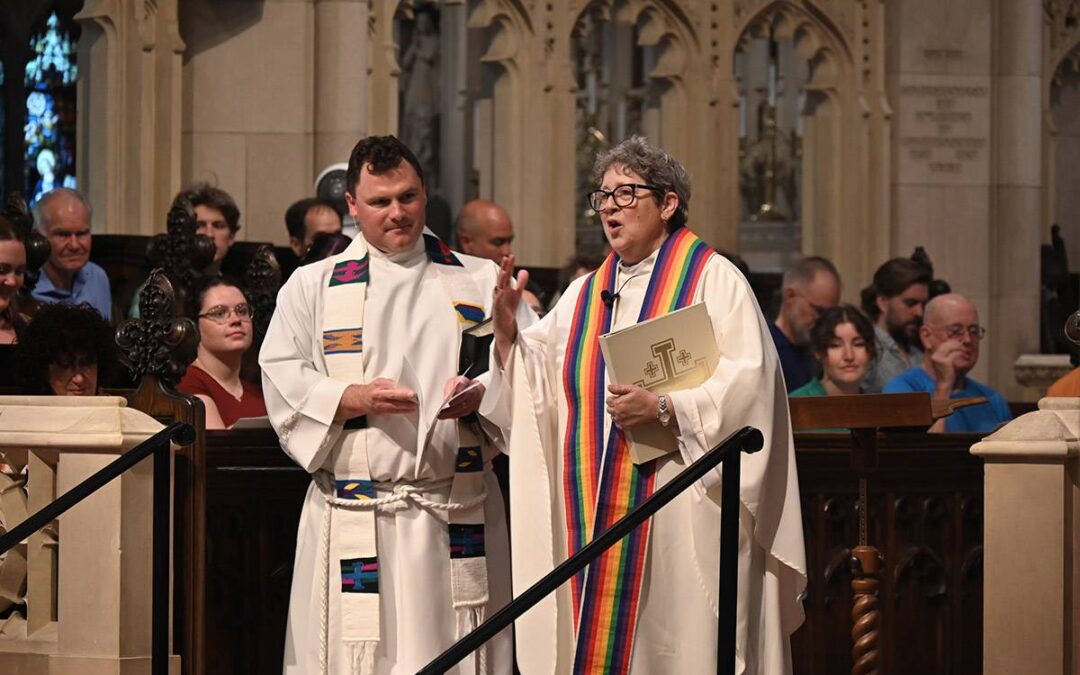

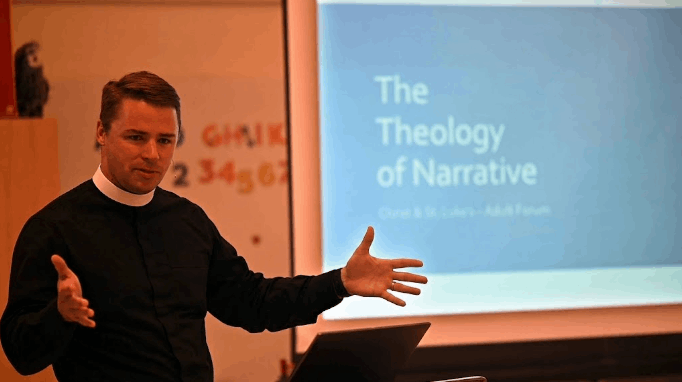
This past Sunday, Fr. Jared Grant kicked off a new, five-part adult formation series about Narrative Theology. He began the session with an invitation: “Turn to someone next to you. What are your favorite stories?”
Parishioners’ responses included The Odyssey, Mary Shelley’s Frankenstein, and James Bond movies. Someone mentioned Lord of the Rings. Another person talked with amusement about the time they shaved off their eyebrows!
Next, Fr. Jared asked: “What does that particular story tell you about your world?”
Stories are more than just entertainment. They are the primary lenses through which we interpret reality. They help us understand our own identities. They help us enter the experiences of others. A great narrative can pull us completely out of our isolated worldview. It can expand our empathy or even alter who we are as human beings. Fr. Jared pointed out that narrative comes in all shapes and sizes. A story can be a sprawling, multi-volume epic, or it can be brief. In scripture, for instance, the book of Jonah spans only 48 verses.
To show how narrative also conveys perspective, Fr. Jared shared a short comic strip by artist Nathan Pyle. In the comic, two eagles sit sipping tea. One eagle asks, “Do you think the owl is a predator?” The second eagle responds, “Of course not.” The first eagle nods in agreement: “Exactly… No idea what Mr. Mouse was going on about.”
So, the subjective perspective of every narrative shapes it. An audience member mentioned Akira Kurosawa’s film Rashomon. In it, four different witnesses describe the exact same event in contradictory ways. Fr. Jared reminded us that no human storyteller is neutral. We bring our own biases to every story we tell and hear. For people of faith, there are more questions: Which narratives are shaping our lives? Where are those stories true, and where might they be false or misleading?
To give us an intellectual framework for the weeks ahead, Fr. Jared unpacked the two core words that form the title of our series: Narrative and Theology. Citing The New Interpreter’s Bible, he offered a classical definition of narrative:
“A narrative is the telling by a narrator to an audience of a connected series or sequence of events. The series of events involves characters and their interrelationships, and the events occur in a place or places which we call the setting. And the plot is the events selected in the particular order in which they are presented.”
He then introduced us to narrative theory. It’s the formal academic study of narrative structure. According to the narrative theory program at Ohio State University:
“Narrative theory starts from the assumption that narrative is a basic human strategy for coming to terms with fundamental elements of our experience, such as time, process, and change…”
Next, Fr. Jared turned to theology, the study of God and God’s relationship to the world. He shared a quote from theologian Frederick Buechner:
“Theology is the study of God and his ways. For all we know, dung beetles may study us and our ways and call it humanology. And if so, we would probably be more touched and amused than irritated. One hopes that God feels likewise.”
When we combine these two fields, we arrive at Narrative Theology. It is the study of how narrative and story reveal the nature of God and God’s relationship with the world. Narrative theology recognizes that God chose to reveal him-or-herself most through story. Then, Fr. Jared walked us through the “Architecture of Theology.” It’s an outline by renowned scholar Alastair McGrath. In it, traditional academic theology is often broken down into five distinct pillars:
- Biblical Studies (the foundational examination of scripture).
- Systematic Theology (the structured organization of doctrines, such as the Nicene Creed).
- Philosophical Theology (engaging faith with logic and philosophical frameworks).
- Pastoral Theology (applying faith to practical human care and lived relationships).
- Church History (tracing the witness of the church across time).
While these academic categories are helpful, Fr. Jared highlighted that 60% of the Holy Bible is presented as narrative. God did not hand humanity a systematic theology manual, dropped from the sky. God gave us a library filled with narrative stories.
Referencing Alastair McGrath’s analysis of C.S. Lewis, Fr. Jared noted that Lewis argued that the Christian story is of primary importance. Doctrines, Lewis argued, are secondary. Doctrines appeal to the intellect, but story appeals to the imagination. When we reduce faith to intellectual propositions, we risk dulling it. Furthermore, narrative theology sits at the very heart of the Incarnation. The central claim of the Christian faith is that God did not remain at a distant remove. God entered human space and time. In the person of Jesus Christ, God’s story intersected our human story in the most intimate way possible.
Fr. Jared closed by addressing the inherent tension between our perspective and God’s truth. 20th-century theologian Rudolf Bultmann attempted to “demythologize” the New Testament. He wanted to strip away its symbols and stories to find bare intellectual concepts. But C.S. Lewis offered a brilliant rebuttal:
“We are invited to restate our belief in a form free from metaphor and symbol. The reason we don’t is that we can’t.”
We cannot strip away the story. Because human beings are wired for story. It is through story and parable that the infinite mystery of God becomes knowable for us.
If you’d like to watch a video of the session, it’s on our YouTube channel here.
—Adult Formation meets every Sunday morning during the program year from 9:15 a.m. to 10:00 a.m. in Lloyd Hall. Come grab a cup of coffee, bring a friend, and join the conversation!