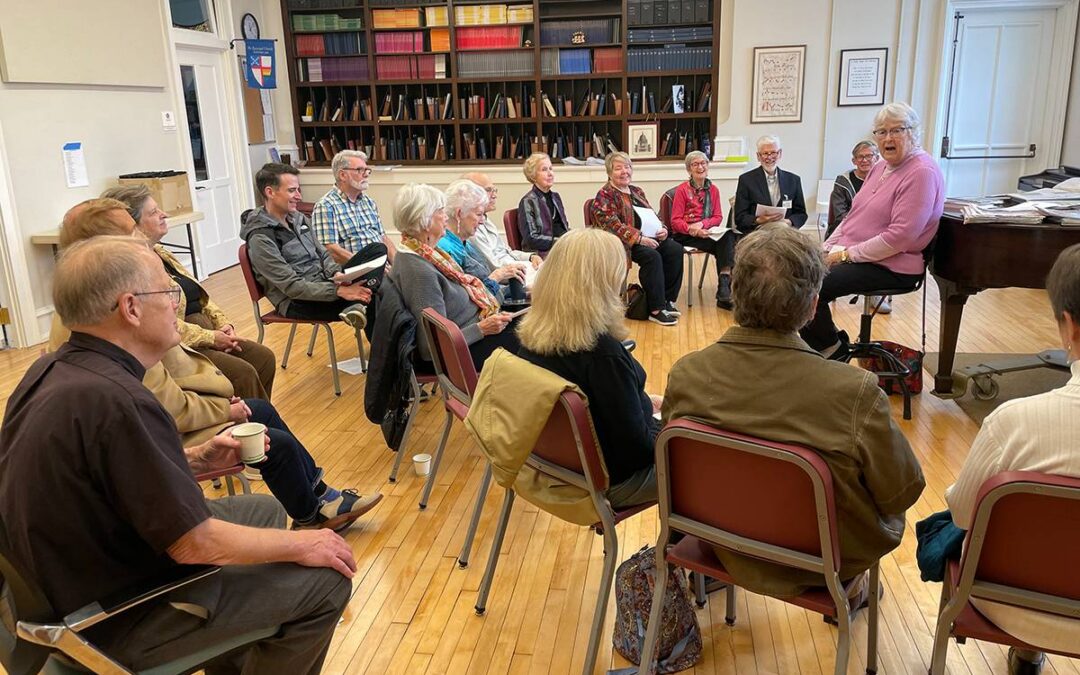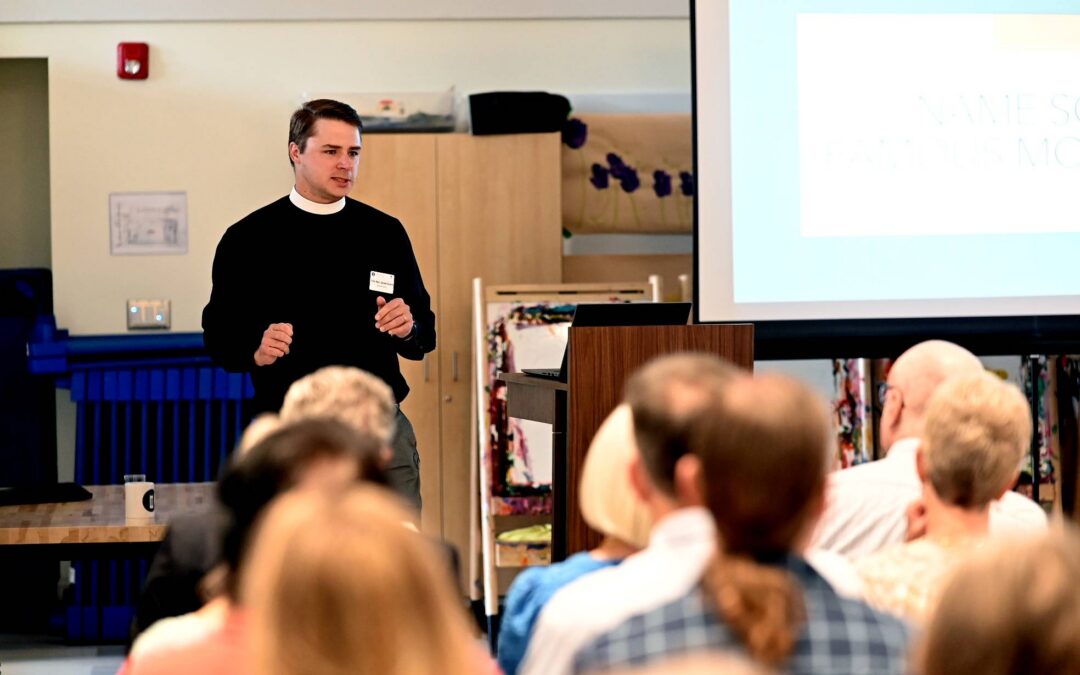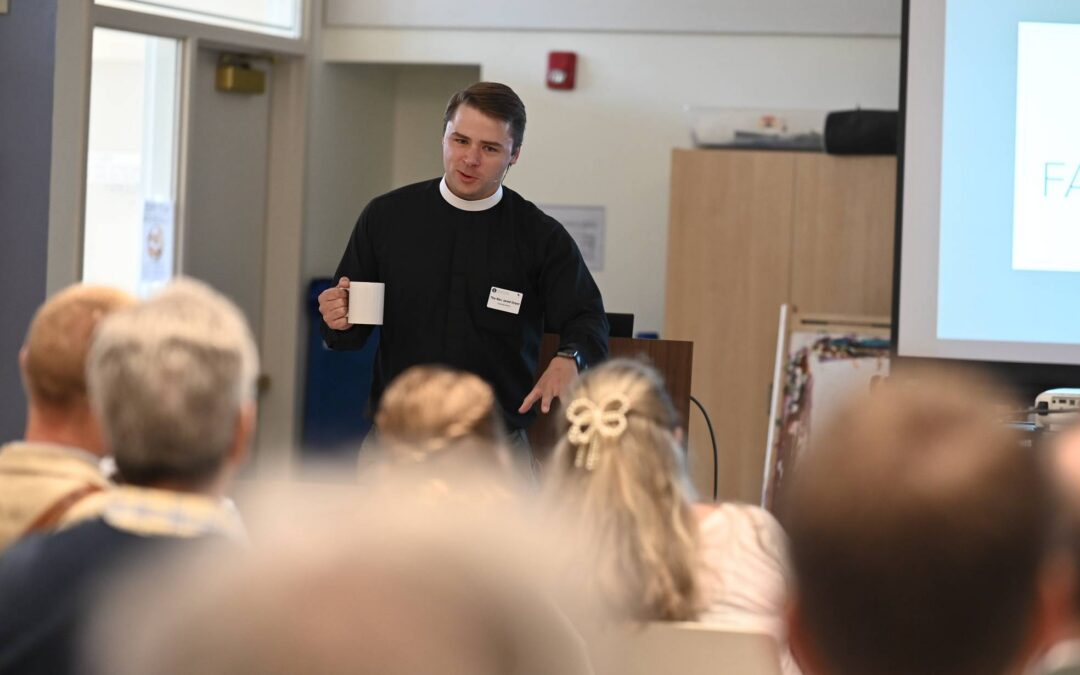

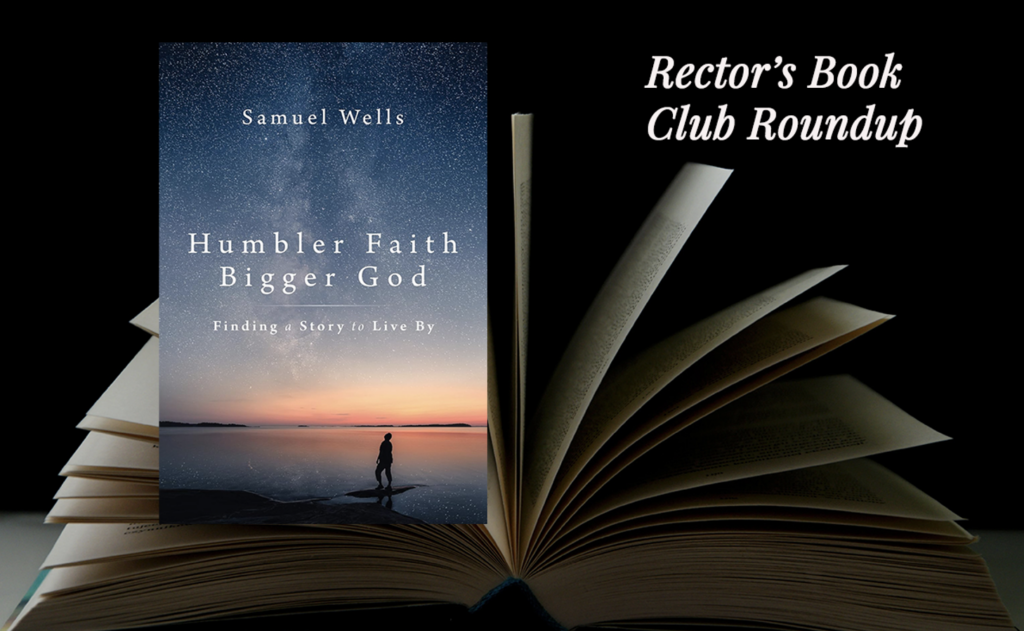
Our February Rector’s Book Club gathering invited us to step into the uncomfortable but deeply necessary and exciting space of self-examination when it comes to our faith. Guided by Fr. Noah, our group spent a Friday afternoon wrestling with the dense, challenging, and profoundly rewarding ideas found in Humbler Faith, Bigger God by Sam Wells.
Wells, the former Dean of Duke Chapel who currently serves as the Vicar of the historic St. Martin-in-the-Fields church in London, brings a unique perspective to theological writing. Having served in both the highest levels of the academic world and now, being deeply embedded in parish life, Wells attempts to rigorously engage with the modern world’s harshest criticisms of Christianity. The core premise of the book, reflected perfectly in its title, is that holding onto Christianity today requires us to develop a humbler relationship with our faith and an appreciation for a God who is vastly bigger than our limited human preconceptions.
The Bible is not meant for passive consumption; it demands active engagement and what Wells calls “improvisation.” The scriptures are a complex record of a people wrestling with the divine. As Fr. Noah noted, “it is a grown-up book” filled with contradictions, and even the first two chapters of Genesis offer conflicting creation accounts.
At Christ & St. Luke’s, we believe that our faith must be complex enough to map onto the realities of the modern world. For many, the book provided exactly the kind of challenging text we needed. It was an invitation to stop sequestering ourselves from reality and to allow our beliefs to be rigorously tested. Of course, that doesn’t mean reading the book was easy.
A Struggle with the Structure
Before diving into the theology, the group was, let’s say, refreshingly honest about the experience of simply reading the book. It was hard! Wells employs a highly systematic, rigid structure for each of his 10 chapters. He begins by outlining the “Old Story” (the traditional, historical understanding of a topic), moves to the “Rival Story” (the modern, secular critique), assesses the validity and flaws of both, and finally attempts to synthesize a “Story to Live By.”
Navigating this architecture proved challenging for many. As Fr. Noah diagrammed the structure on a whiteboard, one participant jokingly confessed that the book possessed “entirely too much logic for somebody with an artistic brain.” Another member admitted that the sheer volume of supporting data and historical detail became so convoluted that they developed a unique reading strategy: “I actually would skip to the end and read the ‘Story to Live By’ first and then go back.”
We all agreed: Whatever works. Yet, despite the frustration with the format, the group appreciated Wells’ goal. As Fr. Noah pointed out, Wells is attempting to do justice to the very real criticisms of the Christian faith, acknowledging that many of them are true, while still affirming that there is a middle ground worth finding, one that doesn’t “throw the baby out with the bathwater.” Taking these criticisms seriously is far better than ignoring them, because an authentic faith must be able to metabolize all of that reality and come out stronger on the other side.
Confronting Colonialism and the “Old Story”
One of the most profound moments of our discussion occurred when the group grappled with the church’s historical complicity in colonialism and cultural erasure. The “Old Story” of Christian missions often ignored the damage done in the name of spreading the Gospel. A member who grew up as a missionary child shared a powerful, personal realization. For years, he had rejected the idea that missionaries were part of a manipulative or colonialist system. His parents were medical professionals running a hospital, doing genuinely good work. However, engaging with the critiques in Wells’ book helped them realize that alongside their medical care and their faith, they were also importing American culture and, in many ways, actively changing and replacing the indigenous way of life in the country they were missionaries in. That’s a complex realization, and it contains nuance because the book club member still felt that his parents were doing good work.
Wrestling with the Bible
This commitment to honest self-examination extended to our discussion of Chapter three of the book, which deals with how we read and interpret the Bible. The “Old Story” approach to scripture often treats it as a literal “moral handbook” that dropped out of the sky.
The group did not shy away from the problems this causes. One participant, who is currently studying Exodus in another group, pointed out that if we read the Bible simply as a moral rulebook, “the treatment of women is pretty appalling” and the rules regarding slaves are even worse. Treating the Bible as an infallible manual forces modern readers to either defend the indefensible or walk away entirely.
Instead, Wells and Fr. Noah encouraged a different framework. The Bible is not meant for passive consumption; it demands active engagement and what Wells calls “improvisation.” The scriptures are a complex record of a people wrestling with the divine. As Fr. Noah noted, “it is a grown-up book” filled with contradictions, and even the first two chapters of Genesis offer conflicting creation accounts. By engaging critically with the text, its historical context, and improvising our way forward, we can avoid falling into the trap of literalism. But it is complicated work.
Transcending Conflict as “Christian Constables”
In a world where political debates can feel like a binary, winner-takes-all battle, the group found interest comfort in chapter seven, which addresses the Church’s historical role in war and conflict. Fr. Noah provided helpful historical context, explaining how the early Church went from being a violently persecuted minority to holding the reins of the Roman Empire, which necessitated the creation of “Just War theory.”
Rather than debating the specific justifications for historical wars, Wells focuses on the underlying framework of tension and difference. Christianity, at its core, offers a way to cherish difference and reduce tension before it escalates into violence.
One participant shared a beautiful analogy from their time living in England. They compared the ideal Christian response to conflict to the unarmed village “constable” in, who carried only a truncheon to keep the peace, in stark contrast to heavily militarized police forces carrying assault rifles in contemporary America.
In our highly polarized society, we do not need to jump into every shouting match or immediately respond to every provocation. Instead, we can step back, ask “what’s really going on here?”, and work to dismantle the conflict through understanding and grace.
The Danger of the “Spiritual but Not Religious” Consumer
Finally, the conversation tackled chapter eight, and we focused on the popular modern identity of being “spiritual but not religious.” While acknowledging that many people have entirely legitimate grievances with institutional religion, the group discussed how this specific mindset often falls victim to a highly consumerist culture.
Fr. Noah noted that the “spiritual but not religious” approach often allows individuals to take the comforting aspects of faith, the peace, the community, the nice feelings, without committing to give anything of themselves. It treats world religions as a buffet where you can pick and choose what you like, often ignoring the profound theological differences and demands of those traditions.
At Christ & St. Luke’s, we strive to be a place of radical inclusion, affirming that everyone belongs. But we also believe that authentic, institutional faith requires mutual responsibility. True faith asks us to abide by practices and make commitments, not just to receive comfort, but to fulfill our duty to love and serve our fellow human beings. We are called to give, not just to take.
Join Us for the Next Chapter!
If this deep, challenging engagement with faith sounds appealing, we would love for you to join us. The journey of faith is not always meant to be comfortable; it is meant to be transformative, as our Rector’s Book Club is increasingly finding out.
Our standard Rector’s Book Club is taking a hiatus in March. Instead, we are partnering with our friends at Second Calvary Baptist Church for a joint Lenten study of Howard Thurman’s foundational civil rights text, Jesus and the Disinherited. We will be gathering on Thursday evenings from 6:00 p.m. to 8:00 p.m., alternating between our two campuses. You can find out more about that book study here.
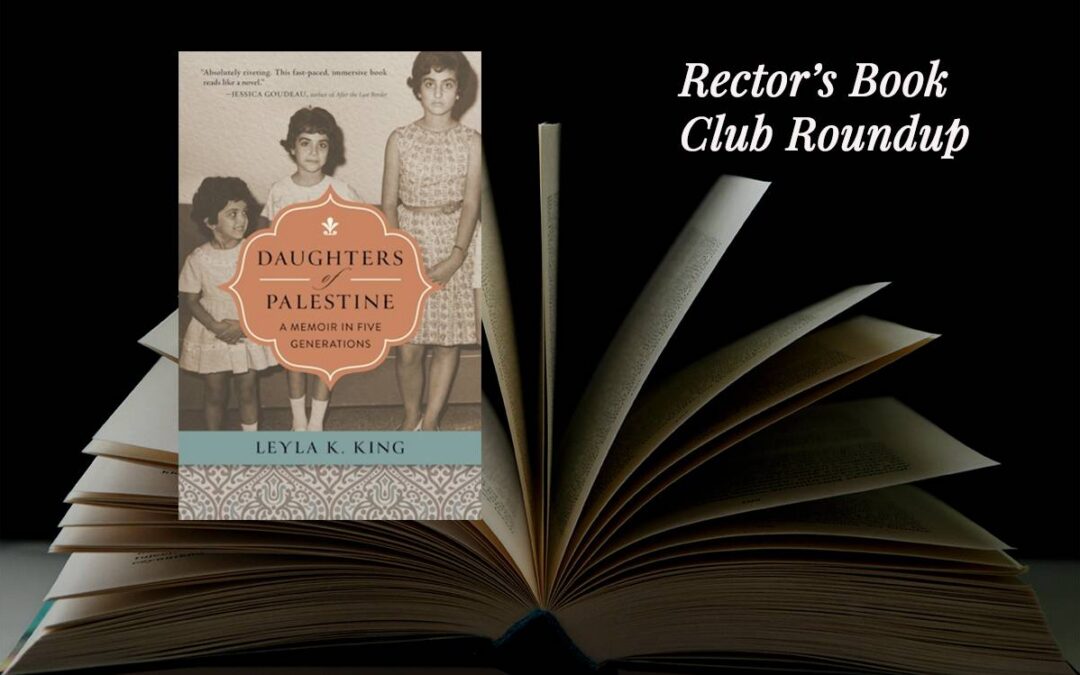
Then in April, we will resume our regular Rector’s Book Club format on April 24, where we will be reading Daughters of Palestine by The Rev. Canon Leyla King, who will also be visiting our parish on March 8 to preach and teach, making this a profoundly special opportunity to engage with her work. You’re very welcome to join us.