
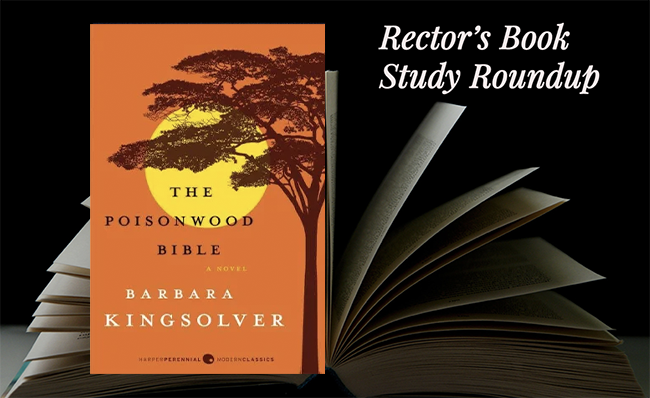
When our Rector’s Book Study gathered to dive into Barbara Kingsolver’s 1998 masterwork, The Poisonwood Bible, we knew we were embarking on an ambitious journey. Set in 1959 in Kilanga in the Belgian Congo, Kingsolver’s novel follows the Price family—Southern Baptist missionary Nathan Price, his wife Orleanna, and their four daughters, Rachel, Leah, Adah, and Ruth May. Together, they travel to Africa carrying an unyielding dogma into a landscape that defies every assumption they bring.
At Christ & St. Luke’s, our theme for this program year is “God’s Story, Our Story”. Throughout our discussion, we examined Kingsolver’s novel through that lens, wrestling with how fictional narratives and historical realities mirror our own struggles with faith, trauma, and identity.
A Chorus of Distinct Voices
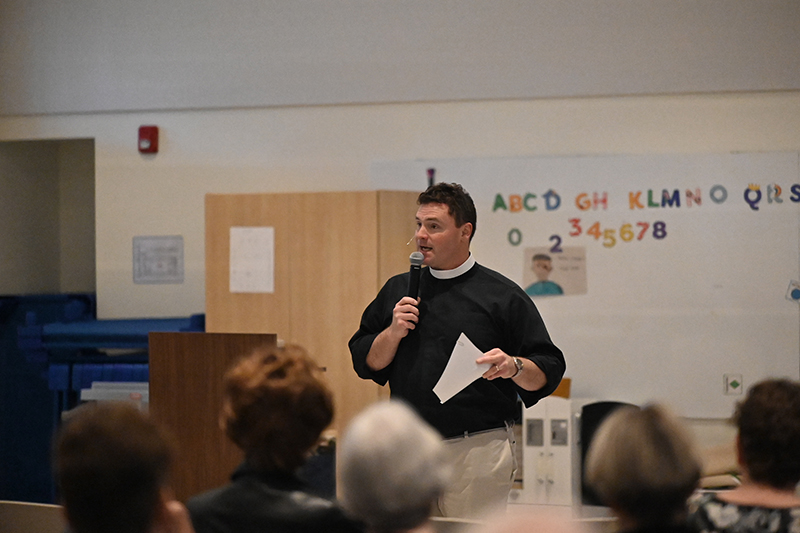
Opening our session, Fr. Noah Van Niel invited the group to share their general impressions of Kingsolver’s epic. Participants immediately pointed to the novel’s vast emotional range and the technical feat of telling one story through five distinct female narrators.
“It is something of an authorial tour-de-force to be able to capture that many distinct voices,” noted Fr. Noah. “She weaves together this complicated narrative of history with fictionalized experiences that feel all too real.”
Group members observed that these contrasting female voices—Orleanna and her daughters—steadily expose the flaws in the rigid worldview enforced by the patriarch, Nathan Price.
Dogmatism, Trauma, and Brokenness
Although Nathan Price never narrates a chapter himself, his domineering presence serves as the center around which the family revolves. Nathan operates as a rigid figure whose zeal blinds him to the humanity of the Congolese people he claims to serve.
“He thinks he’s the force of good, but he’s not,” reflected one participant, during our discussion. “A lot of times when people cling so strongly to a dogmatic version of faith, there’s something in them where that has to be true in order for them to hold together. There was something that broke inside him, and the only duct tape he found was this absolute, aggressive form of faith that drove him into the Congo.”
Participants added further context, noting how Nathan’s fanatical drive was fueled by survivor’s guilt as the sole survivor of his WWII platoon on the Bataan Death March. Group members contrasted Nathan’s transactional approach, focused strictly on baptism counts, with relational Christianity. This disconnect was illustrated by his attempt to plant an American garden in Congolese soil, ignoring local advice on how to do so.
Orleanna: Survival, Domestic Captivity, and Agency
Turning to Orleanna Price, Nathan’s wife, participants expressed deep empathy for a woman trapped in an abusive marriage during an era offering women little independence but also frustration at her inability to extricate herself from the situation earlier. The group reflected on her daily struggle to protect her children while living under a husband who claimed divine authority.
During our session, a member read aloud a defining passage from Orleanna’s narrative:
“To resist occupation, whether you’re a nation or merely a woman, you must understand the language of your enemy. Conquest and liberation and democracy and divorce are words that mean squat, basically, when you have hungry children and clothes to get out on the line and it looks like rain. Maybe you still can’t understand why I stayed so long. I knew Rome was burning, but I had just enough water to scrub the floor and I did what I could”.
Participants noted that Orleanna’s struggle was existential, as defying her husband meant risking the collapse of her world. The tragic loss of her daughter, Ruth May, left her carrying a lifelong burden of grief but ultimately served as the catalyst for her to break free.
The Four Daughters: Four Paths Through Trauma
Our discussion explored how the four Price sisters each developed distinct trajectories for navigating the trauma of their time in the Congo:
- Rachel: The eldest sister approaches life as a pragmatist. As one participant remarked, Rachel navigated crisis with her “elbows out,” eventually owning a hotel in Africa.
- Leah: Beginning as the daughter most attached to her father, Leah’s intensity transforms into a passion for social justice and devotion to her husband, Anatole. Choosing to return to Africa, Leah embraces a life of difficult physical labor in solidarity with the Congolese people she has come to love so much.
- Adah: Silent by choice and living with hemiplegia, Adah provides perceptive observations. The group highlighted her thoughts on disability: “The arrogance of the able-bodied is staggering… We would rather be just like us and have that be all right.” Participants noted how Adah later reclaimed her voice and entered medicine having the most “successful” life of all the women.
- Ruth May: The youngest child, whose fierce innocence allows her to connect effortlessly with local children. Her sudden death from a snake bite breaks the family apart, leaving her spirit in the trees.
Imperialism and the Voluminousness of Life
Beyond domestic dynamics, our discussion grappled with Kingsolver’s critique of Western arrogance and foreign intervention, including the assassination of Patrice Lumumba.
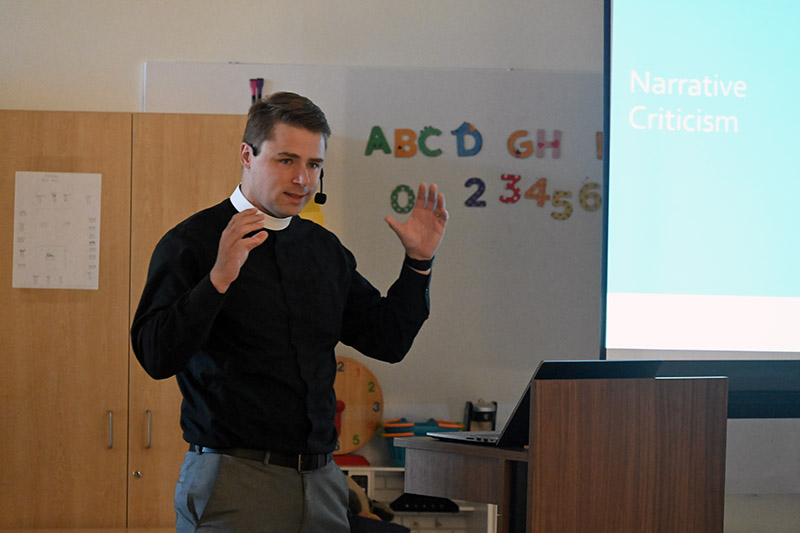
Fr. Noah highlighted how Kingsolver balances political critique with deep reverence for African culture. “There is an appreciation for what life is like there, and a deep respect for the culture,” Fr. Noah noted. “The continent is highly complicated by both the sheer voluminousness of life and the tragic presence of death and exploitation imposed from the outside”.
Finding Grace in Complex Narratives
We concluded by contemplating how literature helps us navigate the complexities of faith. Engaging with challenging stories allows us to cultivate a humbler faith.
“If we have a God that is going to map onto the complicated nature of reality, I would like a God that is complex enough to do that,” Fr. Noah concluded. “Contemplating these individual stories helps us understand and express our own complicated stories as they relate to God’s grander narrative.”
We will take a break in November for Thanksgiving. Then the Rector’s Book Study will gather next on Wednesday, December 4, at 4:00 p.m. in the Gold Room to discuss Charles Dickens’ A Christmas Carol. All are welcome!