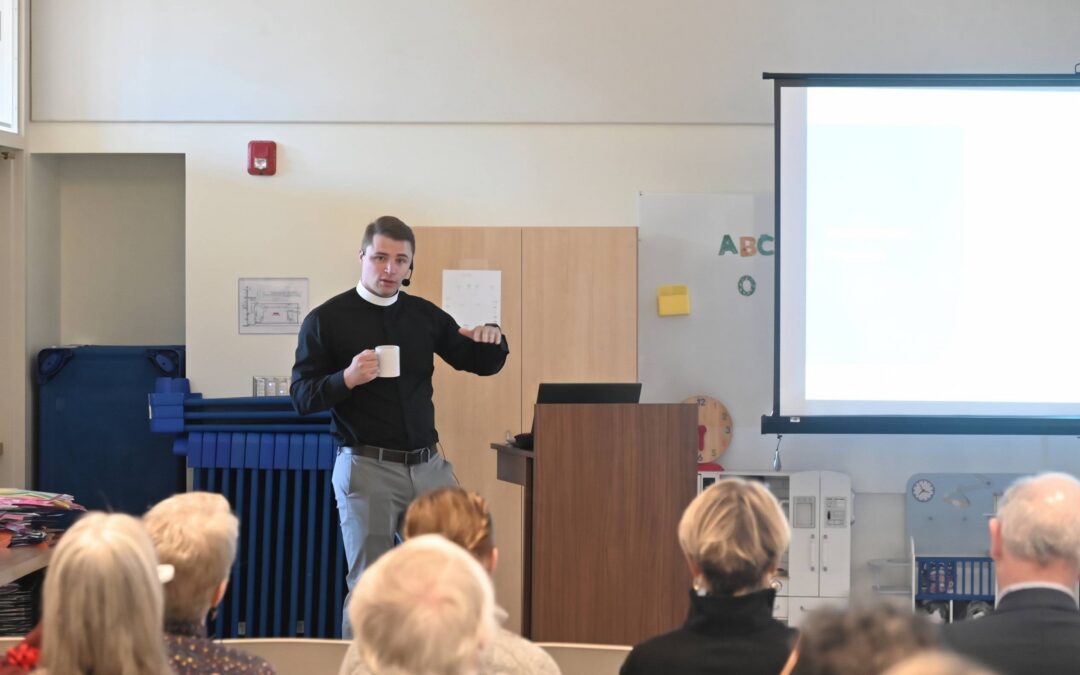

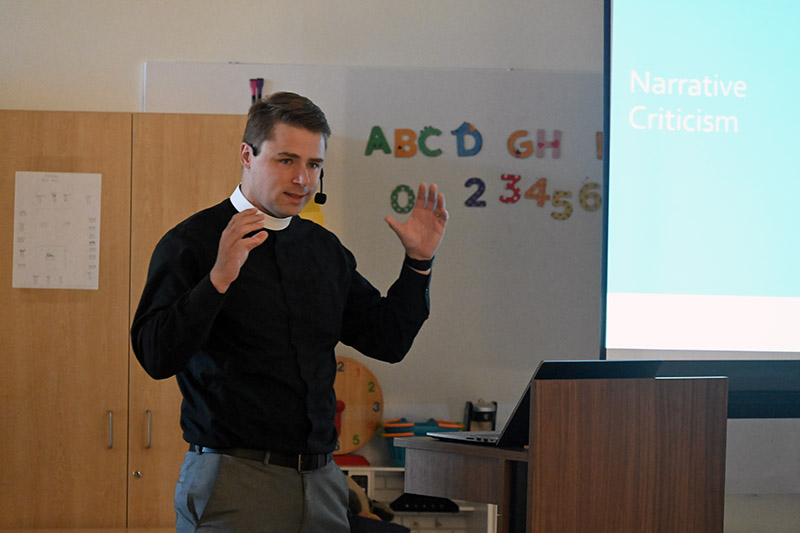
Storytelling is fundamentally built into human identity. From ancient oral traditions around primitive campfires to modern viral social media videos, the narratives we choose to embrace and transmit shape how we view society, ethics, and our shared humanity. In the concluding session of his Adult Formation class series on narrative theology, Fr. Jared Grant led parishioners through an essential exploration of how stories function as active theological and ideological lenses that influence our lives.
Reflecting on the overarching framework established throughout the course, Fr. Jared opened the class by reminding participants of the critical distinction between a text’s real-world origin and its internal narrative structure. He contrasted a real-world writer of the text with the internal dynamics of narrative criticism, where we analyze the implied author, the narrator, and the implied audience.
As Fr. Jared explained, narrative criticism requires readers to temporarily step inside the world created by the story itself rather than immediately imposing external modern assumptions or historical backgrounds upon it. Learning to inhabit that implied world allows us to listen carefully to what the narrative itself seeks to communicate.
Unreliable Narrators and the Manipulation of Story
Fr. Jared addressed the potential for stories to be weaponized or misused in the real world. When narrative frameworks are crafted with hidden agendas, they become powerful mechanisms for shaping public perception and altering worldviews.
To illustrate how drastically a narrative can be reframed, Fr. Jared shared a funny example from pop culture: a recut theatrical trailer of Stanley Kubrick’s famous horror film, The Shining. By swapping out music, selecting specific dialogue clips, and altering the visual pacing, the recut trailer presents the terrifying movie as a heartwarming, upbeat family drama. The exercise highlighted the impact of narrative framing:
Fr. Jared noted this as a perfect example of how a story can be presented “using a completely different narrative within the text or within the story that has nothing to do, or sometimes is not even close,to what the real world author is trying to talk about.
This dynamic closely touches upon the literary concept of the unreliable narrator. While fiction writers like Agatha Christie use deceptive narrators for dramatic suspense and clever plot twists, unreliable narrators in real life pose a distinct danger. When authority figures, commentators, or institutions present false or distorted narratives as objective truth, they can subtly manipulate our understanding of reality and alter our core ethical values.
Christian Nationalism and John Winthrop’s “City Upon a Hill”
Fr. Jared examined how narrative manipulation directly impacts Christian faith and witness, specifically focusing on the rise of Christian nationalism. He referenced a report issued by the House of Bishops Theology Committee addressing the crisis of Christian nationalism and its historical roots in American discourse.
A central historical text frequently cited in discussions of American identity is Jonathan Winthrop’s 1630 sermon, A Model of Christian Charity, written aboard the Arbella en route to New England. Winthrop’s famous line, “for we must consider that we shall be as a city upon a hill,” has been repeatedly quoted across centuries by political leaders and commentators across the political spectrum.
Fr. Jared observed how nationalist movements often isolate that single phrase to promote ideas of national entitlement, cultural dominance, or inherent exceptionalism. However, when one reads Winthrop’s text in its full narrative and Biblical context, a strikingly different theme emerges, one rooted in profound vulnerability, communal accountability, and self-sacrificing love.
Quoting directly from Winthrop’s original sermon, Fr. Jared highlighted the governor’s actual imperative to the community:
“Now the only way to avoid this shipwreck and to provide for our prosperity is to follow the counsel of Micah, to do justly, to love mercy, to walk humbly with our God. For this end we must be knit together and in this work as one man. We must entertain each other in brotherly affection. We must be willing to abridge ourselves of our superfluities for the supply of others’ necessities… We must delight in each other, make others’ conditions our own, rejoice together, mourn together, labor and suffer together, always having before our eyes our commission and community in the work as members of the same body.”
Winthrop made clear that being a “city upon a hill” was not a blank check of divine privilege, but a solemn warning. If the community failed to practice mutual care, equity, and humility, they would bring dishonor upon their faith and face spiritual failure:
Fr. Jared said: “When you look at the ending here, talking about what happens if we don’t live into being the body of Christ in this new world? What happens if we don’t support our fellow human beings? What happens when we don’t support others? We will perish, and with it, we will perish any good news of God. It’s to say that God is not represented well by this community… which is a really different understanding than I think how this is used a lot.”
Testing Narratives Against the Gospel
The central takeaway of the session centered on how Christians ought to evaluate the endless stream of stories presented by modern culture. Fr. Jared challenged the class to look beyond surface-level narratives and carefully examine the real-world intentions and fruits behind them.
Fr. Jared said: “In some extent, what we’re doing in this class has nothing to do with any of the narratives we’ve looked at. It’s about how do we have a specific lens with which to ask, is this narrative representing God? Is this narrative representing what I think of the world? And how I understand my own calls as a person that follows the teachings of Jesus Christ.”
When evaluating any story—whether from media commentary, political speeches, or social trends—we can measure it against the core revelation of God found in Jesus Christ. Narratives that promote fear, division, marginalization, or self-aggrandizement fall short of the Gospel standard. Conversely, narratives that call us toward justice, humility, compassion, and communal solidarity align with the living work of God.
Living as Faithful Participants in God’s Story
In a world saturated with noise, soundbites, and manipulative storytelling, Christians are called to be discerning readers of the culture around them.
By cultivating a deep, Christ-centered understanding of scripture, we equip ourselves to recognize unreliable narrators, reject harmful ideologies like Christian nationalism, and remain grounded in truth.
More importantly, narrative theology invites us to recognize that we are not merely passive audience members watching from the sidelines. We are active participants called to embody God’s overarching story of redemption, justice, and reconciling love in our everyday lives.