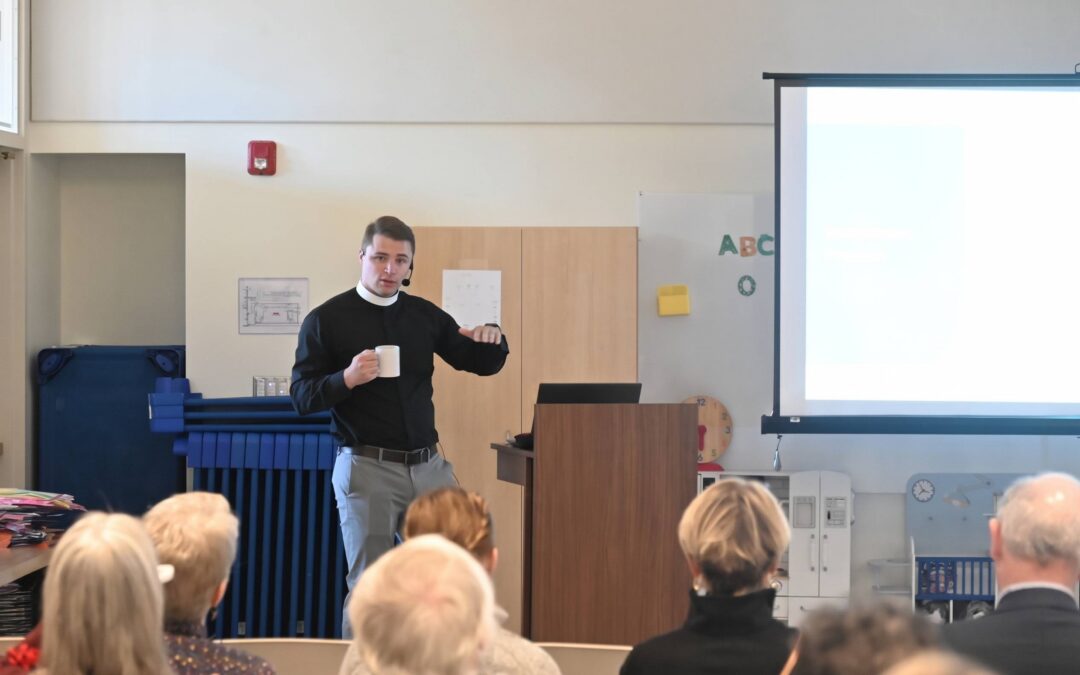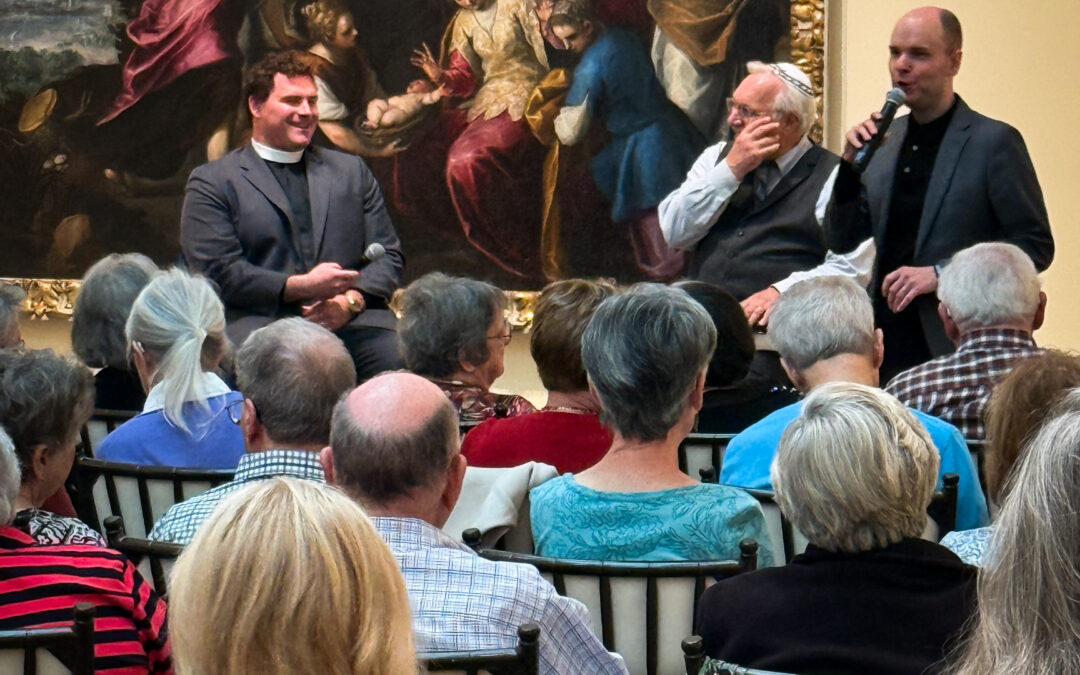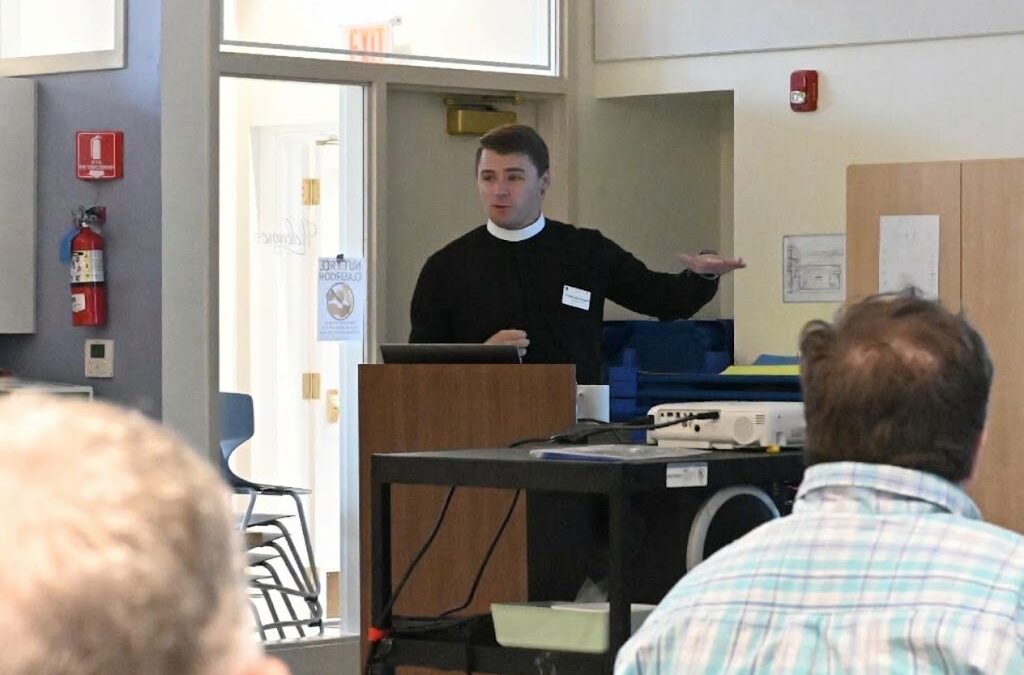

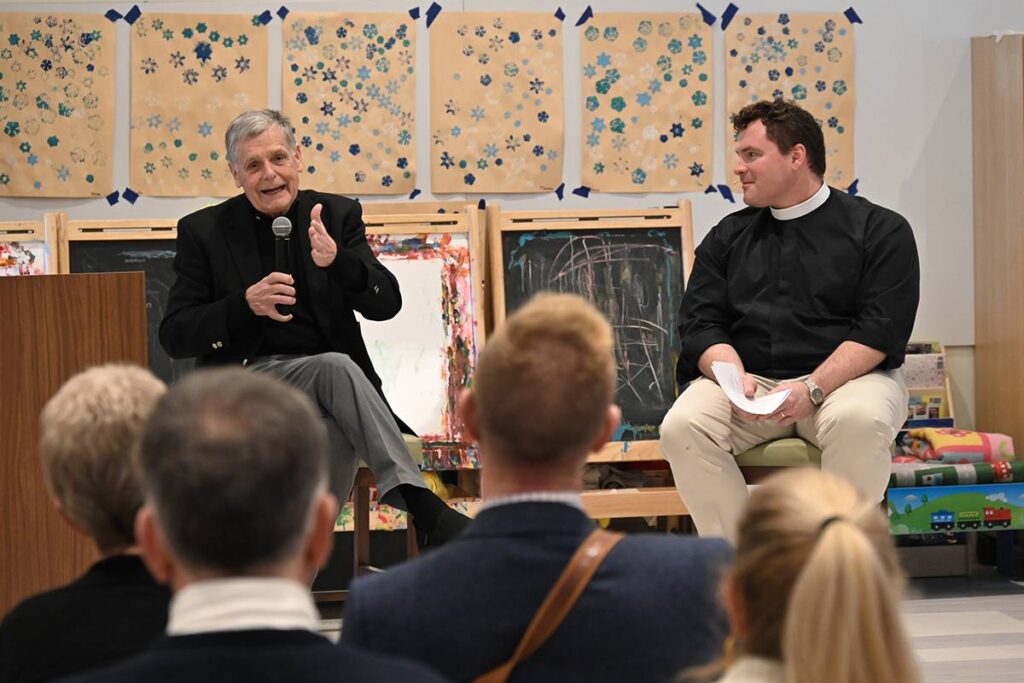
Dr. David R. Black, a parishioner and the Executive in Residence at Virginia Wesleyan University since 2015, discussint Liberation Theology with Fr. Noah at the Sunday Adult Formation session on the second Sunday in Lent, March 1, 2026.
As we journey deeper into Lent, our Sunday Adult Formation series, “Make No Peace with Oppression,” continues to challenge us to view our faith through the lens of oppression. In our opening session, Fr. Noah established that throughout the Bible, God consistently positions Himself on the side of the underdog. But how does that biblical truth translate into modern theology?
On Sunday, March 1, Fr. Noah sat down with Dr. David R. Black, a cherished parishioner who has served as Executive-in-Residence at Virginia Wesleyan University since 2015, to unpack the history, necessity, and challenge of Liberation Theology.
The Foundations of Freedom
Dr. Black traced his understanding of liberation back to his childhood in Alabama, sharing powerful stories of his family. Dr. Black noted that his grandmother’s favorite biblical story was Jesus’s encounter with the Samaritan woman at the well. “From all of history and theology, women have been oppressed,” he said, recalling his grandmother’s teachings. “Who is the first person Jesus revealed his identity to? It was she.”
Perhaps the most visceral lesson for David’s father in systemic oppression came from a proud Black WWII paratrooper at their local drug store. Coming back from the war, the man, a Black veteran, took his young son to the store, which remained segregated by race. “Imagine… a veteran dad who happened to be Black explaining to his son why he couldn’t go to the counter and get a cherry Coke,” Dr. Black recalled. That limiting, painful event changed David’s father’s life. From then on, his father lived by the words of Luke 4:18-19, believing the Spirit of the Lord had “anointed [him] to declare good news to the poor,” Dr. Black said.
A Kenotic God vs. Divine Impassibility
As Dr. Black entered academia, eventually reading foundational texts by theologians like Gustavo Gutiérrez and Paulo Freire, he wrestled with the traditional, institutional definitions of God. He flatly rejected the concept of “divine impassibility,” the idea that God cannot change or feel our emotions.
“I couldn’t comprehend that kind of being. It didn’t make any sense to me,” Dr. Black explained. Instead, he embraced a God that is “kenotic,” pointing to the concept of Kenosis (God’s renunciation of Divine nature) found in Philippians 2:
“Let the same mind be in you that was Christ Jesus, who, though he existed in the form of God, did not regard equality with God as something to be grasped,
Philippians 2:5-7 (New Revised Standard Version).
but emptied himself, taking the form of a slave, assuming human likeness.”
This self-emptying, solidarity-driven God is at the heart of Liberation Theology. Dr. Black highlighted Paulo Freire’s work in Latin America, where Freire taught oppressed, indigenous people to read so they could reclaim their voting rights and humanity after centuries of colonialism.
“Liberation theology emerged as a sacrament of history,” Dr. Black said, “of who God made us to be.”
Orthopraxis and the Cross
Fr. Noah and Dr. Black then discussed the pushback Liberation Theology often receives. Because the movement insists on orthopraxis — applying the ways of the Lord by actually doing them in the real world — it is frequently criticized as being too political.
“The whole point was to get this to actually make a difference in the world,” Fr. Noah noted, defending the movement. “And very often, the way you make a difference in the world is through collective action and decisions and laws and structures.”
Dr. Black agreed, pointing out how oppressive systems, from standardized testing created by eugenicists to unjust economic structures, have historically “worked… to keep the workers in their place.”
Fr. Noah eloquently concluded this deep dive by reminding us where this liberative path ultimately leads.
“When we really get into the example of Jesus Christ, we end up at the cross,” he said. “We end up with total material poverty. We end in complete solidarity with the human condition at its most base.”
That reality is often difficult for people to embrace, Fr. Noah admitted, making Liberation Theology “somewhat of a third rail to a lot of the church.” But the packed room of parishioners at this session were doubtless inspired and moved to consider its implications more deeply.
Next week, March 8, we will hear from Rev. Canon Leyla King, an Episcopal priest and author of the memoir, Daughters of Palestine. She will be our guest preacher and will lead our Sunday formation to continue the conversation about oppression.
Adult Formation: Make No Peace with Oppression On the three remaining Sundays of Lent (March 8, March 15, March 22 from 9:15 a.m. — 10:00 a.m.)
Find out more about our upcoming formation and book club events in our Lent, Easter and Pentecost ministry brochure.