
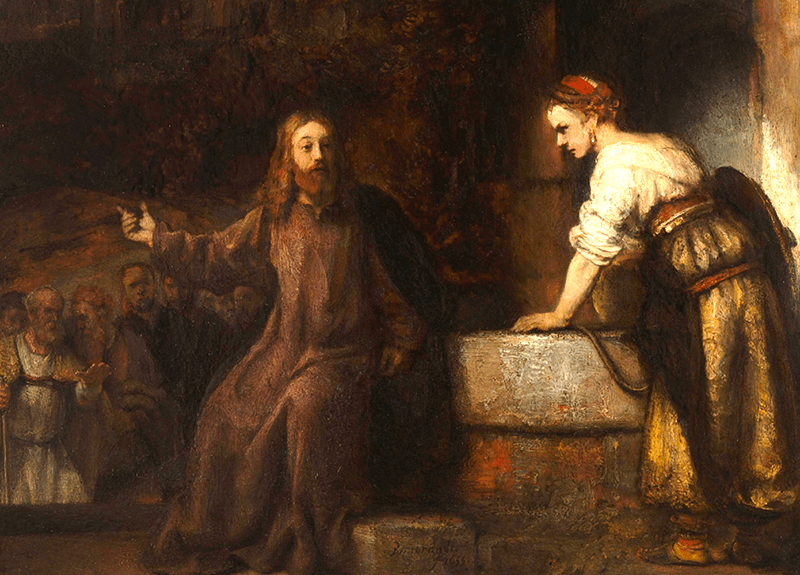
Christ and the Woman of Samaria, Style of Rembrandt, 1650s, New York Metropolitan Museum of Art
At our Queer Theology Discussion Group on Sunday March 8 we discussed the lectionary of the week, focusing on John 4:5-42, when Jesus meets the Samaritan woman at the well. This is noted as the longest, uninterrupted conversation Jesus has in the New Testament, and for that reason itself is a reason to pay attention. But also, as we would discover together in conversation, her story and significance goes so much deeper than just being a person that Jesus spoke with the longest, and that, as one person in our group commented, if the woman in the story was named, she surely would be a “red letter’ saint deserving of a saint day and a feast in her name (church tradition, but not the Bible, has given her a name “Photini” and she has a feast day on February 26).
In the story, Jesus speaks with the women with love and compassion, despite all the factors that should separate them with her being a Samaritan, a woman, and a woman who is living in a relationship outside of wedlock after five previous marriages. The moment that changes the woman is when she realizes that Jesus knows “everything I have ever done,” and does not scold her or shun her for that but rather talks with her in compassion and love about the expansiveness of God’s salvation. She then recognizes him as a prophet, and they have this exchange, in which Jesus responds to her:
Jesus said to her, “Woman, believe me, the hour is coming when you will worship the Father neither on this mountain nor in Jerusalem. You worship what you do not know; we worship what we know, for salvation is from the Jews. But the hour is coming, and is now here, when the true worshipers will worship the Father in spirit and truth, for the Father seeks such as these to worship him. God is spirit, and those who worship him must worship in spirit and truth.” The woman said to him, “I know that Messiah is coming” (who is called Christ). “When he comes, he will proclaim all things to us,” Jesus said to her, “I am he, the one who is speaking to you.”
She then goes off to be an apostle for Jesus to her city, and despite being one of the people most in margins in her society, her testimony is so convincing that many Samaritans come to Jesus and believe in him.
As we always do in our meetings, we re-read the Gospel together, each of us listening for where we saw ourselves in the story and who or what we resonated with. The responses to this were as varied as our growing group, who identify as trans, cis, gay, queer, heterosexual, and as allies.
Some saw themselves in the fire of the spirit that the woman so obviously conveyed as she went out into her city and brought others to come hear Jesus. Others commented on how, while she was an outsider in her society, she also must have had a “found family” and community among them, as so many of us do. She was not a lonely outsider – she was “other” but she was also among her people in her city, and they listened to her and came to hear and witness what she experienced. And because she had the foundation of her own community, she also had the bravery and willingness to go out and testify to everyone in the city, not just brining others who were oppressed or marginalized to Jesus, but everyone she met. She truly served as an apostle, while Jesus’s disciples were left with little else to do but to bring snacks.
Another of our group shared on how troubled he used to be with this story in how Jesus seems to call her out for her multiple marriages and her living in a partnership outside of marriage. It seemed to him rude and even aggressive. However, upon further study, and a long journey of personal change, including in his relationship with the gay community, he came to understand that Jesus brought up her relationship to make it evident to her that he knew her and welcomed her in all of who she was. He was not asking her to stay closeted with him. That pain and isolation of being closeted is something many of us related to. And when allies seem to ignore our identity, they may inadvertently seem to be inviting us to stay closeted. This might come from an intention of politeness, of not bringing something sensitive up, but the gay or trans person knows their difference, and so acknowledging their identity, respectfully and safely (i.e. not outing someone against their consent), it isn’t doing damage, but rather is a way of communicating how you value and accept them for who they fully are. Jesus did this for the woman at the well. He let her know how he knew her fully, and in no way did that change the way he related with her and answered her theological probing.
Recently, I had this acceptance done for me by another member of Christ & St. Luke’s when I attended Christ & St. Luke’s joint book group with Second Calvary Baptist Church on Howard Thurman’s book, Jesus and the Disinherited. I was hesitant in attending, in not knowing what sort of reception I’d find in a traditional, primarily black Baptist Church as gay trans-man, especially as someone who is visibly queer, not fully passing as a man, but also definitely not coming across as a straight woman. However, in the small discussion group that I was in, an older cis-straight woman from our church, who is from an entirely different socio-economic and cultural background from me, showed up as an ally by using my pronouns, referring to me as “he” so often in the first few minutes of our discussion that there could be no doubt as to my identity. She did not skirt around my identity, and so I was able to simply relax and belong to that group and be immersed in the discussion without being misgendered. I ended up feeling such welcome there and enjoyed a richness of conversation and experience. And this was, in large part, because of the safety of being with my people.
This importance of visibility continued to come up in our conversation. The woman did not avoid Jesus when she saw him. She did not deny who she was. And she did not keep the good news of Jesus to herself but rather went out and evangelized. She was visible. So many of us, both queer and allies, came to Christ & St. Luke’s visible and explicit acceptance of the queer community and being a true place of safety. And because of that, repeatedly we are able to connect with God’s love through so many unexpected ways.
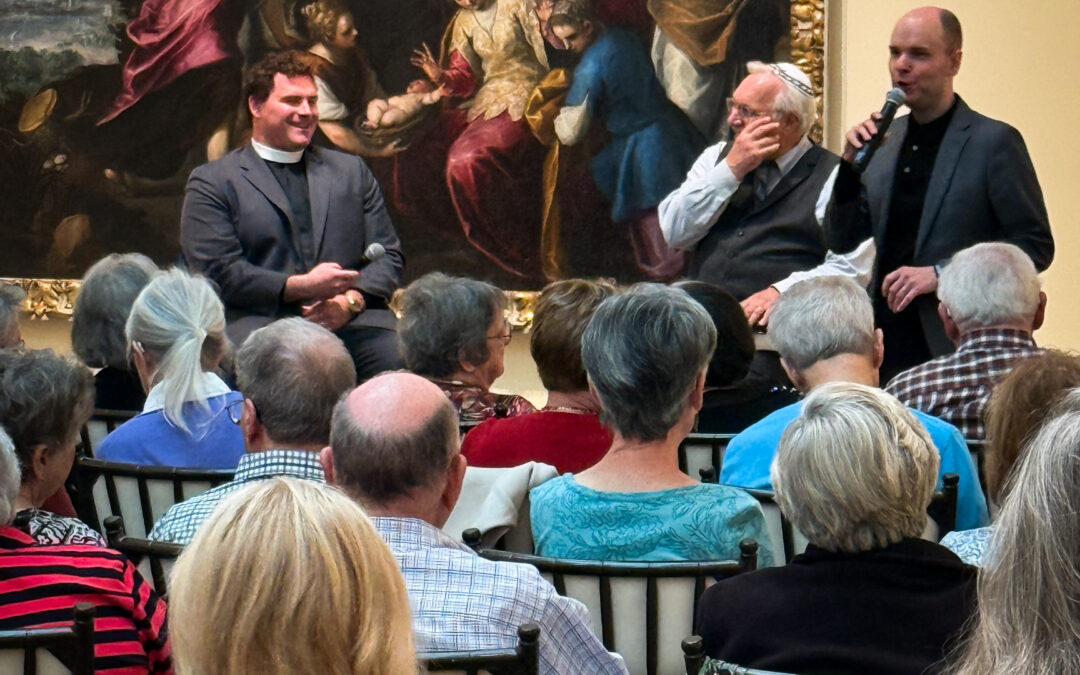
I am so grateful for this ever-growing group of curious queer theologians. As the visiting preacher, The Rev. Canon Leyla King, the author of Daughters of Palestine: A Memoir in Five Generations, commented, the woman at the well distinguished herself by being curious, thoughtful, and interested. She listened and asked questions. She leaned into the conversation and was willing and able to learn and experience new things. The members of our growing Queer Theology community, as well as Christ & St. Luke’s as a whole, share these very same traits of being curious, thoughtful, and interested, and for that, we are all blessed.
Interested in Queer Theology? For more information on our Queer Theology Discussion Group contact Anders Nolan. All LGBTQIA+ people and allies are welcome.