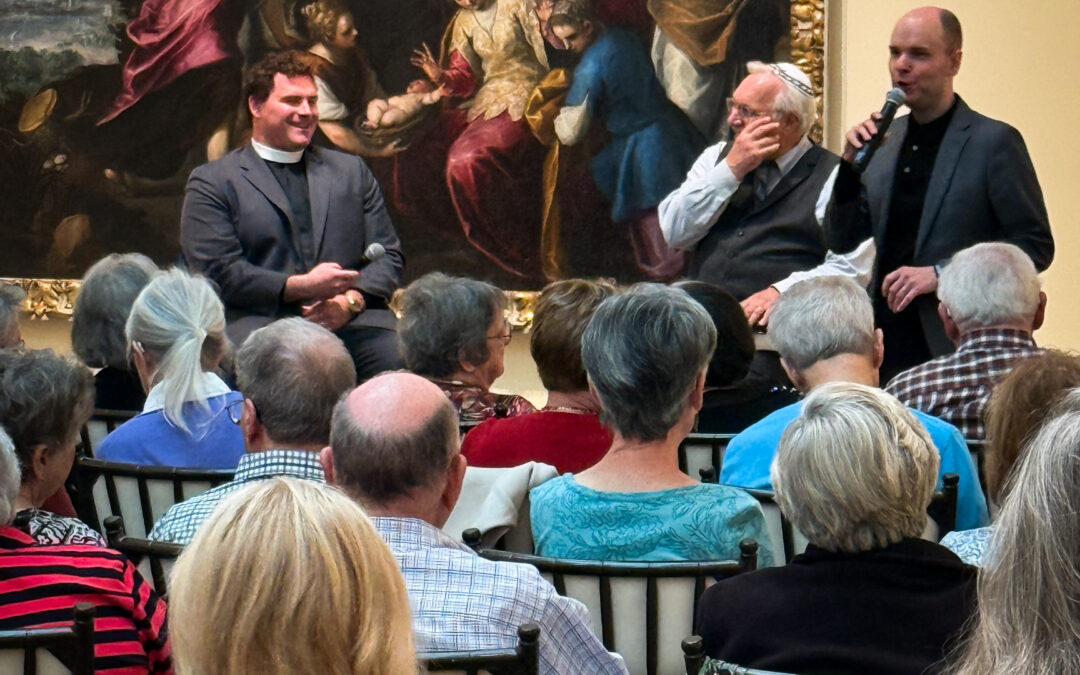

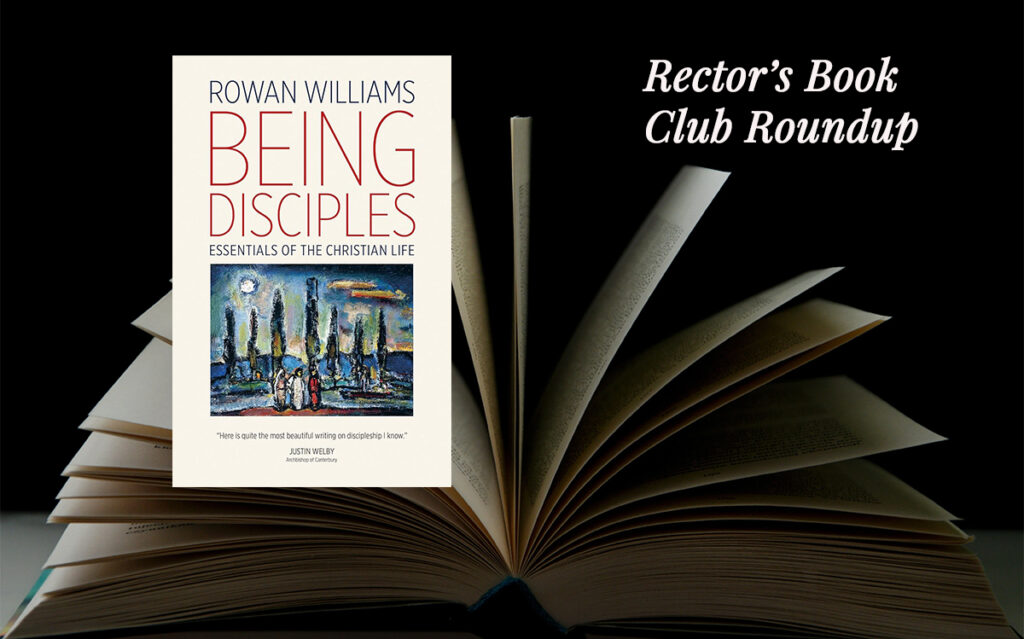
Our January Rector’s Book Club gathering at Christ & St. Luke’s centered on Rowan Williams’ slim but spiritually dense volume, “Being Disciples.” As the former Archbishop of Canterbury, Williams is known for high-level theological thinking, yet our group found this book remarkably accessible and “joyful,” with one member noting they read it in a single sitting.
The conversation moved away from the idea of discipleship as a checklist of tasks and toward a deeper understanding of how we inhabit the world. The book challenges the notion that we need “25 Ways to Be Holy.” Instead, Williams suggests that if you have studied hard to be a Christian, you will simply “be better at doing the washing up.”
“Perhaps we should “write a Bible of our own history,” they said. By recording the specific times God has shown up in our personal lives, we create a reservoir of memory to lean on when we hit the inevitable “brick wall” of life where answers fail us”.
Discipleship Without Furrowed Brows
A central theme of our discussion was the shift from striving to abiding. Williams argues that discipleship is a state of being rather than a frantic state of doing. One member was struck by the passage stating that this state happens “not by effort or struggle with furrowed brows or tense muscles, but by allowing something to rise up… that is God’s purpose coming through.”
This resonated deeply with the group, with participants reflecting on how often we exhaust ourselves trying to “acquire skills” to be a disciple, rather than recognizing that God asks us to be fully ourselves. As one member put it, the text was a relief from a lifetime of “working harder” and “apologizing,” offering instead a connection where the right actions just happen naturally because the heart has changed.
A Bible of Our Own History
In discussing the chapter on “Faith, Hope, and Love,” the group explored the relationship between hope and memory, as Williams does in the book. Williams suggests that hope is not just about the future, but about a “hope for continuity” — trusting that the God who acted in the past will act again.
This sparked an idea from one participant: Perhaps we should “write a Bible of our own history,” they said. By recording the specific times God has shown up in our personal lives, we create a reservoir of memory to lean on when we hit the inevitable “brick wall” of life where answers fail us. The group agreed that this “dependable relationship” with God remains even when our understanding of the world crumbles.
Holiness and the “Long-Term Questions”
We also tackled the intimidating concept of holiness. Rather than defining holiness as being set apart or removed from the world, Williams argues — and our group agreed — that holiness involves running toward the world and its messiness. One member drew a powerful comparison to the first responders on 9/11 who ran toward the danger while others fled, suggesting that holiness involves a similar willingness to engage with reality rather than escape it.
Finally, the conversation turned to faith in society. The group found Williams’ definition of the church’s role in politics to be particularly grounding: churches are called to be “trustees or guardians of the long-term questions.” In a polarized world, the church holds the vision that every human being is precious and that our nature does not depend on political fashions. One member summarized the church’s role as standing in the gap between “law and license” to insert a buffer of love.
In all it was a rigorous and powerful discussion that shed new light on some of the fundamental understandings we all have on what it means to be a disciple.
If you enjoyed this roundup, we would love to see you at our upcoming gatherings of the Rector’s Book Club.
- February 27 at 4 p.m.: “Humbler Faith, Bigger God” by Sam Wells. We will discuss how to retell the Christian story in a way that is humble yet profound.
- March (Lenten Series): “Jesus and the Disinherited” by Howard Thurman. In a special collaboration, we will join our friends at Second Calvary Baptist Church for a five-week study of this foundational civil rights text.
- The first three sessions will take place on Thursday evenings from 6:00 – 8:00 p.m. at Second Calvary Baptist Church, 2940 Corprew Ave, Norfolk, VA, 23504 on February 26, March 5, and March 12. The final two sessions will take place at the same time at Christ & St. Luke’s on March 19 and March 26.
Please come along!