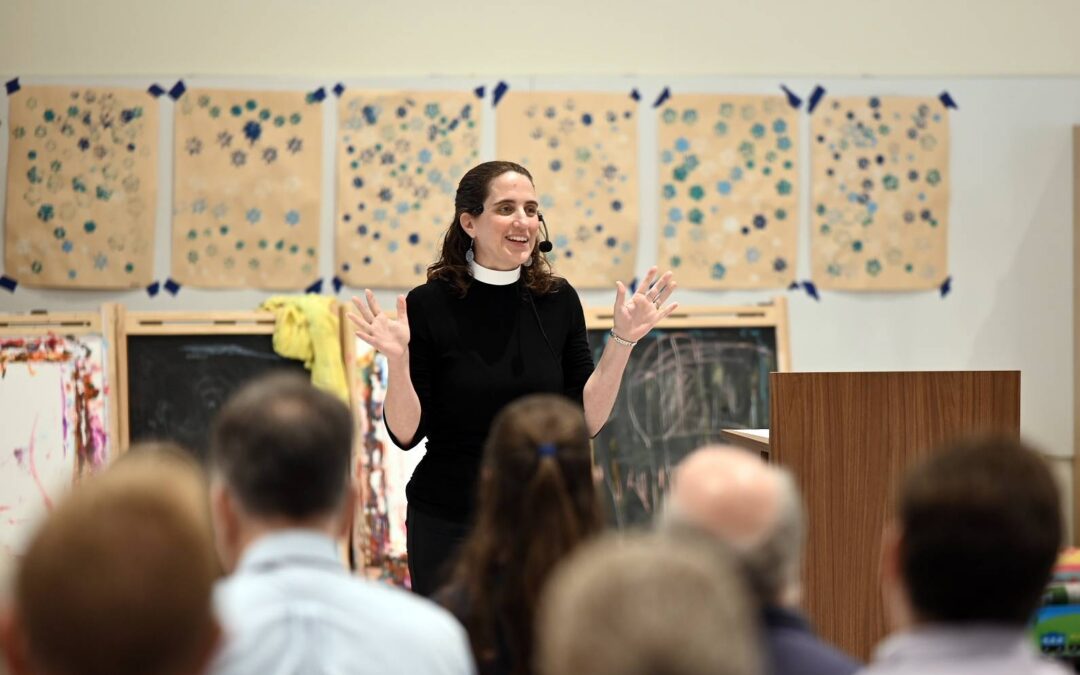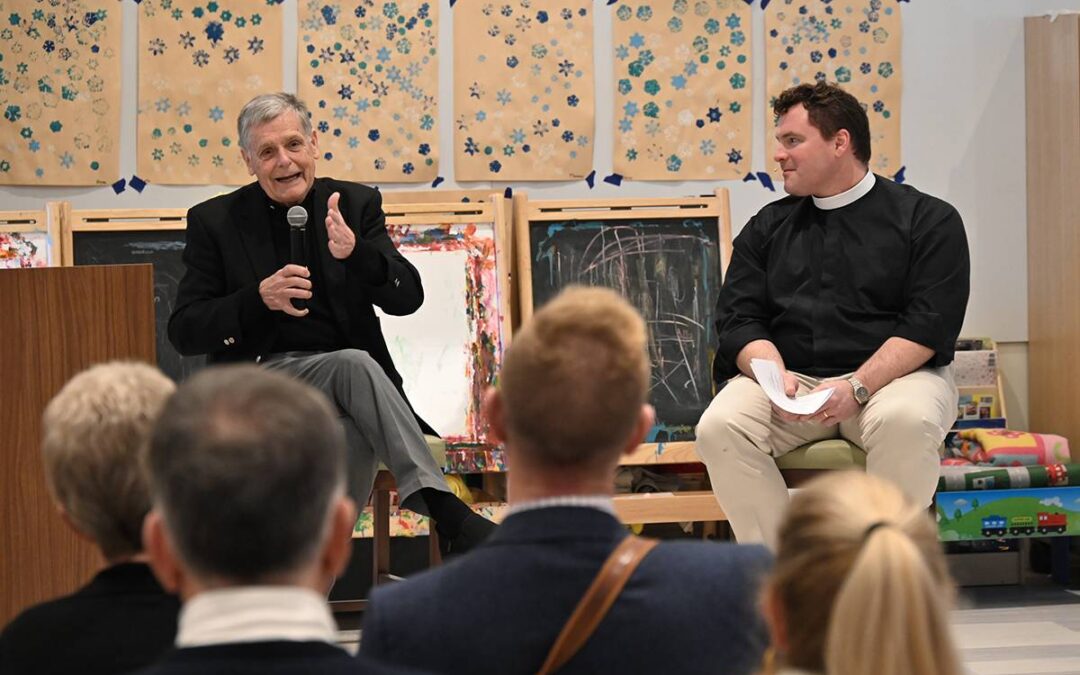

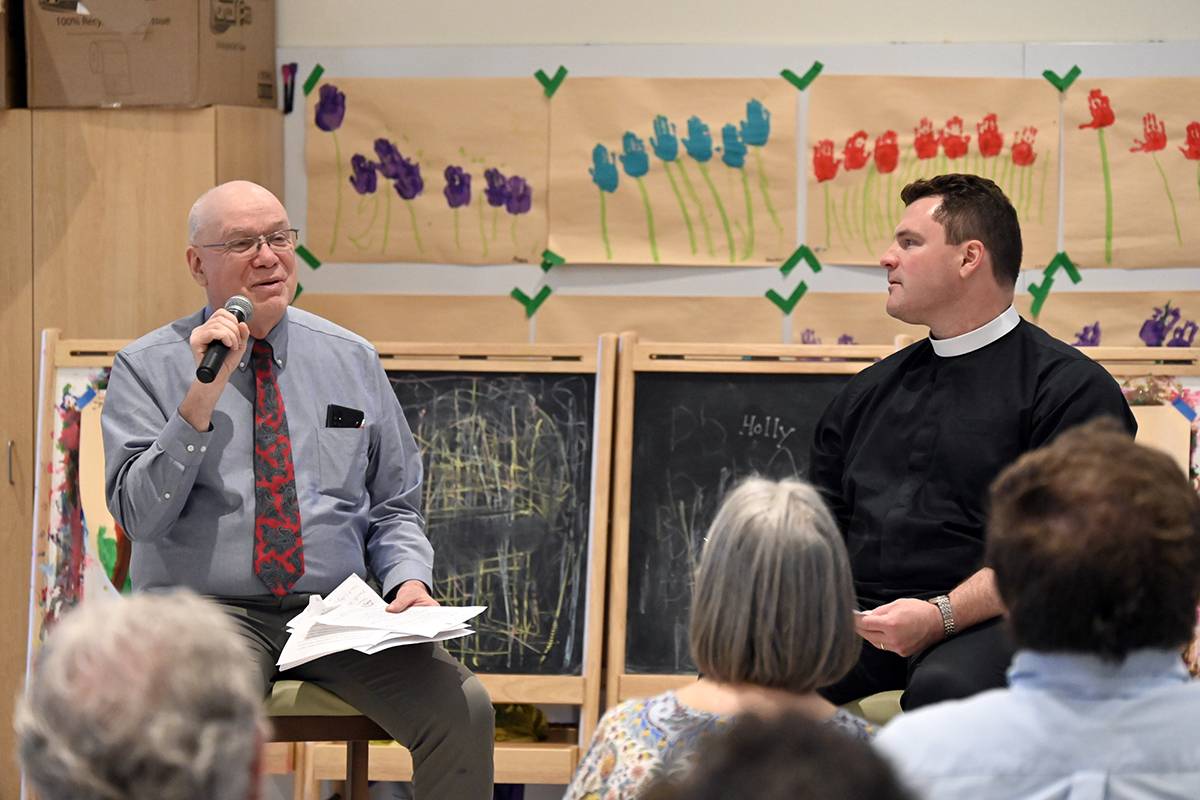
Prof. Charles H. Ford (left) and Fr. Noah Van Niel at the adult formation session, “Make No Peace with Oppression,” on Sunday, March 15, at Christ & St. Luke’s Episcopal Church, Norfolk, VA.
As our Lenten Adult Formation series, “Make No Peace with Oppression,” continues to challenge us, we have been exploring how systemic power imbalances deny people access to resources, rights, and opportunities. We have discussed the theological foundations of a liberative God and the international plight of the marginalized.
On Sunday we brought the conversation much closer to home. We were honored to welcome parishioner Charles H. Ford, esteemed local historian, Norfolk State University professor, and co-author of LGBT Hampton Roads, to explore Norfolk’s local LGBTQ+ experience through the lens of systemic marginalization and liberation.
In rigorous conversation with Fr. Noah Van Niel, Charles guided our parish through the hidden histories, the heartbreaking struggles, and the resilient triumphs of queer Virginians.
Reclaiming the Language of Liberation
Fr. Noah opened the session by noting how language itself can be a tool of marginalization, observing, “ideas can be oppressive. Terminology can be impressive. The way we use language can be a form of instantiating some oppressive systems or ideas.”
Charles began by addressing the very terminology used to describe the community. He noted that the word “queer” in the 20th century “was something negative towards LGBT people,” but that reclaiming the word was a powerful, defiant act.
“Just liberating that kind of stigma to get rid of that stigma and turning it to the umbrella term from which LGBT people can be described… I think it’s very liberating in that sense,” Charles said. This linguistic and theoretical shift allowed historians and theologians to move away from grand, sweeping narratives and instead focus on “micro-histories, looking at the very, very local, in very, very archival ways,” giving voice to the actual, lived experiences of everyday people right here in our region.
The Historical Weight of Systemic Oppression
To truly make no peace with oppression, we must understand how it has historically functioned. Charles reminded us that for centuries, queer individuals were legally and medically targeted. He noted that there were specific laws dating back to Henry VIII “that made sodomy a capital crime,” explaining that queer people were historically defined as “criminal, bad, villainous, awful people”. “And that was based on religion mainly, until the 20th century, when it became based on psychiatry,” Charles noted, pointing out the damaging belief that “homosexuality is a mental disease.”
Because of these systemic forces, many queer youth felt the need to leave their biological families and migrate to larger cities to establish their own chosen families. Charles also highlighted the terrifying era of the “Lavender Scare,” which was “an attempt to rid the government, especially, of [perceived] security risks”. Gay men and women in the military and civil service were fired en masse because they were perceived as susceptible to blackmail by foreign adversaries. Fr. Noah poignantly pointed out the tragic irony of this era, noting that even within supposedly progressive political movements, liberation “did not seem to extend to the queer community.”
The Hampton Roads Experience: Raids and Safe Havens
This oppression was not just a distant national issue; it happened right here in Hampton Roads. Charles recounted the intense surveillance of local queer spaces, noting that at the Q Club in Norfolk in 1971 and 1972, there was a “constant undercover operation to identify lesbian gay men by just having them say they were lesbian or gay.” People were arrested simply for stating their identity. In 1964, a venue in Virginia Beach called Craig’s was raided just for allowing same-sex dancing. “The 86 men were arrested. Their names were placed in the Virginia Beach Sun,” Charles shared. “Some of them killed themselves.”
In the darkness of the AIDS crisis in the 1980s, Norfolk also emerged as a “real powerhouse in terms of advocacy and organization,” Charles said. He specifically highlighted the role of local churches, including Christ & St. Luke’s, in providing a haven and acting as the ancestor to modern LGBT centers.
This deep commitment to being a community of consequence was beautifully echoed by a parishioner during the session’s Q&A, who recalled joining the church precisely because of its active support for the LGBTQ+ community during the AIDS epidemic. She shared how CSL members cooked meals for AIDS patients while other religious figures were calling the disease a divine punishment.
“I felt like this is the right statement, this is right ministry. And that’s one of the main reasons I chose to stay in this church,” she said. Fr. Noah affirmed this, stating that our parish proudly owns “our history as trying to be an ally in this work,” making ourselves known so that “people who are in search of a safe haven… will be able to find that as well.”
The ‘Double-Edged Sword’ of ‘Respectability Politics’
As the conversation turned to the present day, Fr. Noah asked about the legalization of gay marriage and the current state of LGBTQ+ rights. Charles provided a nuanced critique of how this modern liberation was achieved. He explained that a very successful strategy used by activists to “bring down 800 years of legal and cultural stigma and oppression was to embrace the culture, the politics of respectability.”
However, Charles warned that this strategy was a “double-edged sword”. “It also left people who could not pass, who didn’t have connections, who weren’t as wonderfully materially resourced… much more vulnerable,” he explained. This pursuit of respectability protected the upper echelons of the community while leaving transgender individuals, queer youth, and marginalized people exposed to the fierce legislative and cultural backlash we see sweeping the nation today, Charles and Fr. Noah agreed.
Fr. Noah reflected on this complex reality, stating, “even within oppressed groups… there become striations within themabout who’s acceptable and who’s not”. It serves as a stark reminder that our work as a parish to build genuine relationships across differences and break down dividing walls, is far from over. We cannot be satisfied with a liberation that only frees the most privileged among the marginalized.
Queer Theology and the Call to Radical Inclusion
Ultimately, this Adult Formation session challenged us to re-examine our faith. The exploration of “Queer Theology” invites us to look closely at our sacred texts, recognizing that Jesus himself lived a life that defied the rigid, binary expectations of his time. Queer theology allows us to see a more complex, nuanced, and detailed reflection of God’s diverse creation.
At Christ & St. Luke’s, we are proudly committed to this radical inclusion. We believe that dismantling systemic oppression requires us to listen to the lived experiences of those who have been systemically marginalized, to stand in solidarity with them, and to rigorously examine our own frameworks of understanding.
—Our “Make No Peace with Oppression” series concludes next Sunday, March 22, on the last Sunday of Lent.