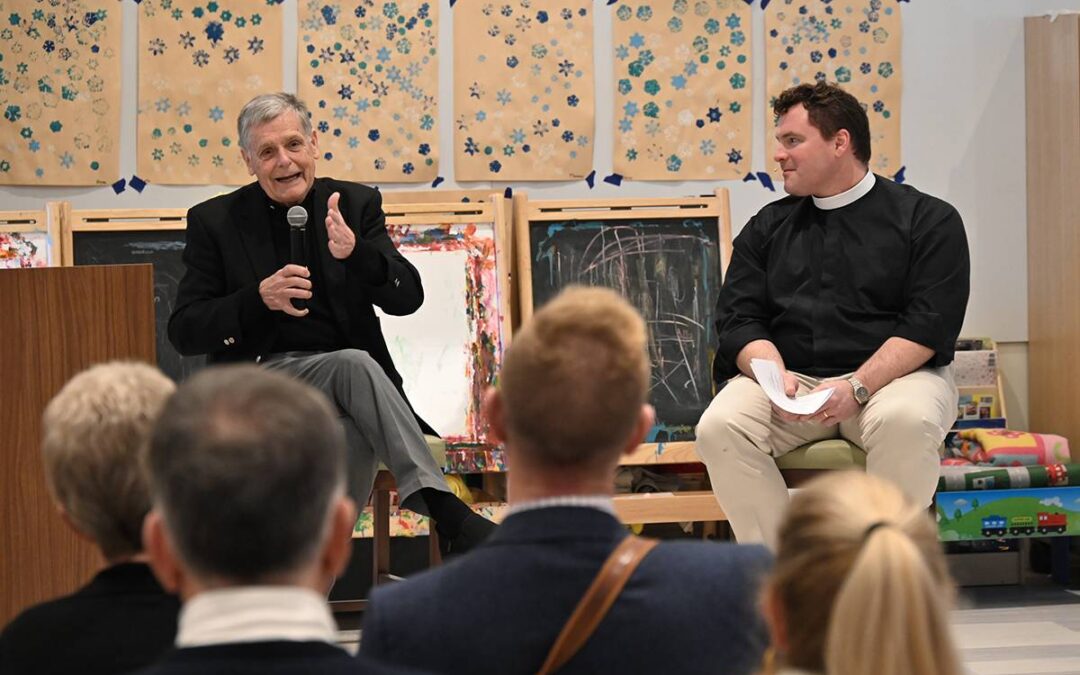

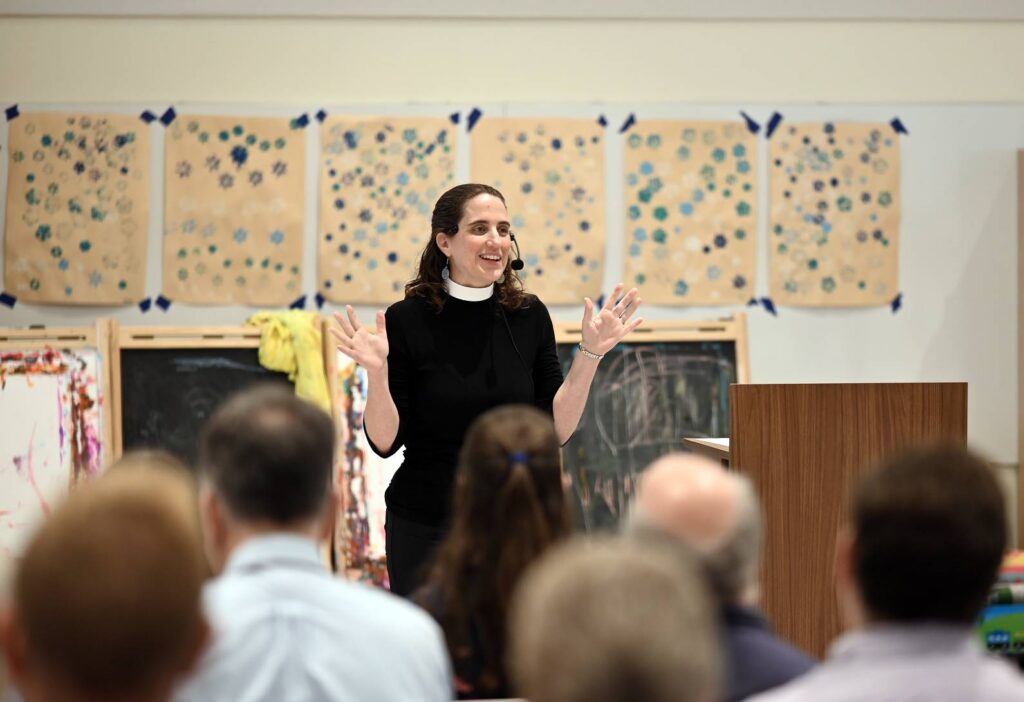
As our Lenten Adult Formation series, “Make No Peace with Oppression,” continues to unfold, we have been continually challenged to view our faith through the eyes of the marginalized. We have explored the biblical foundations of a liberative God and discussed how systemic power imbalances deny people access to resources, rights, and opportunities. On Sunday, March 8, we were honored to ground these theological concepts in lived reality by welcoming a special guest: The Rev. Canon Leyla King.
Rev. King, an Episcopal priest who serves as the Canon for Mission in Small Congregations in the Diocese of West Texas, is a Palestinian American. As the daughter of Palestinian immigrants, she joined us to share the history of her ancestors, offering a deeply personal and often challenging perspective on the ongoing crisis in the Holy Land. Through a mix of historical education, family storytelling, and a healthy dose of prophetic challenge, Rev. King invited us to rethink the narratives we so often accept as fact.
“What about the ‘land without people?’ What does that refer to?”
The Rev. Canon Leyla King
A Pop Quiz and a Shared Heritage
Rev. King ran her session not as a lecture, but as a pop quiz to test our assumptions, joking that anyone who scored a 100 would go “straight to heaven.” Her first question tackled the word “Semitic.” While often used exclusively in relation to Jewish people, she clarified that the term refers to a family of languages and the people who speak them, including both Hebrew and Arabic.
“Arabs, Palestinians are a Semitic people,” Rev. King explained. “We are cousins to Jews. We are all of us Semitic”.
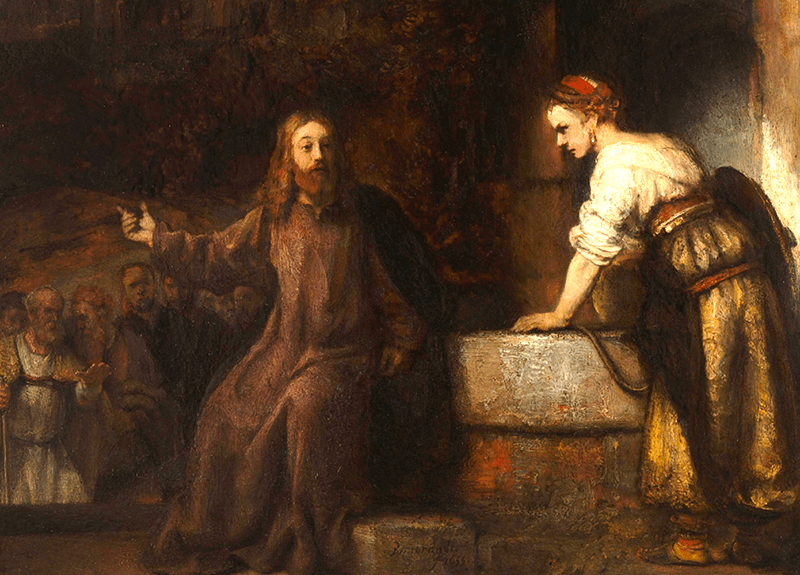
To illustrate how closely knit these identities are, she shared a humorous story about scrolling through Facebook and repeatedly seeing a picture she thought was her cousin Joe, who had seemingly grown a beard and dressed in “funny clothes.” Upon reading the caption, she realized it wasn’t her cousin at all; it was an AI-generated image of what the historical Jesus would have looked like. “I say that because it’s a reminder that Aramaic, Hebrew, and Arabic are all linguistic siblings,” she said. “Like Jesus, like Jews, Arabs, especially Palestinians… We share the language, we share the ancestry, we share culture”.
The Myth of Ancient Religious Conflict
One of the most pervasive and dangerous lies surrounding the modern crisis, Rev. King argued, is the idea that it is an ancient religious war. Looking back to the first half of the 20th century in Palestine, she painted a picture of a society where Arabs practiced Islam, Christianity, and Judaism side by side.
Whether someone was Muslim, Christian, or Jewish, they functioned as one community. “If there was someone in the community who died, everyone in the village went to that funeral… and mourned that death together,” she said. “If there was a wedding everyone goes to that wedding. They would all dance the dabke together”. (The dabke is a traditional folk line dance, translating to “stamping of the feet” in Arabic, it symbolizes comnmnunbity, joy, and particularly for Palestinians, resistance and unity).
The Nakba and the Birth of Faith
To understand the true root of the conflict, Rev. King pointed to the rise of Zionism — a political movement originating in Europe that advocated for a Jewish homeland in Palestine. She highlighted the intense racism embedded in the movement’s famous tagline: “A land without a people for a people without a land.”
“What about the land without people? What does that refer to?” she asked the room. “That refers to Palestine… And do you see the lie? There were very many people on that land. And there still are today. They were my people.”
Rev. King shared the harrowing story of her own grandparents, who were married in Haifa in January 1948. By April of that year, the violence from Zionist militias rolling barrels of explosives into Christian and Muslim neighborhoods became unbearable. Her grandparents fled their home and boarded a ship to Beirut. During the journey, a wooden board collapsed in the ship’s hold, striking her grandfather and knocking him unconscious.
Her grandmother, four months pregnant, seasick, and terrified that her husband was dead, prayed desperately to God. “She always felt like her prayer in that desperate moment was heard,” Rev. King said.
For years, her grandmother believed they had randomly chosen to flee on that specific day. It was only recently that Rev. King learned they had been swept up in a strategic military campaign known as “Operation Passover Cleansing,” designed to ethnically cleanse native Palestinians from the area.
Confronting Christian Zionism
As a Palestinian Christian, Rev. King reminded us that her people trace their faith back to the very beginning of Christianity. Quoting the story of Pentecost in the book of Acts, she pointed out that the first people filled with the Holy Spirit were Galileans, Palestinian Jews. “This is why we are called First Christians,” she said.
Yet, today, these First Christians are suffering under what Rev. King described as “Israeli apartheid and oppression.” Rev. King challenged us to examine the pervasive ideology of Christian Zionism, which she defined as “a political movement that uses the Bible to justify and legitimize Israel’s position of power at the expense of Palestinians.”
On the Episcopal Church’s official response to the ongoing atrocities in Palestine, she did not mince words: “The Episcopal Church sucks on this topic. I’m just going to say it. We are far behind our other progressive, mainline denominations,” she said.
Rev. King’s ultimate desire is simple: “I want the ability to tell my story, my ancestors’ story, my grandparents’ story, my mother’s story without being labeled anti-Semitic,” she said. “I want a global political recognition of the real underlying issues of the conflict in the Holy Land being located in British imperialism and violent Zionism… so that we can find a political solution to the crisis that gives Palestinians voice, dignity, and equality.”
If you’re curious to learn more about Palestinian Christians, a good place to start is by reading the Kairos Palestine document, written by Palestinian Christian theologians, and by reading Rev. King’s own memoir, Daughters of Palestine. Our Rector’s Book Club will be discussing the book on April 24 from 4 p.m. in the Gold Room at Christ & St. Luke’s, and we invite you to join us.
Adult Formation: Make No Peace with Oppression — On the remaining Sundays of Lent (March 15, March 22 from 9:15 a.m. — 10:00 a.m.)
Find out more about our upcoming formation and book club events in our Lent, Easter and Pentecost ministry brochure.