
This Lent, our Adult Formation series at Christ & St. Luke’s tackles a challenging and profoundly biblical theme: Oppression.
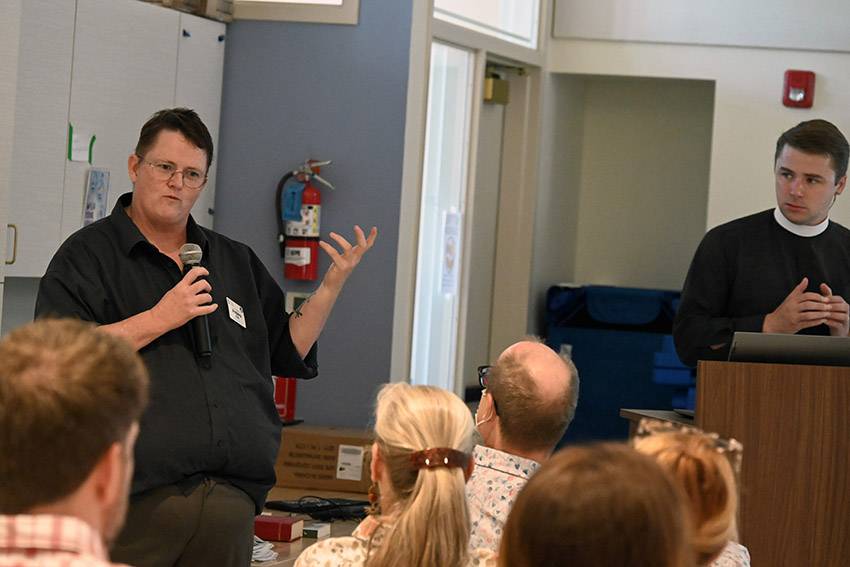
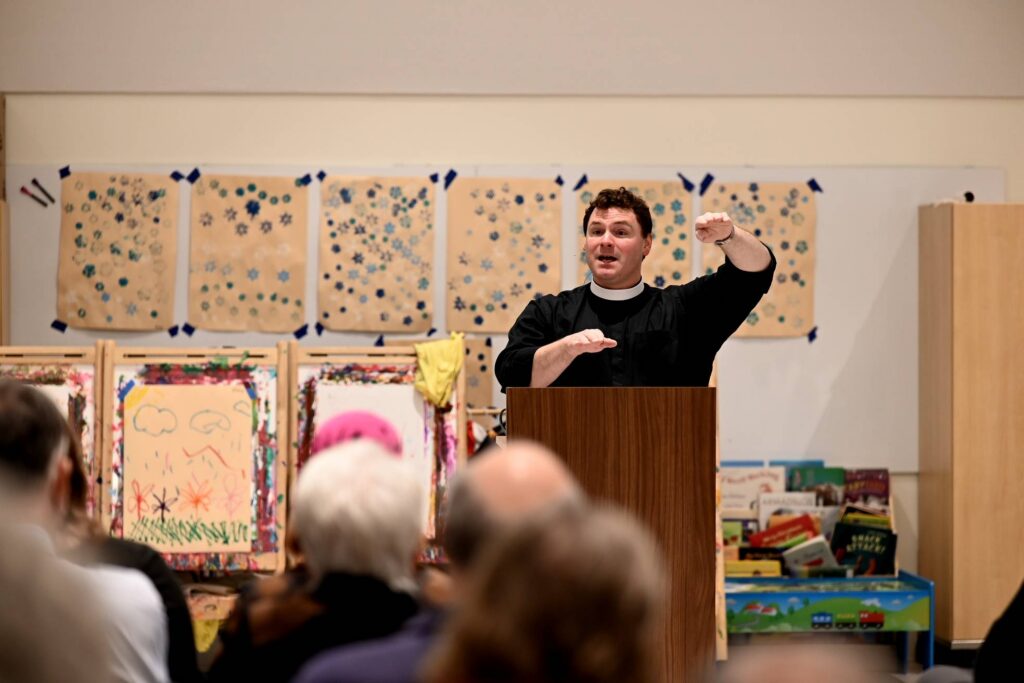
In our opening session, Fr. Noah Van Niel guided a packed room through some of the theological, historical, and ecclesiastical realities of oppression. The goal was not simply an academic exercise, but an exploration of how our faith demands we engage with the world today. From the stories of Exodus to the modern public square, we serve a God of liberation and are called to connect faith with action.
“Oppression is systemic power imbalances where one dominant group uses prejudice and institutional power to unjustly disadvantage and marginalize other social groups.”
Defining Oppression in a Polarized World
The word “oppression” is frequently used in our modern discourse, sometimes so loosely that it loses its meaning. Fr. Noah began by grounding the room in a clear, working definition: “Oppression is systemic power imbalances where one dominant group uses prejudice and institutional power to unjustly disadvantage and marginalize other social groups,” he said.
He stressed that this imbalance denies people “access to resources, rights, and opportunities, creating a system that benefits the dominant group and restricts the potential of the oppressed through social norms, biases, and laws.”
Crucially, Fr. Noah also clarified what oppression is not. “Oppression is not a feeling,” he explained. While it certainly feels terrible to be oppressed, true oppression is rooted in institutional and systemic power, not just individual hurt. Furthermore, setting limits or rules is not oppression. Fr. Noah noted that being told you cannot use hurtful or hateful speech is not oppression, because it does not restrict your fundamental rights, resources, or opportunities. Oppression fundamentally deals with “issues of agency, authority, and power, and then freedom and opportunity,” Fr. Noah said.
A Liberative God: The Old Testament Foundation
To understand why the Church must confront oppression, Fr. Noah reminded us that “the idea of oppression is a through-line in the Bible.”
For the Old Testament Israelites, the defining narrative of their faith was God’s intervention to free them from slavery in Egypt. “It is God’s formational act on behalf of the Israelites to liberate them from oppression,” Fr. Noah said. “From basically the beginning of the understanding of this faith… it is a liberative God.”
Because the Israelites knew the pain of being marginalized, God gave them specific laws to ensure they did not become oppressors themselves. They were commanded to free slaves, protect widows and orphans, care for the resident alien, and avoid charging interest to the poor. Perhaps most radically, God established the Jubilee year. Every fifty years, debts were to be forgiven, Hebrew slaves freed, and property ownership reset. Fr. Noah explained that this protected against the long-term effects of systemic power imbalances, preventing the board from continually being set to favor the wealthy and powerful.
The prophets continually echoed this demand for justice. Fr. Noah read from Isaiah 58, where God rejects performative worship in favor of actual justice: “Is not this the fast that I choose? To loose the bonds of injustice… to let the oppressed go free and to break every yoke?”
God makes it clear that true faith must include the liberation of the vulnerable.
“He has anointed me to bring good news to the poor. He has sent me to proclaim release to the captives… and to let the oppressed go free.”
Luke 4
Jesus and the Fullness of Life
This liberative thread continues directly into the New Testament, which takes place entirely under the oppressive context of the Roman Empire. Before Jesus is even born, Mary sings the Magnificat — what Fr. Noah called her “revolution song” — praising a God who “has cast down the mighty from their thrones” and “lifted up the lowly.”
When Jesus begins his public ministry in Luke 4, he reads from the scroll of Isaiah to announce his mission statement: “He has anointed me to bring good news to the poor. He has sent me to proclaim release to the captives… and to let the oppressed go free.”
Jesus embodied this by spending his time with the marginalized, the sick, the outcast, and the poor, those at the very bottom of society’s power structure. “Oppression inhibits fullness of life,” Fr. Noah noted. “Anything which inhibits one of living a full and free life, Jesus is seeking to undo.”
The Danger of “Spiritualizing” Oppression
If Jesus’ message of liberation is so clear, how has the Church historically gotten it so wrong? Fr. Noah tackled this head-on, noting that because Jesus did not bring about a military or political overthrow of Rome, some early followers began “spiritualizing” oppression. They argued that Jesus only came to free us from the spiritual oppression of sin, while ignoring the real-world, systemic oppression happening around them.
When Christianity became the religion of the Roman Empire in the 4th century, the Church went from being the underdog to wielding massive institutional power. Tragically, the Church then “turned Christianity into a tool of oppression… under the guise of saving, of liberating people,” Fr. Noah said. By spiritualizing oppression, the Church justified horrors like colonialism, unfettered capitalism, and slavery by claiming it was doing the oppressed a favor by introducing them to Jesus.
“I cannot believe that, from looking at and listening to Jesus, that what he meant was for his work to only be understood as internal work, while leaving in place the oppressive systems and power structures which rule the day,” Fr. Noah challenged the room.
Fr. Noah also warned against a modern variation of this issue: Those with societal power claiming to be oppressed. He pointed to Christian nationalism and the manufactured “war on Christmas” as examples where a dominant group claims victimhood simply because a pluralistic society asks them not to privilege their faith over others.
Our Call: Bringing Power to the Margins
As Episcopalians at Christ & St. Luke’s, we are proudly anchored in a tradition of unconditional love. But that love must compel us to action.
Fr. Noah left us with a profound question regarding the Kingdom of God: “Does the kingdom of God mean that everyone is Christian? Or does it mean that everyone is free to love and live and serve… that fullness of life?”. If our goal is the latter, we must look at how we utilize our own resources and privileges.
“Jesus ostensibly was the possessor of all the power,” Fr. Noah reminded us. “So, the example of what to do when you have all the power possible is to bring it to the least desirables, to enter at the lowest point and let it permeate there through those people in that place and empower them to a fuller life.”
This requires us to actively listen to the voices of the marginalized. That is why we are so excited to continue this conversation by stepping outside our own walls. In the coming weeks, we will welcome special guests to discuss Liberation Theology, and we will join with the congregation at Second Calvary Baptist Church to study Howard Thurman’s foundational civil rights text, Jesus and the Disinherited. Thurman’s work highlights how the marginalized, even while enslaved, found the true “seeds of liberation” in the Gospel story.
We invite you to join us for the rest of this vital Lenten series. The journey of faith is not meant to be comfortable; it is meant to be transformative. Come, listen, and learn what it means to truly make no peace with oppression.
Adult Formation: Make No Peace with Oppression On the four remaining Sundays of Lent (March 1, March 8, March 15, March 22 from 9:15 a.m. — 10:00 a.m.)
Find out more about our upcoming formation and book club events in our Lent, Easter and Pentecost ministry brochure.